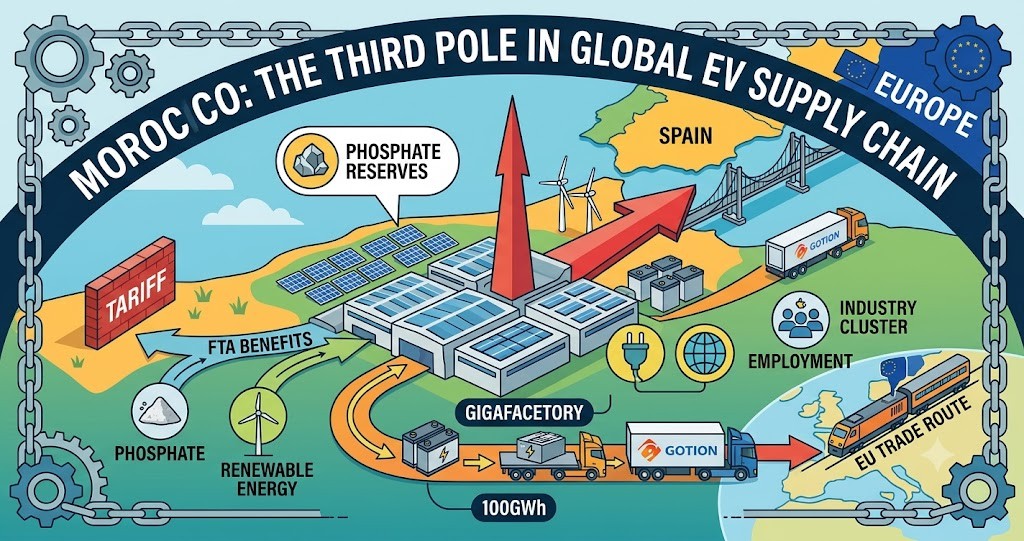
世界の電気自動車(EV)産業において、サプライチェーンの再編が急速に進んでいます。その象徴的な動きが、中国の車載電池大手・国軒高科(Gotion High-Tech)によるモロッコへの56億ドル(約8979億円)にのぼる巨額投資です。
欧州市場に隣接する北アフリカの地で、アフリカ初となる大規模なバッテリー工場(ギガファクトリー)の建設が始まっています。本記事では、提供された情報にマクロ経済や資源の観点からの関連情報を補足し、なぜ今モロッコが世界のEV供給網の「第3極」として台頭しているのかをまとめます。
- 1. モロッコが選ばれる理由:地理的優位性と「リン鉱石」の存在
- 2. 56億ドル投資の全貌:部材から完成品への垂直統合
- 3. 地政学的リスクの回避:EUの対中関税と欧米規制への対策
- 4. 製造と物流のシームレスな統合
- まとめ:従来の「資源供給地」からの脱却
- Why is a Chinese Battery Giant Investing 5.6 Billion Dollars in Morocco? The Geopolitical Shift in the European EV Supply Chain
- 1. Reasons for Choosing Morocco: Geographical Advantages and the Presence of Phosphate Rock
- 2. The Full Scope of the 5.6 Billion Dollar Investment: Vertical Integration from Components to Finished Products
- 3. Evading Geopolitical Risks: Countermeasures Against EU Tariffs on China and Western Regulations
- 4. Seamless Integration of Manufacturing and Logistics
- Conclusion: Moving Away from Traditional “Resource Suppliers”
1. モロッコが選ばれる理由:地理的優位性と「リン鉱石」の存在
モロッコがEV産業の拠点として注目される背景には、地理的・制度的な強みに加え、バッテリー製造に不可欠な「資源」の存在があります。
- 欧州への圧倒的な近さと無関税措置: 海路でスペインまで1時間あまりという近さにあり、EU(欧州連合)との自由貿易協定(FTA)によって無関税での輸出が可能です。これにより、輸送費と二酸化炭素(CO2)排出量を劇的に削減できます。
- 確立された自動車産業の基盤: すでに仏ルノーやステランティスが進出しており、年間70万台の生産能力を持つ自動車産業の土台があります。2023年の自動車輸出額は140億ドルに達しています。
- 豊富な再生可能エネルギー: 太陽光や風力発電が盛んであり、EUの厳しい「炭素国境調整措置(CBAM)」やライフサイクルアセスメント(LCA)規制をクリアするために必要な「グリーン電力」を確保しやすい環境です。
- 【関連情報】世界最大のリン鉱石埋蔵量: モロッコは世界最大のリン鉱石の埋蔵量を誇ります。Gotionをはじめとする中国企業が得意とする「リン酸鉄リチウム(LFP)バッテリー」は、安価で安全性が高いことから現在のEV市場の主流になりつつあり、その主原料であるリンを現地調達できることは極めて大きなアドバンテージです。
2. 56億ドル投資の全貌:部材から完成品への垂直統合
Gotionのプロジェクトは、単にバッテリーを組み立てるだけでなく、材料からの一貫生産(垂直統合)を目指している点が特徴です。
- 巨大ギガファクトリーの建設: ケニトラ地区などで建設が進んでおり、2026年第3四半期に稼働予定です。初期の生産能力は年間20GWh(数十万台のEV分)で、将来的に100GWhまで拡大する構想です。
- 中国系サプライヤーの集積: Gotionの進出に合わせ、BTR New Material GroupやCNGR Advanced Materialといった中国の有力部材メーカーもモロッコ国内に正極材工場などの建設を進めています。
- 雇用の創出: 第一フェーズだけで1万7000人、計画全体(全5フェーズ)では最大3万人の雇用が生み出される見込みであり、一大産業クラスターが形成されつつあります。
3. 地政学的リスクの回避:EUの対中関税と欧米規制への対策
中国の電池メーカーがモロッコへの進出を急ぐ最大の動機は、欧米による「中国排除」の動きを回避することにあります。
- 【関連情報】EUによる中国製EVへの追加関税: 近年、EUや米国は中国製のEVやバッテリーに対して高い相殺関税を課すなど、警戒を強めています。中国本土から欧州へ直接輸出するリスクが高まるなか、欧米とFTAを締結しているモロッコを経由することで、これらの通商摩擦(関税リスク)を合法的に回避する「迂回生産拠点」としての役割を果たしています。
- 法規制への適応: 欧州ではサプライチェーンの透明性や監査義務が強化されています。部材の調達から製造までを欧州近隣のモロッコで完結させることで、自動車メーカー側のコンプライアンス(法令順守)の負担を軽減できます。
4. 製造と物流のシームレスな統合
Gotionは、バッテリーの製造だけでなく、それを運ぶ「物流」の脱炭素化にも着手しています。
- 電気物流回廊の整備: 2026年4月、モロッコ企業や中国のChery Heavy Trucksと提携し、モロッコ南部のアガディールからフランスのペルピニャンまでを結ぶ全長2000kmの「貨物EV向け物流網」の開発に合意しました。
- エネルギー貯蔵システム(ESS)への展開: この拠点で作られるバッテリーはEV用だけでなく、モロッコ国内やアフリカ・中東地域向けの再エネ用蓄電池(ESS)市場もターゲットにしています。EVトラック自体を移動式の蓄電池として活用する、新しいエネルギー基盤の構築も視野に入れています。
まとめ:従来の「資源供給地」からの脱却
モロッコにおけるGotionの投資は、単なる一企業の工場建設にとどまりません。これまでアフリカはコバルトやリチウムといった「原材料の供給地」として扱われることが大半でしたが、今回の動きは、自国のクリーンエネルギーを活用して高付加価値な製品を製造する「先端産業の拠点」へと変貌しつつあることを示しています。
欧米の厳格な規制や関税リスク、そして脱炭素への要請が、世界のEVサプライチェーンの地図を塗り替え、モロッコをその中心地へと押し上げています。
出典:https://topics.smt.docomo.ne.jp/article/merkmalbiz/business/merkmalbiz-116787
Why is a Chinese Battery Giant Investing 5.6 Billion Dollars in Morocco? The Geopolitical Shift in the European EV Supply Chain
The restructuring of supply chains is progressing rapidly in the global electric vehicle (EV) industry. A symbolic move of this trend is the massive investment of 5.6 billion dollars (approximately 897.9 billion yen) in Morocco by Gotion High-Tech, a leading Chinese EV battery manufacturer.
In North Africa, adjacent to the European market, construction has begun on Africa’s first large-scale battery factory (gigafactory). This article supplements the provided information with relevant macroeconomic and resource perspectives to summarize why Morocco is now emerging as the “third pole” of the global EV supply chain.
1. Reasons for Choosing Morocco: Geographical Advantages and the Presence of Phosphate Rock
The background of Morocco drawing attention as a hub for the EV industry lies not only in its geographical and institutional strengths but also in the presence of resources essential for battery manufacturing.
- Overwhelming Proximity to Europe and Duty-Free Measures: Located just over an hour by sea from Spain, Morocco can export duty-free thanks to its Free Trade Agreement (FTA) with the European Union (EU). This drastically reduces transportation costs and carbon dioxide (CO2) emissions.
- Established Automotive Industry Base: Major companies like French automaker Renault and Stellantis have already entered the market, providing an industrial foundation with a production capacity of 700,000 vehicles per year. In 2023, the country’s automotive exports reached 14 billion dollars.
- Abundant Renewable Energy: With thriving solar and wind power generation, Morocco offers an environment where it is easy to secure the “green power” necessary to clear the EU’s strict Carbon Border Adjustment Mechanism (CBAM) and Life Cycle Assessment (LCA) regulations.
- [Related Information] World’s Largest Phosphate Rock Reserves: Morocco boasts the world’s largest reserves of phosphate rock. Lithium Iron Phosphate (LFP) batteries, which Chinese companies like Gotion excel at producing, are becoming the mainstream in the current EV market due to their low cost and high safety. Being able to locally source phosphate, the main raw material, is an extremely significant advantage.
2. The Full Scope of the 5.6 Billion Dollar Investment: Vertical Integration from Components to Finished Products
Gotion’s project is characterized by its aim for integrated production (vertical integration) from raw materials to finished goods, rather than just assembling batteries.
- Construction of a Massive Gigafactory: Construction is underway in areas such as the Kenitra region, with operations scheduled to begin in the third quarter of 2026. The initial production capacity will be 20 GWh per year (equivalent to hundreds of thousands of EVs), with plans to expand to 100 GWh in the future.
- Concentration of Chinese Suppliers: In line with Gotion’s entry, prominent Chinese component manufacturers such as BTR New Material Group and CNGR Advanced Material are also moving forward with the construction of cathode material factories and other facilities within Morocco.
- Job Creation: The project is expected to create 17,000 jobs in the first phase alone, and up to 30,000 jobs across the entire 5-phase plan, forming a major industrial cluster.
3. Evading Geopolitical Risks: Countermeasures Against EU Tariffs on China and Western Regulations
The biggest motivation for Chinese battery manufacturers to rush into Morocco is to circumvent the moves by Western nations to exclude China.
- [Related Information] Additional EU Tariffs on Chinese EVs: In recent years, the EU and the US have heightened their vigilance, imposing high countervailing duties on Chinese-made EVs and batteries. As the risk of exporting directly from mainland China to Europe rises, routing through Morocco—which has an FTA with Western countries—allows companies to act as a “detour production base” to legally avoid these trade frictions (tariff risks).
- Adaptation to Legal Regulations: Supply chain transparency and audit obligations are being tightened in Europe. By completing everything from component procurement to manufacturing in Morocco, which is close to Europe, the burden of compliance for automakers can be reduced.
4. Seamless Integration of Manufacturing and Logistics
Gotion is working to decarbonize not only battery manufacturing but also the logistics used to transport them.
- Development of an Electric Logistics Corridor: In April 2026, Gotion partnered with a Moroccan company and China’s Chery Heavy Trucks to develop a 2000 km “logistics network for freight EVs” connecting Agadir in southern Morocco to Perpignan in southern France via the port of Tangier.
- Expansion into Energy Storage Systems (ESS): The batteries produced at this base are targeted not only for EVs but also for the renewable energy storage system (ESS) market in Morocco, Africa, and the Middle East. Gotion also envisions a new energy infrastructure where EV trucks themselves are utilized as mobile storage batteries.
Conclusion: Moving Away from Traditional “Resource Suppliers”
Gotion’s investment in Morocco represents more than just a single company building a factory. In the past, Africa was mostly treated as a supplier of raw materials such as cobalt and lithium. However, this movement demonstrates that the region is transforming into an “advanced manufacturing hub” that utilizes its own clean energy to produce high-value-added products. Strict Western regulations, tariff risks, and the demand for decarbonization are reshaping the global EV supply chain map, pushing Morocco into the center of it.
コメント