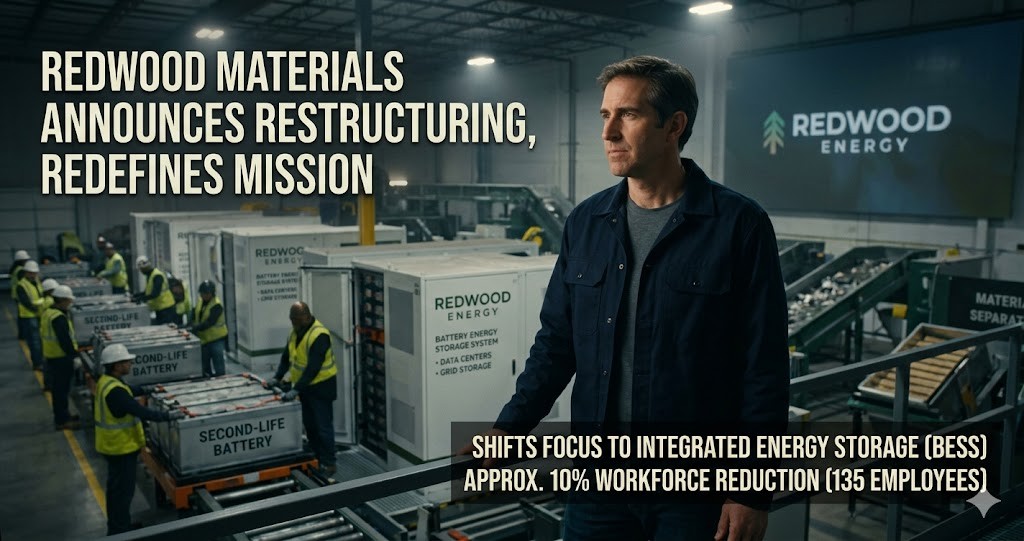
北米のバッテリーリサイクル市場で圧倒的なシェアを誇るRedwood Materialsは、全従業員の約10パーセントにあたる約135名の解雇を発表しました。今回の決定は、急激な組織拡大を見直すと同時に、新設部門「Redwood Energy(レッドウッド・エナジー)」が担うエネルギー貯蔵事業へのリソース集中を目的としています。
1. 人員削減の背景と経営状況
創業者のJB・ストラウベルCEOは、今回の削減を「市場変化への適応」と位置づけています。
- 組織の適正化: 一部の部門が将来の方向性に対して過剰なペースで拡大していたことを認め、エンジニアリングやオペレーション部門を含む複数のセクションで人員を削減しました。
- 強固な財務基盤: 直近ではGoogleやNvidiaの子会社等から4億2500万ドルの資金を調達しており、リサイクル事業自体も年間20GWh(電気自動車約25万台分)以上の処理能力を持つなど、事業基盤は依然として強固です。
2. 「リサイクル」から「エネルギー貯蔵(BESS)」へのシフト
同社は、これまでの「電池材料の回収(リサイクル)」に加え、使用済みEVバッテリーを再利用した「定置型蓄電池システム(BESS)」に勝機を見出しています。
- Redwood Energyの設立: 2025年夏に設立されたこの子会社は、リサイクルに回すにはまだ性能が高い「セカンドライフ・バッテリー」を活用したシステムを開発しています。
- ターゲット市場: AIの爆発的普及に伴い電力需要が急増しているデータセンター、および不安定な再生可能エネルギーを補完する国家送電網への供給を狙います。
- リビアンとの提携: 最近、米EVメーカーのリビアンから工場向けの蓄電システムを受注するなど、具体的な成果も出始めています。
3. ロードマップと今後の展望
ストラウベル氏は、今後の道筋を「世界で最も統合された重要材料およびエネルギー貯蔵事業」と定義しています。
- ホームページの刷新: 会社紹介の優先順位を「エネルギー貯蔵システムの提供」を筆頭に掲げるなど、企業のアイデンティティを再定義しています。
- 効率化による競争力向上: 少人数の精鋭チーム体制へ移行することで、コスト競争力を高め、競合他社が苦戦する市場環境を勝ち抜く構えです。
関連情報:バッテリー蓄電(BESS)市場とセカンドライフ利用の背景
今回の戦略変更の背景にある、業界の重要なトピックをまとめました。
バッテリーの「セカンドライフ(二次利用)」の価値
EV用バッテリーは、容量が当初の70パーセントから80パーセント程度に低下すると車両用としては寿命とされますが、充放電の頻度が低い「定置型蓄電」としては十分な性能を持っています。
- コストメリット: 新品のバッテリーを製造するよりも安価にシステムを構築できるため、大規模なデータセンター等のコスト削減に直結します。
- サステナビリティ: リサイクル(分解・抽出)の前に「再利用(再製品化)」の工程を挟むことで、バッテリーのライフサイクル全体の環境負荷を最小化できます。
データセンターと電力需要の急増
AI(人工知能)の進化により、電力網への負荷は世界的な課題となっています。
- 24時間365日の安定供給: AIの演算処理には膨大な電力が必要であり、太陽光や風力などの変動電源を安定させるための「巨大なバッファ(蓄電池)」が不可欠となっています。
- Nvidiaなどの関与: Redwoodへの投資家にAIチップ大手のNvidia子会社が含まれている点は、エネルギー供給と計算資源の密接な関係を象徴しています。
まとめ
Redwood Materialsの動向は、単なるスタートアップのリストラではなく、EV普及の次のフェーズである「バッテリー資源の循環とエネルギーインフラの統合」を先取りした動きと言えます。リサイクルで培った材料確保の能力と、蓄電システムによるエネルギー供給を組み合わせることで、同社は次世代のアメリカのエネルギー基盤を支える存在を目指しています。
Redwood Materials Cuts 135 Jobs While Pivoting Full Speed Toward Energy Storage
Redwood Materials, which holds a dominant share of the North American battery recycling market, has announced the layoff of approximately 135 employees, or about 10 percent of its workforce. This decision aims to recalibrate after rapid organizational expansion while shifting resources toward its energy storage business, managed by the newly established division, Redwood Energy.
1. Background of Layoffs and Financial Health
Founder and CEO JB Straubel characterized these cuts as an “adaptation to market changes.”
- Organizational Right-sizing: Acknowledging that certain departments expanded at a pace exceeding the company’s strategic needs, layoffs were implemented across several sections, including engineering and operations.
- Solid Financial Foundation: Despite the workforce reduction, the business remains robust. The company recently secured 425 million dollars in funding from investors including subsidiaries of Google and Nvidia. Its recycling operations maintain a massive processing capacity of over 20 GWh per year, equivalent to approximately 250,000 electric vehicles.
2. Shifting from “Recycling” to “Energy Storage (BESS)”
In addition to its traditional “battery material recovery (recycling)” business, the company sees a major opportunity in Battery Energy Storage Systems (BESS) that repurpose used EV batteries.
- Establishment of Redwood Energy: Founded in the summer of 2025, this subsidiary develops systems utilizing “second-life batteries”—units that are no longer suitable for EVs but still perform well enough to avoid immediate recycling.
- Target Markets: The company is targeting data centers, where power demand is skyrocketing due to the AI explosion, and national power grids that require stabilization for intermittent renewable energy.
- Partnership with Rivian: Concrete results are already emerging, such as a recent contract to provide a second-life battery storage system for Rivian’s factory in Normal, Illinois.
3. Roadmap and Future Outlook
Straubel defines the company’s future path as building the “world’s most integrated critical materials and energy storage business.”
- Website Refresh: The company has redefined its identity by placing “Providing domestic-scale energy storage systems” at the top of its mission statement.
- Competitiveness through Efficiency: By moving to a leaner, more focused team structure, the company aims to improve cost competitiveness and succeed in a market environment where many competitors are struggling.
Related Context: The BESS Market and Second-Life Utilization
Key industry trends providing the backdrop for this strategic pivot:
The Value of “Second-Life” Battery Utilization
EV batteries are often considered at the end of their automotive life when capacity drops to 70 to 80 percent. However, they retain sufficient performance for stationary storage, where charge/discharge cycles are less demanding.
- Cost Advantages: Building systems with repurposed batteries is significantly cheaper than using new ones, directly benefiting large-scale facilities like data centers.
- Sustainability: By inserting a “reuse” phase before final recycling (disassembly and extraction), the environmental footprint of the battery’s entire life cycle is minimized.
Data Centers and Rising Power Demand
The evolution of AI has made power grid strain a global challenge.
- 24/7 Stable Supply: AI processing requires immense amounts of electricity. Large-scale “buffers” (storage batteries) are essential to stabilize grids relying on solar or wind power.
- Nvidia’s Involvement: The fact that an Nvidia subsidiary is among Redwood’s investors underscores the intimate link between energy supply and computing resources.
Conclusion
The shift at Redwood Materials is not merely a startup restructuring; it is a move to lead the next phase of the EV era—the integration of battery resource circulation and energy infrastructure. By combining its material sourcing capabilities with energy storage systems, the company aims to become a cornerstone of America’s next-generation energy foundation.
コメント