電気自動車(EV)普及の最大の壁といわれてきた「バッテリーの寿命」と「充電時間」。世界最大手のバッテリーメーカーである中国のCATL(寧徳時代)が、これらの課題を過去のものにする画期的な新技術を発表しました。
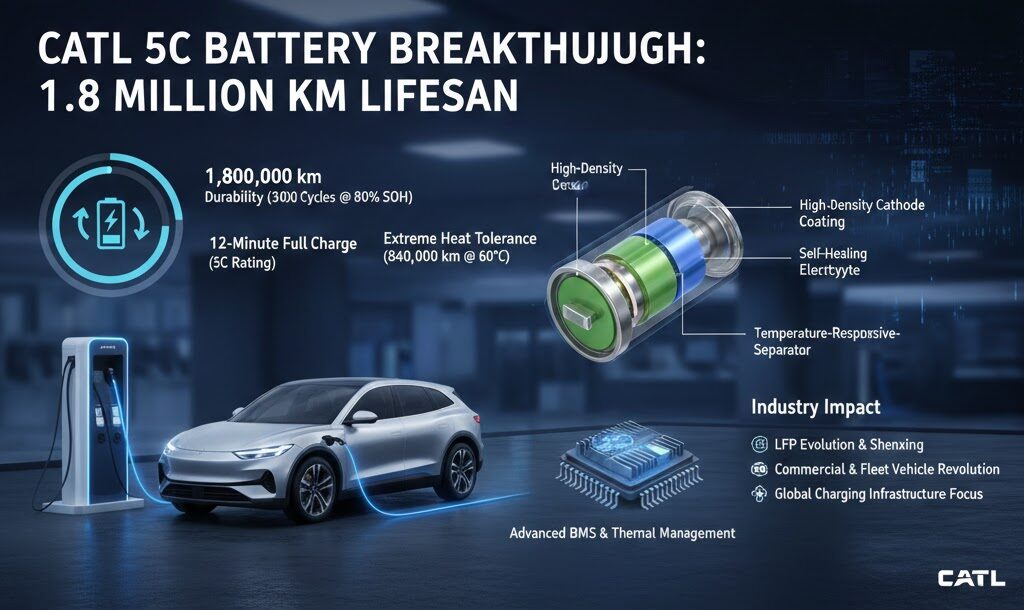
2026年1月29日に公開された最新情報によると、新型「5C」バッテリーは、超急速充電を繰り返しても180万km走行(地球約45周分)に相当する耐久性を備えているといいます。これは、一般的な車両そのものの耐用年数を大幅に上回る驚異的な数字です。
1. 驚異のサイクル寿命と耐熱性能
CATLが公開したデータによると、新型5Cバッテリーは以下の過酷な条件下でも高いパフォーマンスを維持します。
- 標準環境(20℃): 3,000サイクルの充放電を繰り返しても、初期容量の80%を維持。走行距離に換算すると約180万kmに達します。これは現在の業界平均の約6倍の寿命です。
- 酷暑環境(60℃): ドバイの夏に匹敵する高温下でも、1,400サイクル(約84万km走行)後も80%の容量を維持します。
2. 「5C」が意味する超急速充電
「C」定格とは、バッテリーの充放電速度を示す単位です。
- 5Cバッテリー: 理論上、わずか12分でフル充電が可能です。
- 実用性: これにより、ガソリン車に近い感覚でエネルギーを補給できるようになり、長距離走行や商用利用での利便性が劇的に向上します。
3. 長寿命と安全性を支える3つの技術革新
超急速充電は通常、バッテリーに大きな負荷をかけ劣化を早めますが、CATLは以下の技術でこれを解決しました。
- 高密度・均一正極コーティング: 金属イオンの損失を抑え、構造的な劣化を防ぎます。
- 自己修復型電解液: 独自の添加剤が内部の微小な亀裂を自動で封鎖し、リチウムの減少を抑制します。
- 温度応答性セパレーター: 局所的な温度上昇を検知するとイオンの動きを自動で制御し、火災の原因となる熱暴走を防ぎます。
また、最新のバッテリー管理システム(BMS)が、パック内の熱を均一に保つために冷却剤の流量をリアルタイムで最適化しています。
【関連情報】2026年のEVバッテリー市場動向
今回のCATLの発表を補足する、現在の業界の重要な動きは以下の通りです。
- LFP(リン酸鉄リチウム)の進化: CATLはLFPベースの急速充電バッテリー「神行(Shenxing)」も展開しており、安価で安全なバッテリーの急速充電化が加速しています。今回の5C技術も、こうした低コスト・高耐久路線の延長線上にあります。
- 商用車・フリート車両への波及: 180万kmという超長寿命は、1日の走行距離が長いタクシー、配送車、大型トラックにおいて劇的なコスト削減(LCOS:ライフサイクルコストの低減)をもたらします。
- 充電インフラの課題: 5C充電をフルに活用するには、400kWを超える超高出力な充電ステーションの整備が不可欠です。車両側の技術進化に合わせ、インフラ整備が世界的な焦点となっています。
CATL Announces New 5C Battery Capable of 1.8 Million KM, Boasting 6x the Industry Average Lifespan
The primary obstacles to electric vehicle (EV) adoption have long been “battery lifespan” and “charging time.” CATL, the world’s largest battery manufacturer, has unveiled a groundbreaking technology that aims to make these concerns a thing of the past.
According to the latest information released on January 29, 2026, the new “5C” battery possesses the durability to last for 1.8 million kilometers (equivalent to roughly 45 trips around the Earth), even with repeated ultra-fast charging. This staggering figure significantly exceeds the typical lifespan of the vehicles themselves.
1. Incredible Cycle Life and Heat Resistance
Data released by CATL shows that the new 5C battery maintains high performance even under the following extreme conditions:
- Standard Environment (20 C): The battery retains 80% of its initial capacity after 3,000 charge-discharge cycles. This translates to approximately 1.8 million kilometers of travel—about six times the current industry average.
- Extreme Heat (60 C): Even in high temperatures comparable to a summer in Dubai, it maintains 80% capacity after 1,400 cycles (approximately 840,000 kilometers).
2. What “5C” Means for Ultra-Fast Charging
The “C” rating is a unit that represents the speed at which a battery charges or discharges.
- 5C Battery: Theoretically, a full charge can be achieved in just 12 minutes.
- Practicality: This allows for energy replenishment similar to refueling a gasoline car, drastically improving convenience for long-distance travel and commercial use.
3. Three Technological Innovations Supporting Longevity and Safety
While ultra-fast charging typically puts heavy stress on a battery and accelerates degradation, CATL has overcome this with the following innovations:
- High-Density, Uniform Cathode Coating: This reduces structural degradation and suppresses the loss of metal ions.
- Self-Healing Electrolyte: Unique additives automatically identify and seal micro-cracks inside the battery, reducing irreversible lithium loss.
- Temperature-Responsive Separator: When local temperature rises occur, the coating automatically slows ion movement, providing a self-regulating protection feature to reduce the risk of thermal runaway.
Additionally, an upgraded Battery Management System (BMS) optimizes coolant flow in real-time to maintain thermal uniformity across the battery pack.
[Related Information] 2026 EV Battery Market Trends
The following industry movements provide context to CATL’s announcement:
- Evolution of LFP (Lithium Iron Phosphate): CATL continues to promote its LFP-based “Shenxing” fast-charging batteries. The new 5C technology follows this trajectory of providing low-cost, high-durability, and fast-charging solutions.
- Impact on Commercial and Fleet Vehicles: A 1.8-million-km lifespan offers dramatic reductions in the Levelized Cost of Storage (LCOS) for high-mileage vehicles such as taxis, delivery vans, and heavy-duty trucks.
- Charging Infrastructure Challenges: To fully utilize 5C charging, infrastructure capable of delivering over 400kW is essential. Global focus is now shifting toward upgrading charging grids to match these rapid advancements in vehicle technology.


コメント