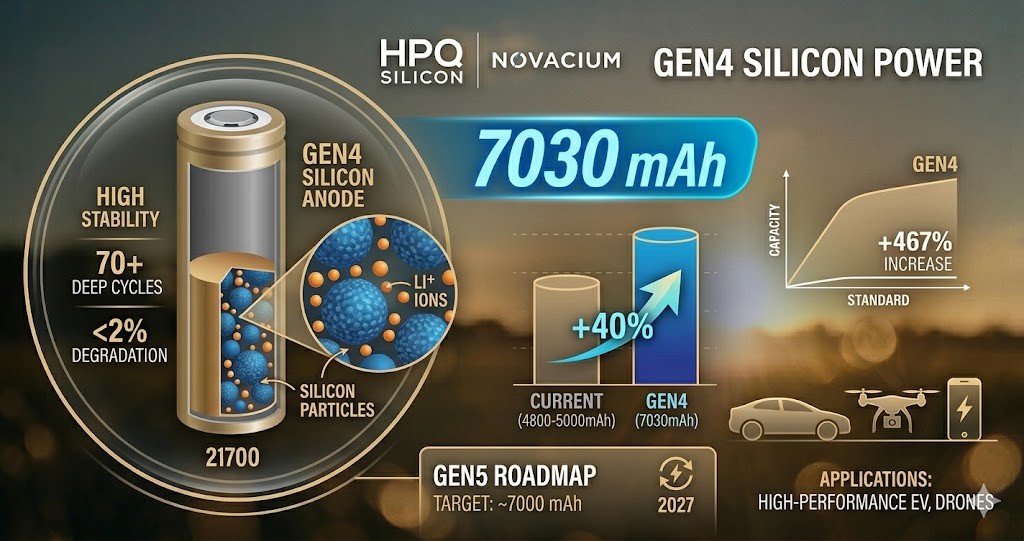
HPQ Silicon社とそのパートナーであるNovacium社は、最新の「GEN4」シリコン系負極材料を用いた21700型円筒形電池において、7030mAhという驚異的な放電容量を記録したと発表しました。これは、現在市場に流通している一般的な21700電池(4800mAhから5000mAh程度)を約40パーセント以上上回る数値です。
1. 驚異的な容量と「深放電」プロトコル
今回の記録は、一般的なカットオフ電圧(放電終止電圧)である2.5Vではなく、0.55Vという極めて低い電圧まで放電させる「深放電プロトコル」を用いて達成されました。
- 達成容量: 7030mAh
- 安定性: この過酷な条件下で70サイクルを完了しても、容量劣化は2パーセント未満に抑制されました。
- 標準条件下の性能: 通常の試験条件下でも、GEN4はすでに6696mAhを記録しており、着実な進化を証明しています。
2. シリコン負極技術のブレイクスルー
シリコンはグラファイト(黒鉛)に比べて約10倍の理論容量を持ちますが、充放電時に体積が激しく膨張・収縮し、材料が崩壊しやすいという大きな課題がありました。
- GEN4の成果: Novacium社の技術は、この膨張問題を克服し、深い放電を繰り返しても構造を維持できる安定性を実現しました。
- CEOのコメント: ベルナール・トゥリヨン氏は、「工業用サイズのセルでこの壁を突破した公表データは他に類を見ない」と、その独自性を強調しています。
3. 次なる目標:GEN5へのロードマップ
HPQ社はすでに次世代の「GEN5」開発を見据えています。
- 目標: 2027年までに、特殊な深放電プロトコルを必要としない「標準的な運用条件」において、約7000mAhの容量を実現することを目指しています。
- 商用化への課題: 商用展開にはさらなる検証とシステムレベルでの最適化が必要であるものの、高エネルギー密度が求められるドローンや高性能EV等への応用が期待されています。
- 関連情報:シリコン負極の市場動向と技術的意義
- まとめ
- Breaking the Limits of Silicon Anodes: HPQ Silicon Records Over 7000 mAh Discharge Capacity in 21700 Cells
関連情報:シリコン負極の市場動向と技術的意義
本ニュースを補足する、バッテリー業界の最新トレンドをまとめました。
シリコン負極(Silicon Anode)の現在地
現在、多くの電池メーカーがグラファイトに数パーセントから十数パーセントのシリコンを混ぜる「シリコン添加」を行っています。
- 完全シリコンへの挑戦: HPQ社のようにシリコン比率を極限まで高める試みは、次世代リチウムイオン電池の本命とされています。
- エネルギー密度の向上: バッテリーの重さを変えずに容量を増やせるため、EVの航続距離延長や、スマートフォンの薄型化に直結します。
21700という「標準規格」の意味
21700型(直径21mm、長さ70mm)は、テスラのModel 3やModel Yに採用されたことで世界標準となったサイズです。
- 互換性のメリット: 既存の製品設計を大きく変えることなく、セルを入れ替えるだけで大幅なアップグレードが可能になるため、このサイズでの容量向上は市場に与えるインパクトが非常に大きいです。
4680セルへの波及
現在、さらに大型の4680セルへの移行も進んでいますが、負極材料そのものの進化(シリコン化)はセルの形状を問わず適用可能です。HPQ社の技術が確立されれば、あらゆる形状の電池に応用されることが予想されます。
まとめ
HPQ Silicon社による7000mAhの突破は、シリコン負極が「研究段階」から「実用可能な工業製品」へと大きな一歩を踏み出したことを示しています。2027年のGEN5登場に向け、バッテリーのエネルギー密度をめぐる開発競争はさらに激化していくでしょう。
出典:https://www.bestmag.co.uk/hpq-silicon-7000-mah-breakthrough/
Breaking the Limits of Silicon Anodes: HPQ Silicon Records Over 7000 mAh Discharge Capacity in 21700 Cells
HPQ Silicon and its partner, Novacium, have announced a staggering discharge capacity of 7030 mAh in a 21700-type cylindrical battery using their latest “GEN4” silicon-based anode material. This figure is more than 40 percent higher than the typical 21700 batteries currently on the market, which generally offer between 4800 mAh and 5000 mAh.
1. Remarkable Capacity and the “Deep Discharge” Protocol
This record was achieved using an enhanced “deep discharge protocol” that discharges the cell down to an extremely low voltage of 0.55V, rather than the industry-standard cutoff voltage of 2.5V.
- Achieved Capacity: 7030 mAh
- Stability: Even after completing 70 cycles under these grueling conditions, capacity degradation remained below 2 percent.
- Standard Condition Performance: Under normal testing conditions, the GEN4 has already recorded 6696 mAh, proving steady and significant progress.
2. Breakthrough in Silicon Anode Technology
While silicon has roughly ten times the theoretical capacity of graphite, it faces a major challenge: it expands and contracts violently during charging and discharging, which typically leads to material structural failure.
- GEN4 Achievement: Novacium’s technology overcomes this expansion issue, achieving structural stability that allows the material to maintain its integrity even through repeated deep discharge cycles.
- CEO Commentary: Bernard Tourillon stated that this breakthrough in an industrial-sized cell is unprecedented in widely published data, highlighting the uniqueness of their achievement.
3. The Next Goal: Roadmap to GEN5
HPQ is already looking ahead to the development of “GEN5.”
- Objective: By 2027, the company aims to achieve a capacity of approximately 7000 mAh under “standard operating conditions” without the need for specialized deep discharge protocols.
- Path to Commercialization: While commercial deployment will require further validation and system-level optimization, applications are highly anticipated in sectors requiring high energy density, such as drones and high-performance EVs.
Related Context: Market Trends and Technical Significance
The following trends provide context for the importance of this development in the battery industry:
The Current State of Silicon Anodes
Currently, many battery manufacturers utilize “silicon additives,” mixing a small percentage of silicon into graphite.
- The Challenge of Pure Silicon: Efforts to maximize the silicon ratio, as HPQ is doing, are considered the “holy grail” for next-generation lithium-ion batteries.
- Increased Energy Density: Increasing capacity without adding weight directly translates to longer ranges for EVs and thinner designs for smartphones.
The Significance of the “21700” Standard
The 21700 format (21 mm diameter, 70 mm length) became a global standard after being adopted for the Tesla Model 3 and Model Y.
- Benefits of Compatibility: Because cells can be swapped to provide a major upgrade without drastically changing existing product designs, a capacity increase in this specific format has a massive market impact.
Implications for 4680 Cells
While the industry is also moving toward the larger 4680 format, the evolution of the anode material itself (siliconization) can be applied regardless of cell shape. Once HPQ’s technology is established, it is expected to be utilized across various battery forms.
Conclusion
The 7000 mAh breakthrough by HPQ Silicon marks a giant leap for silicon anodes, moving them from the “research phase” into the realm of “viable industrial products.” With the anticipated arrival of GEN5 in 2027, the development race for energy density is set to intensify even further.

コメント