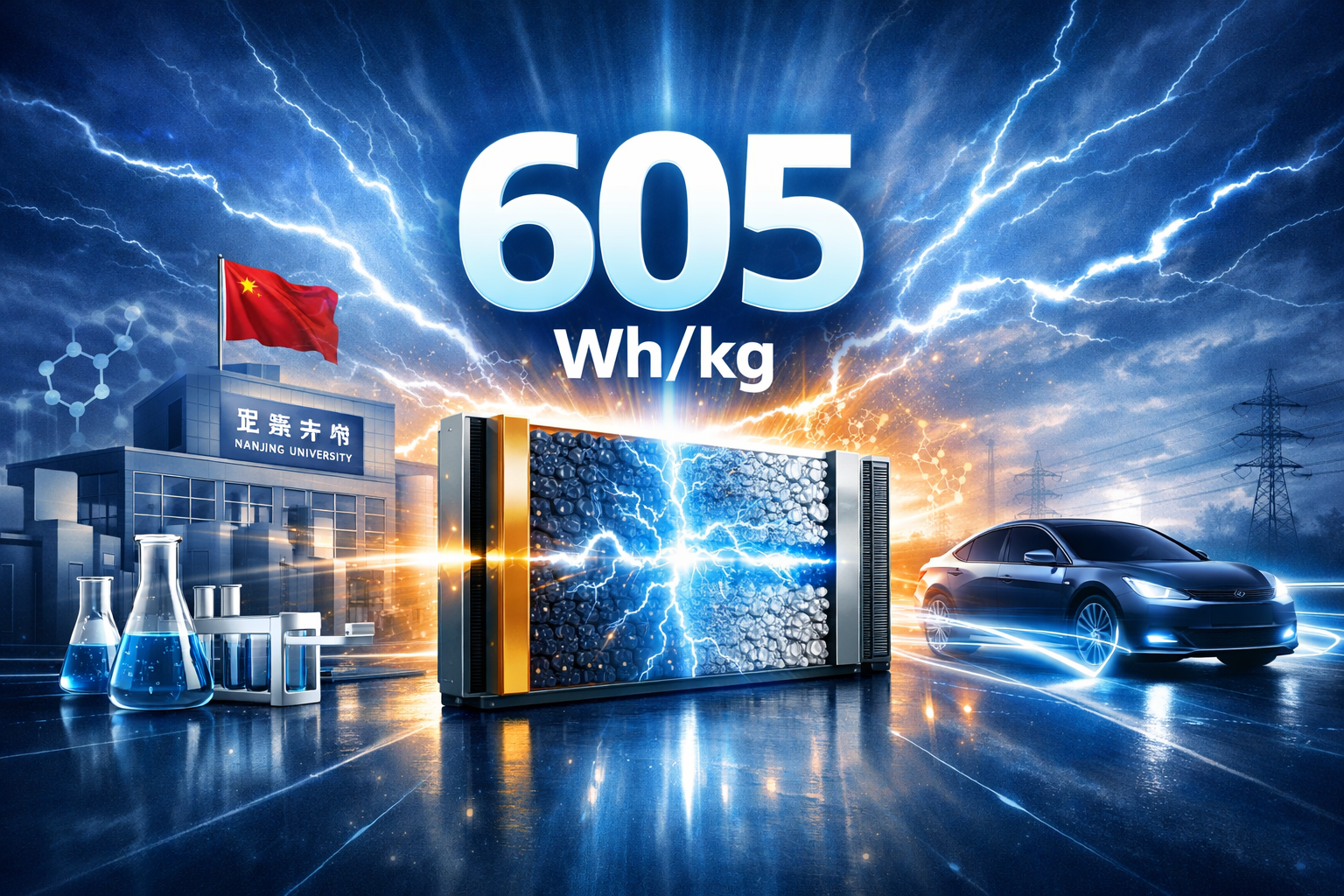
中国・南京大学の研究チームが、リチウム金属電池のエネルギー密度(容量)と寿命を同時に大幅に向上させる画期的な新型電解液を開発しました。2026年7月8日付の国際的学術誌「Nature(ネイチャー)」に掲載されたこの成果は、「標的配位反溶媒(TLAS)」と呼ばれる独自のアプローチを導入したものです。高電圧の電場下でリチウムイオンの挙動を動的に制御することで、従来のリチウム金属電池で致命的だった安全性の問題や電解液の劣化を克服し、次世代の新エネルギー自動車や電子機器向け超高エネルギー密度電池の実用化を大きく加速させる可能性を秘めています。
- 1. リチウム金属電池の背景と核心的な課題
- 2. 新技術のメカニズム:「標的配位反溶媒(TLAS)」
- 3. 実験データと驚異的な性能実績
- 4. 市場・産業における意義(関連情報)
- 1. Background and Core Challenges of Lithium-Metal Batteries
- 2. Mechanism of the New Technology: “Targeted Ligand Antisolvent” (TLAS)
- 3. Experimental Data and Phenomenal Performance Results
- 4. Significance in the Market and Industry (Related Information)
1. リチウム金属電池の背景と核心的な課題
- 次世代電池への期待: リチウム金属電池は、現在主流のリチウムイオン電池をはるかに凌駕する理論上極めて高いエネルギー密度を持つため、次世代の理想的な電源として世界中で研究されています。
- デンドライト(樹枝状結晶)の問題: 従来の液体電解液はリチウム金属負極との相性が悪く、充放電を繰り返すうちに電極表面に「リチウムデンドライト」と呼ばれる微細な結晶が針状に成長します。これが電池内部のセパレーター(絶縁材)を突き破ると、短絡(ショート)を起こし、発火や爆発などの熱暴走につながる危険性があります。
- 既存技術の限界: デンドライトを抑制するため、近年は「局所高濃度電解液(LHCE)」と呼ばれる技術が業界のトレンドとなっていました。しかし、この方法では高電圧での充電時に電解液の成分が電極表面で不可逆的に分解されてしまい、充放電を重ねるごとに電解液が徐々に消耗して電池性能が低下するという致命的な寿命の短さ(サイクル特性の悪さ)が課題でした。
2. 新技術のメカニズム:「標的配位反溶媒(TLAS)」
南京大学の周豪慎教授と筆頭著者である楊伍桀氏らの研究チームは、エーテル系電解液に「標的配位反溶媒(TLAS)」と呼ばれる特殊な成分を組み込むことで、この分解問題を根底から解決しました。
- 静的状態(通常時): バッテリーが作動していない静止状態では、この反溶媒のリチウムイオン(Li+)に対する結合能力は比較的弱いため、通常のリチウムイオンの溶媒和構造(イオンが溶媒分子に囲まれた状態)にはほとんど関与しません。
- 高電圧状態(充電時): しかし、高電圧フルセルの強い電場が加わると、この反溶媒の向きや分布がダイナミックに変化し、正極(プラス極)表面でリチウムイオンを受け取る「配位能力」が活性化します。
- 界面劣化の抑制: 活性化した反溶媒が正極から放出されたリチウムイオンを適切に処理することで、従来の電解液システムで起きていた「溶媒やアニオン(陰イオン)の無理な脱配位・再配位(構造の崩壊)」を防ぎます。結果として、電解液の構造破壊と電極界面の劣化を最小限に抑えることに成功しました。
3. 実験データと驚異的な性能実績
研究チームはこの新型電解液を用いて、実用化に近い多層構造の「リチウム金属パウチ型電池(パウチセル)」を試作し、性能試験を行いました。その数値は、現在普及している電気自動車(EV)用バッテリーを圧倒しています。
- 現在のEV用電池との比較: 現在の一般的な電気乗用車に搭載されているリチウムイオン電池のエネルギー密度は、約200 Wh/kgです。
- 450 Wh/kgでの実績: 現在の2倍以上となる450 Wh/kgという高エネルギー密度において、750回以上の充放電サイクルを繰り返しても、初期容量の80%を維持するという長寿命を達成しました。
- 605 Wh/kgでの実績: さらにエネルギー密度を605 Wh/kgまで極限に高めた検証でも、96%という極めて高い容量保持率のまま、150回の安定した安定した充放電サイクルを維持しました。
4. 市場・産業における意義(関連情報)
- EVの航続距離に革命: 450から605 Wh/kgというエネルギー密度が実用化されれば、電気自動車の1回充電あたりの航続距離を現在の2倍から3倍に伸ばすことが可能になります。これにより、ガソリン車と同等以上の実用性を持たせることができ、ユーザーの「航続距離への不安」を完全に解消するゲームチェンジャーとなります。
- 全固体電池ルートに対する強力な代替案: 現在、世界(特に日本や韓国の自動車・バッテリー大手)は、液体電解液の危険性を排除するために「全固体電池」の開発に巨額の投資を行っています。しかし今回の研究は、「優れた液体(またはゲル状)電解液を開発すれば、全固体にしなくても極めて高いエネルギー密度と安全性を両立できる」ことを証明しました。
- 実用化への課題(コストと量産化): 中国の世界最大手バッテリーメーカーCATLの曾毓群会長が「全固体電池は技術とコストの壁から2030年以前の商用化は難しい」と指摘しているように、次世代電池の最大の壁は「コスト」です。今回のリチウム金属電池も、既存の製造ラインを一部流用できる可能性はあるものの、生産単価は既存バッテリーよりも大幅に高くなると予想されます。今後、素材・セル・システム全般にわたるサプライチェーン(供給網)を構築し、いかに早く量産化してコストを引き下げられるかが、真の大衆化(普及)に向けた絶対条件となるでしょう。
出典:https://j.people.com.cn/n3/2026/0709/c95952-20476174.html
https://www.nature.com/articles/s41586-026-10732-z#data-availability
Next-Level 605 Wh/kg: How China’s New Electrolyte Technology Is Changing Next-Gen EV Specs
A research team at Nanjing University in China has developed a groundbreaking new electrolyte that significantly improves both the energy density (capacity) and lifespan of lithium-metal batteries. This achievement, published in the international scientific journal “Nature” on July 8, 2026, introduces a unique approach called a “Targeted Ligand Antisolvent” (TLAS). By dynamically controlling the behavior of lithium ions under a high-voltage electric field, this technology overcomes the critical safety issues and electrolyte degradation that have plagued conventional lithium-metal batteries. It holds the potential to greatly accelerate the practical application of ultra-high-energy-density batteries for next-generation new energy vehicles and electronic devices.
1. Background and Core Challenges of Lithium-Metal Batteries
- Expectations for Next-Gen Batteries: Lithium-metal batteries are being researched worldwide as an ideal next-generation power source because their theoretical energy density far surpasses that of today’s mainstream lithium-ion batteries.
- The Dendrite Problem: Conventional liquid electrolytes are highly incompatible with lithium-metal anodes. As the battery repeatedly charges and discharges, microscopic, needle-like crystals called “lithium dendrites” grow on the electrode surface. If these dendrites pierce the separator (the insulating material inside the battery), they cause a short circuit, which can lead to thermal runaway, including fires and explosions.
- Limitations of Existing Technology: To suppress dendrite growth, a technology known as “Localized High-Concentration Electrolytes” (LHCE) has recently become an industry trend. However, this method faces a fatal drawback: during high-voltage charging, the electrolyte components decompose irreversibly on the electrode surface. This continuous consumption of the electrolyte over repeated cycles gradually degrades battery performance, resulting in an unacceptably short cycle life.
2. Mechanism of the New Technology: “Targeted Ligand Antisolvent” (TLAS)
The research team, led by Professor Haoshen Zhou and lead author Wujie Yang at Nanjing University, completely resolved this decomposition issue by incorporating a special component called a “Targeted Ligand Antisolvent” (TLAS) into an ether-based electrolyte.
- Static State (Normal Conditions): When the battery is at rest and not operating, this antisolvent has a relatively weak binding affinity for lithium ions (Li+). Therefore, it barely participates in the standard lithium-ion solvation structure (where ions are surrounded by solvent molecules).
- High-Voltage State (During Charging): However, when the intense electric field of a high-voltage full cell is applied, the orientation and distribution of the antisolvent change dynamically. This activates its “coordination capacity” to receive lithium ions at the cathode (positive electrode) surface.
- Suppressing Interface Degradation: By properly managing the lithium ions released from the cathode, the activated antisolvent prevents the destructive forced decoordination and recoordination of solvents and anions that typically occurs in conventional electrolyte systems. As a result, the team successfully minimized both the structural breakdown of the electrolyte and the degradation of the electrode interface.
3. Experimental Data and Phenomenal Performance Results
Using this new electrolyte, the research team fabricated prototype multi-layer “lithium-metal pouch cells,” which closely resemble practical, commercial battery formats, and conducted performance tests. The figures completely overwhelm the batteries currently used in electric vehicles (EVs).
- Comparison with Current EV Batteries: The energy density of lithium-ion batteries installed in typical electric passenger cars today is approximately 200 Wh/kg.
- Results at 450 Wh/kg: At an energy density of 450 Wh/kg—more than double that of current batteries—the cell achieved a long lifespan of over 750 charge-discharge cycles while maintaining 80% of its initial capacity.
- Results at 605 Wh/kg: Even when pushed to the absolute extreme energy density of 605 Wh/kg, the battery maintained a stable and consistent performance for 150 cycles with an exceptionally high capacity retention rate of 96%.
4. Significance in the Market and Industry (Related Information)
- Revolutionizing EV Driving Range: Commercializing batteries with energy densities ranging from 450 to 605 Wh/kg could extend the driving range of an electric vehicle on a single charge by two to three times. This would provide EVs with practicality equal to or greater than gasoline-powered vehicles, making it a true game-changer that completely eliminates consumer “range anxiety.”
- A Powerful Alternative to All-Solid-State Batteries: Currently, major automotive and battery companies worldwide (particularly in Japan and South Korea) are investing massive sums into developing “all-solid-state batteries” to eliminate the safety hazards of liquid electrolytes. However, this research proves that by developing a superior liquid (or gel) electrolyte, it is entirely possible to achieve both ultra-high energy density and high safety without transitioning to a solid-state architecture.
- Challenges for Practical Application (Cost and Mass Production): As Robin Zeng, chairman of China’s CATL (the world’s largest battery manufacturer), has pointed out that commercializing all-solid-state batteries before 2030 is difficult due to technical and cost barriers, the biggest hurdle for next-generation batteries remains cost. While this new lithium-metal battery might be able to utilize parts of existing production lines, its manufacturing cost is expected to be significantly higher than current batteries. Establishing a robust supply chain across materials, cells, and systems to rapidly scale up mass production and drive down costs will be an absolute prerequisite for true, widespread adoption.

コメント