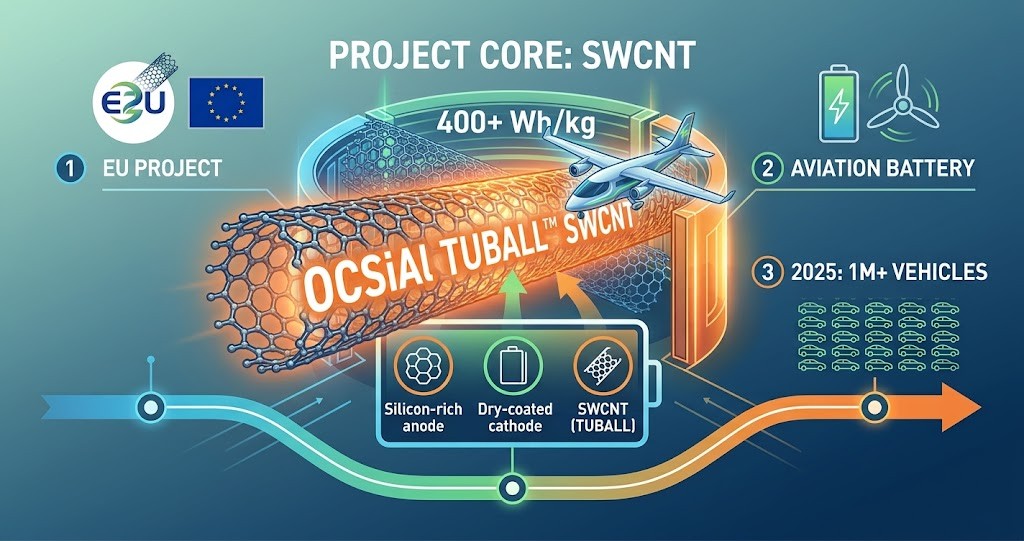
欧州連合(EU)の「Horizon Europe」プログラムのもと、航空機グレードの超高エネルギー密度バッテリーを開発する新たなプロジェクトが始動しました。単層カーボンナノチューブの世界的大手であるOCSiAl(オクシアル)を中心に、欧州の主要企業や研究機関が集結し、電動航空機の実現に向けた革新的な電池技術の実用化に挑んでいます。
主なポイント
- 高エネルギー密度の達成: 商業的に実現可能な電動リージョナル航空機に必要な 400 Wh/kg 以上のエネルギー密度を持つセル開発を目指す。
- 先進技術の統合: シリコンリッチ負極、ドライコーティング正極、SWCNT(TUBALL)といった最先端技術を組み合わせて開発を進める。
- 業界全体での採用拡大: SWCNTは車載電池分野ですでに検証段階から大規模導入へと移行しており、2025年には搭載車が100万台を超えると予測されている。
記事の要約
1. プロジェクトの概要と目指す性能
EUの支援を受ける本コンソーシアムは、電動航空機への搭載を視野に入れた次世代バッテリーセルの開発を進めています。目標とするエネルギー密度 400 Wh/kg 以上は、リージョナル(地域間)航空機の電動化を実現するための重要な基準です。
2. OCSiAl社SWCNT(TUBALL)の役割と強み
従来型の導電助剤とは異なり、単層カーボンナノチューブは電極内部で長距離の導電ネットワークを網の目状に形成します。
- 機械的安定性と耐久性: 活物質粒子同士を架橋して電極構造を補強し、充放電時に発生するシリコン負極などの体積膨張を抑制する。
- 製造プロセスの適合性: カレンダー加工(圧延)後のスプリングバックを最小限に抑え、柔軟性を向上させることで、持続可能な溶剤フリーのドライコーティング技術などにも寄与する。
3. 次世代電池におけるSWCNTの展開状況
OCSiAlの担当者によれば、SWCNTはシリコン負極、高ニッケル・単結晶NCM正極、LFP正極、全固体電池、乾式電極など多岐にわたる次世代技術で採用が進んでいます。EV(電気自動車)分野ではすでに市場への大量導入段階に入っています。
4. コンソーシアムの結集力
先進セル製造のUniverCellや電動航空機開発のVaeridionをはじめ、ダイキンケミカルヨーロッパ、ブラウンシュバイク工科大学、CIDETEC、Addionicsなど、材料開発からセル設計、生産、最終的な航空機への統合に至るサプライチェーン全体をカバーするメンバーが参画しています。
関連情報・背景知識
カーボンナノチューブ(CNT)の種類と特徴
カーボンナノチューブには多層(MWCNT)と単層(SWCNT)があります。単層カーボンナノチューブは、筒の壁が炭素原子1層で構成されており、極めて少量(0.1% 未満の添加)でも優れた電気伝導性と機械的強度を発揮します。この特徴により、エネルギー密度を落とさずに電池の出力を向上させることができます。
電動航空機(eAviation)とバッテリーの課題
自動車向けEV電池のエネルギー密度(一般的に 200 ~ 300 Wh/kg 程度)に比べ、航空機は自重による揚力依存度が非常に高いため、400 Wh/kg 以上の高エネルギー密度化が必須とされています。さらに、膨張抑制や熱管理をはじめとする高いレベルの安全性と信頼性が要求されます。
溶剤フリー(ドライコーティング)プロセスの重要性
従来の電池製造では、有機溶剤(NMPなど)を使って塗工液を作り、それを大規模な乾燥炉で乾燥させる必要がありました。ドライコーティング技術は溶剤を使用しないため、製造コストの大幅な削減、工場の設置面積縮小、CO2排出量の削減を同時に達成できる技術として世界中で開発競争が激化しています。
出典:https://batteryindustry.net/ocsial-nanotubes-enable-next-generation-aviation-battery-technologies/
OCSiAl Single-Wall Carbon Nanotubes Contribute to Next-Generation Aviation Battery Development — EU “Horizon Europe” Project Begins in Earnest
Under the European Union’s “Horizon Europe” program, a new project has launched to develop aviation-grade ultra-high energy density batteries. Led by OCSiAl, a global leader in single-wall carbon nanotubes, key European companies and research institutions have joined forces to commercialize innovative battery technology for electric aircraft.
Key Points
- Achieving High Energy Density: Aiming to develop battery cells with energy densities exceeding 400 Wh/kg, a threshold widely considered essential for commercially viable electric regional aircraft.
- Integrating Advanced Technologies: Combining cutting-edge technologies including silicon-rich anodes, dry-coated cathodes, and SWCNTs (TUBALL).
- Expanding Industry-Wide Adoption: SWCNTs have already transitioned from the validation phase to large-scale deployment in automotive batteries, with adoption expected to exceed 1 million vehicles by 2025.
Article Summary
- Project Overview and Target Performance This EU-backed consortium is developing next-generation battery cells designed for integration into electric aircraft. The target energy density of over 400 Wh/kg represents a crucial benchmark for enabling the electrification of regional aircraft.
- Role and Advantages of OCSiAl SWCNTs (TUBALL) Unlike conventional conductive additives, single-wall carbon nanotubes form a long-range conductive network throughout the electrode interior.
- Mechanical Stability and Durability: They bridge active material particles to reinforce the electrode structure, suppressing the volume expansion of silicon anodes during charging and discharging cycles.
- Manufacturing Compatibility: They minimize spring-back after calendering and enhance flexibility, contributing directly to sustainable, solvent-free dry coating processes.
- Deployment of SWCNTs in Next-Generation Batteries According to OCSiAl representatives, SWCNTs are increasingly used across various next-generation battery technologies, including silicon anodes, high-nickel and single-crystal NCM cathodes, LFP cathodes, solid-state batteries, and dry electrode architectures. In the electric vehicle sector, SWCNTs have already entered mass-market deployment.
- Strength of the Consortium The consortium brings together expertise covering the complete value chain—from material development and cell design to production and final aircraft integration. Key members include UniverCell (advanced cell development), Vaeridion (electric aircraft developer), Daikin Chemical Europe, Technical University of Braunschweig, CIDETEC, Addionics, and others.
Related Information and Background Knowledge
Types and Characteristics of Carbon Nanotubes (CNTs) Carbon nanotubes are classified into multi-wall (MWCNT) and single-wall (SWCNT) types. Single-wall carbon nanotubes consist of a single atomic layer of carbon rolled into a cylinder. Even at extremely low concentrations (less than 0.1% addition), they deliver exceptional electrical conductivity and mechanical strength, enhancing battery power output without sacrificing energy density.
Challenges in Electric Aviation (eAviation) and Batteries Compared to automotive EV batteries (typically around 200 to 300 Wh/kg), aircraft depend heavily on lift generated relative to their own weight, making an energy density of over 400 Wh/kg essential. Furthermore, aviation applications demand extraordinary levels of safety and reliability, particularly regarding swelling suppression and thermal management.
Importance of Solvent-Free (Dry Coating) Processes Traditional battery manufacturing relies on organic solvents (such as NMP) to make slurries, which require large drying ovens to process. Dry coating technology eliminates solvents entirely, enabling simultaneous reductions in manufacturing costs, factory footprints, and carbon dioxide emissions.
コメント