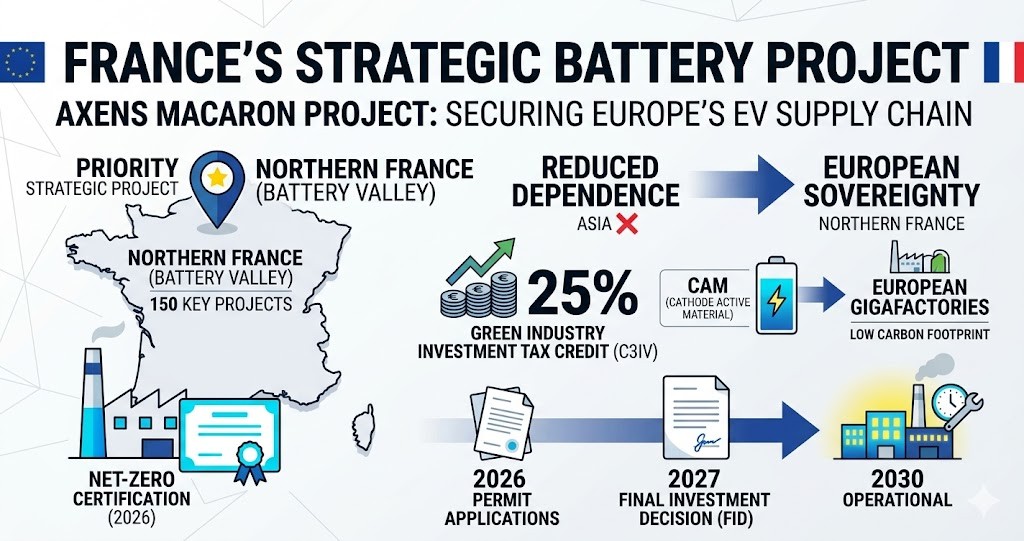
フランス北部サン=ソルヴで計画されているこのプロジェクトは、電気自動車(EV)用リチウムイオン電池の核心材料である正極活物質(CAM)を国内生産することを目指しています。パブリックコンサルテーション開始から1年を経て、本プロジェクトはフランス政府および欧州連合(EU)の戦略において極めて重要な地位を確立しました。
1. 戦略的地位と政府による公認
2026年4月、MACARONプロジェクトはエリゼ宮(フランス大統領府)によって、国内の「150の主要戦略プロジェクト」の一つに選定されました。
- 産業主権の強化: 先進的な電池材料を欧州圏内で生産することで、アジア諸国への供給依存を低減します。
- ネットゼロ認証: 2026年3月、フランス政府からネットゼロ認証を授与されました。これにより、建設に必要な各種認可の取得プロセスにおいて当局から優先的かつ綿密な支援を受けることが可能になります。
2. 強力な財務支援:グリーン産業投資税額控除(C3IV)
2026年初頭、本プロジェクトは「グリーン産業投資税額控除(C3IV)」の承認を受けました。これはフランスの2023年度財政法に基づき、エネルギー転換に貢献する特定分野を支援する制度です。
- 投資支援額: 工場建設および設備設置(Licamaxプロセス等)に関連する投資額の25パーセントに相当する税額控除が適用されます。
- 支援の意義: 巨額の初期投資が必要な電池材料産業において、フランス国内での産業創出を確実にするための不可欠な柱となります。
3. 今後のロードマップ
プロジェクトは今後、具体的な建設・操業フェーズへと移行します。
- 2026年5月~6月: 環境認可および建築許可の申請を提出。
- 2026年夏: 公聴会の実施。
- 2027年中盤: 最終的な投資決定(FID)。
- 2030年: 工場の操業開始(予定)。
関連情報:正極活物質(CAM)と欧州の市場背景
プロジェクトの意義を理解するための補足情報です。
正極活物質(CAM)の重要性
正極活物質は、リチウムイオン電池のエネルギー密度、安全性、寿命、そしてコストの約40パーセントから50パーセントを決定する最も重要な材料です。
- 高ニッケル化の潮流: 現在のEV市場では、走行距離を伸ばすためにニッケル比率を高めた「高ニッケルCAM」の開発が主流となっています。
- LFPとの棲み分け: 安価なリン酸鉄リチウム(LFP)も普及していますが、ハイエンド車種や長距離走行車には依然として三元系(NMC等)の高いエネルギー密度が求められています。
欧州「バッテリー・ギガファクトリー」との連携
フランス北部からベルギー、ドイツにかけては「バッテリーバレー」と呼ばれ、多くの電池工場(ギガファクトリー)の建設が進んでいます。
- 地産地消のメリット: CAM工場をギガファクトリーの近隣に配置することで、物流コストの削減とサプライチェーンの二酸化炭素排出量の低減(低炭素フットプリント)が可能になります。
- CRMA(欧州重要原材料法): EUが制定したこの法律により、域内での材料調達比率目標が設定されており、MACARONプロジェクトはこの目標達成に直結します。
まとめ
Axens社のMACARONプロジェクトは、単なる工場の建設ではなく、欧州がEVシフトにおける主導権を取り戻すための国家的なプロジェクトです。25パーセントの投資支援と戦略的優先権を背景に、2030年の操業開始に向けて、フランスのバッテリー・サプライチェーンはより強固なものへと進化しています。
補足:Licamaxについて 本文中で言及されたLicamaxは、Axens社が提供するリチウム精製や回収に関連する高度な技術パッケージを指しており、高純度な電池グレードの材料供給を実現するための鍵となります。
Selected as a “Major Strategic Project” by the French Government: Inside Axens’ CAM Plant and Europe’s Self-Sufficiency Network
Planned for Saint-Saulve in Northern France, this project aims for the domestic production of Cathode Active Materials (CAM), a core component of lithium-ion batteries for electric vehicles (EVs). One year after the start of public consultation, the project has established a pivotal position within the strategies of both the French government and the European Union (EU).
1. Strategic Status and Government Recognition
In April 2026, the MACARON project was selected by the Elysee Palace (the French Presidency) as one of the country’s “150 Major Strategic Projects.”
- Strengthening Industrial Sovereignty: Producing advanced battery materials within Europe reduces supply dependence on Asian countries.
- Net-Zero Certification: Awarded by the French government in March 2026, this certification allows the project to receive close and prioritized support from authorities during the permitting and licensing processes.
2. Strong Financial Support: Green Industry Investment Tax Credit (C3IV)
In early 2026, the project received approval for the “Green Industry Investment Tax Credit (C3IV).” This system was created under France’s 2023 Finance Act to support specific sectors contributing to the energy transition.
- Investment Support Amount: A tax credit equivalent to 25 percent of the investment costs related to plant construction and equipment installation (including the Licamax process) will be applied.
- Significance of Support: In the battery materials industry, which requires massive initial investment, this is an essential pillar for ensuring the creation of a genuine domestic industry in France.
3. Future Roadmap
The project is now moving into the concrete construction and operational phases.
- May–June 2026: Submission of environmental authorization and building permit applications.
- Summer 2026: Public hearings.
- Mid-2027: Final Investment Decision (FID).
- 2030: Planned start of plant operations.
Related Context: CAM and the European Market Landscape
Supplementary information to understand the significance of this project:
The Importance of Cathode Active Materials (CAM)
CAM is the most critical material in a lithium-ion battery, determining approximately 40 percent to 50 percent of its cost, as well as its energy density, safety, and lifespan.
- The High-Nickel Trend: To extend driving range, the development of “high-nickel CAM” is currently the mainstream in the EV market.
- Coexistence with LFP: While low-cost Lithium Iron Phosphate (LFP) is spreading, high-end and long-range vehicles still require the superior energy density of ternary systems like NMC.
Synergy with Europe’s “Battery Gigafactories”
The region stretching from Northern France to Belgium and Germany is known as “Battery Valley,” where numerous gigafactories are under construction.
- Local Production Benefits: Locating a CAM plant near gigafactories reduces logistics costs and the supply chain’s carbon footprint.
- CRMA (Critical Raw Materials Act): This EU act sets targets for internal material sourcing; the MACARON project directly contributes to meeting these goals.
Conclusion
Axens’ MACARON project is more than just a factory construction; it is a national endeavor for Europe to regain leadership in the EV shift. Backed by 25 percent investment support and strategic priority, France’s battery supply chain is evolving toward a stronger future as it targets a 2030 operational start.
Note on Licamax: > Licamax, mentioned in the text, refers to an advanced technology package provided by Axens for lithium purification and recovery. It is a key factor in achieving a high-purity, battery-grade material supply.


コメント