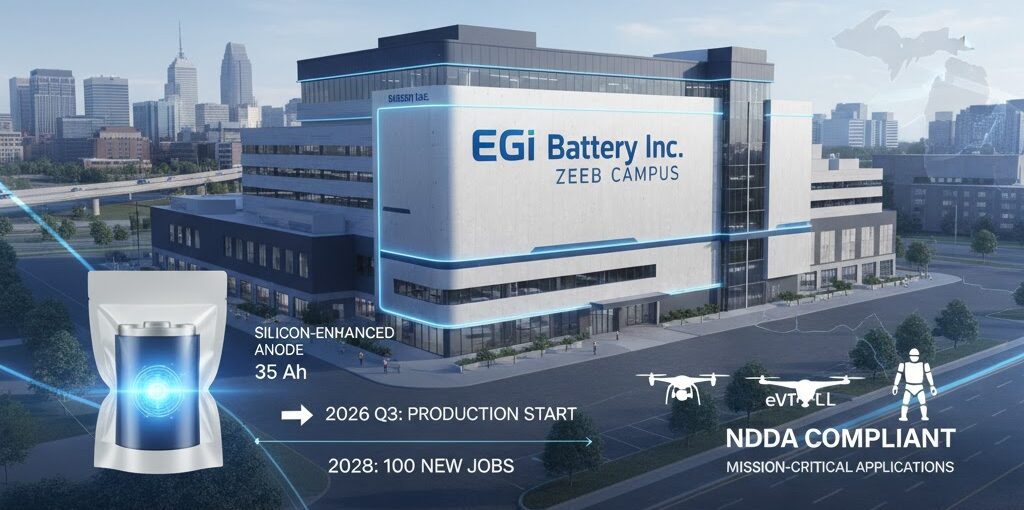
米国のアドバンスト・リチウムイオン電池メーカーであるEGI Battery Inc. (EGI)は、ミシガン州アナーバーに同社初となる製造キャンパス「Zeebキャンパス」を設立すると発表しました。これは、米国内でのサプライチェーン確保と商用生産拡大に向けた重要な戦略的拠点となります。
1. 製造拠点の概要とスケジュール
アナーバーの施設は、段階的な拡張モデル(フェーズ展開)を採用し、リスクを抑えながら生産能力を引き上げる設計となっています。
- 所在地: ミシガン州アナーバー 300 North Zeeb Road
- 施設規模: 初期は約15,000平方フィート(約1,400平方メートル)からスタートし、最終的には総面積130,000平方フィート(約12,000平方メートル)まで拡張可能。
- スケジュール: 2026年第1四半期末までに現場受入試験(SAT)を完了し、2026年第3四半期に生産開始(SOP)を予定。
- 雇用創出: 2028年までにフル稼働(3交代制)で約100人の新規雇用を創出する見込み。
2. 生産能力と技術仕様
EGIは、ドローンや航空宇宙など、特定の高性能が求められる市場に特化した製品を製造します。
| フェーズ | 開始時期 | 主な工程 | 生産能力(目安) |
| フェーズ1 | 2026年 | 電解液充填、エージング、成形、グレーディング | 年間30万セル(約40 MWh) |
| フェーズ2 | 2027年 | 電極製造から組立までの垂直統合 | 年間60万セル(約80 MWh) |
- ターゲット製品: 容量35 Ahの商用NMC(ニッケル・マンガン・コバルト)リチウムイオンパウチセル。
- 先端材料: シリコン強化型アノード(負極)やグラファイトアノードを採用し、高いエネルギー密度を実現。
3. 戦略的背景:NDAA準拠とミッションクリティカル市場
今回の拠点設立には、米国の経済安全保障を背景とした明確な戦略意図があります。
- NDAA(国防権限法)への準拠: 防衛・航空宇宙分野での調達要件を満たすため、2028年までにコストベースで少なくとも95%のNDAA準拠材料を確保する計画です。
- 特定市場への集中: 汎用的な電気自動車(EV)向けではなく、ドローン(クラス1および2)、電気航空機、航空宇宙、ヒューマノイドロボットといった、高出力と安全性が極めて重要な「ミッションクリティカル」な分野をターゲットとしています。
- 品質規格: 航空宇宙産業の品質マネジメントシステム規格であるAS9100およびISO 9001に準拠した運用を行います。
【関連情報】米国バッテリー市場の動向とミシガン州の役割
- 「ラストマイル」の国内回帰: 米国政府はインフレ抑制法(IRA)などを通じ、バッテリーの製造・原材料調達の脱中国・国内回帰を強力に推進しています。EGIのNDAA準拠戦略は、政府系案件や防衛関連契約を獲得する上で極めて有利に働きます。
- ミシガン州の「バッテリーベルト」化: 歴史的に自動車産業のハブであるミシガン州は、現在バッテリー産業の集積地へと変貌を遂げています。大学(ミシガン大学など)の研究リソースや熟練した製造労働力が豊富なため、EGIのようなスタートアップがスケールアップするのに適した環境といえます。
- パウチ型セルの利点: EGIが採用するパウチ型(袋状)セルは、円筒形セルに比べて形状の自由度が高く、軽量化が可能なため、ドローンや空飛ぶクルマ(eVTOL)など、重量制限が厳しい用途に適しています。
EGI Battery Establishes First Manufacturing Hub in Michigan: Accelerating Domestic Supply for Drones and Robotics
EGI Battery Inc. (EGI), a US-based advanced lithium-ion battery manufacturer, has announced the establishment of its first manufacturing campus, the “Zeeb Campus,” in Ann Arbor, Michigan. This facility serves as a critical strategic hub for securing a domestic supply chain and expanding commercial production within the United States.
1. Facility Overview and Schedule
The Ann Arbor facility is designed with a phased expansion model to increase production capacity while mitigating operational risks.
- Location: 300 North Zeeb Road, Ann Arbor, Michigan
- Facility Size: Starting with approximately 15,000 square feet (approx. 1,400 square meters), with the potential to expand to a total of 130,000 square feet (approx. 12,000 square meters).
- Timeline: Site Acceptance Testing (SAT) to be completed by the end of Q1 2026, with Start of Production (SOP) scheduled for Q3 2026.
- Job Creation: Expected to support approximately 100 new jobs by 2028 under full three-shift operations.
2. Production Capacity and Technical Specifications
EGI manufactures products tailored for specialized high-performance markets such as drones and aerospace.
- Phase 1 (Starting 2026): Focuses on electrolyte filling, aging, formation, and grading. Capacity: 300,000 cells per year (approx. 40 MWh).
- Phase 2 (Starting 2027): Vertical integration from electrode manufacturing to cell assembly. Capacity: 600,000 cells per year (approx. 80 MWh).
- Target Product: Commercial NMC (Nickel Manganese Cobalt) lithium-ion pouch cells with a capacity of 35 Ah.
- Advanced Materials: Implementation of silicon-enhanced anodes and graphite anodes to achieve high energy density.
3. Strategic Background: NDAA Compliance and Mission-Critical Markets
The establishment of this hub carries a clear strategic intent rooted in US economic security.
- NDAA Compliance: To meet procurement requirements for the defense and aerospace sectors, EGI plans to secure at least 95% NDAA-compliant materials on a cost basis by 2028.
- Focus on Specialized Markets: Rather than general electric vehicles (EVs), EGI targets “mission-critical” sectors where high power and safety are paramount, such as Class 1 and 2 drones, electric aviation, aerospace, and humanoid robots.
- Quality Standards: Operations will comply with ISO 9001 and AS9100, the quality management system standard for the aerospace industry.
[Related Information] US Battery Market Trends and Michigan’s Role
- Reshoring the “Last Mile”: Through initiatives like the Inflation Reduction Act (IRA), the US government is strongly promoting the reshoring of battery manufacturing and raw material procurement. EGI’s NDAA-compliant strategy is highly advantageous for securing government projects and defense contracts.
- Michigan’s “Battery Belt”: Historically the hub of the automotive industry, Michigan is transforming into a cluster for the battery industry. With abundant research resources from institutions like the University of Michigan and a skilled manufacturing workforce, it provides an ideal environment for startups like EGI to scale.
- Advantages of Pouch Cells: The pouch-style cells adopted by EGI offer greater form-factor flexibility and lighter weight compared to cylindrical cells. This makes them ideal for weight-sensitive applications such as drones and electric vertical takeoff and landing (eVTOL) aircraft.


コメント