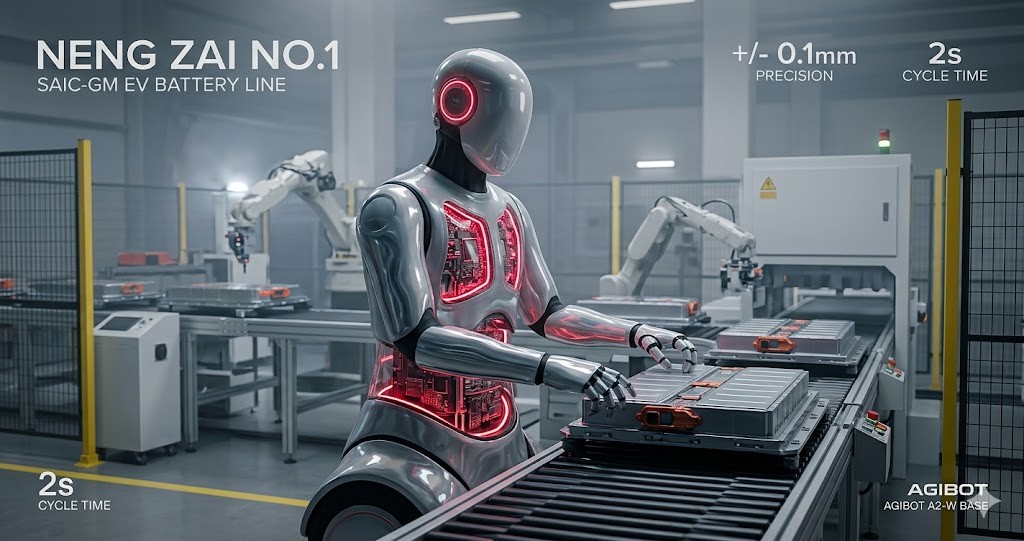
中国の自動車メーカー上汽通用(SAIC-GM)は、EV(電気自動車)用バッテリーの量産ラインに、同社初となる人型ロボット「能仔1号(Neng Zai No.1)」を導入しました。
1. 開発背景と技術仕様
- ベースモデル: 中国のユニコーン企業「智元機器人(Agibot)」の車輪式ヒューマノイド「A2-W」をカスタマイズ。
- 稼働場所: ビュイック(Buick)のEV「Electra E7」向けバッテリー製造ライン。
- 主な性能:
- 高精度・高速: 位置決め精度は +/- 0.1mm、処理速度は1件あたり 2秒。
- 自律性: 固定プログラムではなく、視覚認識と双腕協調により自ら作業経路を計画。
- 省スペース: 統合設計により、設置面積を従来の 15%未満 に削減。
2. 導入のメリット
- 安全性の向上: 感電のリスクがある「活線作業(通電状態での作業)」を人間に代わって遂行。
- コスト削減: 車輪式ベースの採用により、既存ラインの大規模な改修を不要にし、導入コストを抑制。
- 本格運用への移行: 実証実験段階を終え、実際の量産工程を担う実用化フェーズに突入。
関連情報:中国におけるヒューマノイド開発の潮流
今回の導入をより深く理解するための、背景的な関連情報を補足します。
智元機器人(Agibot)とは
2023年に設立された上海発のスタートアップです。創業者の「稚暉君(Peng Zhihui)」氏は、ファーウェイ(Huawei)出身の著名なエンジニアで、技術コミュニティでも絶大な影響力を持っています。設立からわずか1年余りで複数のモデルを発表し、時価総額が急上昇している「ユニコーン企業」の筆頭です。
自動車業界で加速するロボット導入
上汽GMだけでなく、中国の他の自動車メーカーもヒューマノイド導入を急いでいます。
- NIO(蔚来汽車): 優必選(UBTECH)のヒューマノイド「Walker S」を生産ラインに導入し、シートベルトの検査やロゴの貼り付け試験を実施。
- BYDや小米(Xiaomi): 自社でのロボット開発や、専門メーカーとの提携を強化しており、車造りとロボット製造の境界線が曖昧になりつつあります。
車輪式と二足歩行の使い分け
今回導入された「A2-W」は車輪式です。これは工場内での「移動の安定性」と「可搬重量」を優先した現実的な選択です。一方で、同社は今後、より複雑な地形や段差に対応できる二足歩行型「遠征 A2(Yuanzheng A2)」の導入も検討しており、作業内容に応じて形態を使い分けるハイブリッドな自動化戦略を描いています。
まとめ
上汽GMによる「能仔1号」の導入は、単なる省人化ではなく、「2秒処理」という高効率と「高精度な自律判断」を両立させた点が画期的です。今後は、バッテリー製造だけでなく、より複雑な部品の組み立てや品質検査への応用が期待されており、NEV(新エネルギー車)生産における世界的なベンチマークとなる可能性があります。
Better-than-human Precision of +/- 0.1mm: SAIC-GM Hires Agibot Humanoid as New Employee
Chinese automaker SAIC-GM has introduced its first humanoid robot, Neng Zai No.1, to its mass production line for EV (Electric Vehicle) batteries.
1. Development Background and Technical Specifications
- Base Model: A customized version of the wheeled humanoid A2-W developed by the Chinese unicorn startup Agibot.
- Location: Battery production line for the Buick Electra E7 EV.
- Key Performance:
- High Precision and Speed: Positioning accuracy of +/- 0.1mm and a processing speed of 2 seconds per task.
- Autonomy: Instead of relying on fixed programming, it plans its own work paths using visual recognition and dual-arm coordination.
- Space Saving: The integrated design reduces the required floor space to less than 15% of traditional setups.
2. Benefits of Implementation
- Improved Safety: Performs live-line work (tasks performed while energized), which carries high electric shock risks for humans.
- Cost Reduction: The wheeled base eliminates the need for large-scale modifications to existing lines, keeping implementation costs low.
- Transition to Full-scale Operation: Marks the shift from the experimental demonstration phase to the practical application phase, handling actual mass production processes.
Related Information: Trends in Humanoid Development in China
The following background information provides deeper context for this implementation.
What is Agibot?
Agibot is a Shanghai-based startup founded in 2023. Its founder, Peng Zhihui, is a renowned former Huawei engineer with significant influence in the technical community. In just over a year since its founding, the company has released multiple models and has become a leading unicorn with a rapidly surging market valuation.
Accelerating Robot Adoption in the Auto Industry
Beyond SAIC-GM, other Chinese automakers are also rushing to introduce humanoids:
- NIO: Has introduced the Walker S humanoid from UBTECH to its production lines for seatbelt inspections and logo application tests.
- BYD and Xiaomi: Are strengthening their own robot development and partnerships with specialized manufacturers, blurring the lines between car manufacturing and robot production.
Differentiation Between Wheeled and Bipedal Models
The A2-W introduced this time is a wheeled model. This is a practical choice that prioritizes movement stability and payload capacity within a factory setting. However, the company is also considering the future introduction of the bipedal Yuanzheng A2 model, which can handle more complex terrain and steps, illustrating a hybrid automation strategy that selects the robot form factor based on the specific task.
Summary
The introduction of Neng Zai No.1 by SAIC-GM is a breakthrough that balances high efficiency (2-second processing) with high-precision autonomous judgment, going beyond simple labor reduction. Moving forward, applications are expected to expand from battery manufacturing to the assembly of more complex parts and quality inspections, potentially setting a new global benchmark for NEV (New Energy Vehicle) production.


コメント