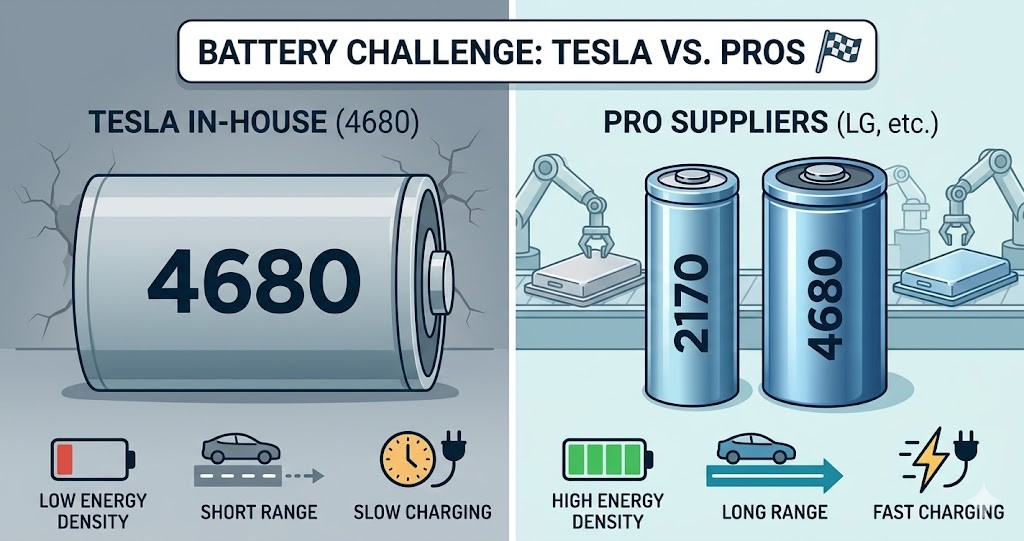
EV(電気自動車)市場を牽引する米テスラは、2020年の「バッテリー・デー」にて次世代の大型円筒形バッテリー「4680」を大々的に発表しました。CEOのイーロン・マスク氏が「EVの製造コストを劇的に下げ、航続距離を伸ばす革命」と自信を示したこのプロジェクトは、外部サプライヤーへの依存を減らし、バッテリーの「完全内製化(自給自足)」を果たすための核心戦略でした。
しかし、2026年現在の最新動向は、マスク氏が思い描いたシナリオ通りには進んでいません。自社製4680バッテリーを搭載した車両が欧州市場に投入されたものの、パートナー企業(韓国LGエナジーソリューションなど)製の従来型バッテリーに比べ、性能の低下が露呈する事態となっています。
本稿では、公開された記事をベースに、テスラが直面している「内製化の壁」と、その背後にあるバッテリー大型化の技術的難所、そして韓国勢を中心とするプロのバッテリーメーカーが持つ圧倒的な製造優位性について、最新の関連情報を交えて分かりやすく整理・解説します。
- 1. テスラ自社製「4680バッテリー」が直面した現実
- 2. なぜ大型化は難しいのか?「ラーメンの法則」と技術的課題
- 3. 浮き彫りになった韓国サプライヤーの「製造優位性」
- 4. テスラの次世代戦略と市場の展望(〜2030年)
- まとめ
- Tesla’s In-House Challenge: The Miscalculation Behind the Scaling Up of Next-Gen “4680” Batteries
- 1. The Reality Facing Tesla’s In-House “4680 Battery”
- 2. Why is Scaling Up So Difficult? “The Ramen Analogy” and Technical Challenges
- 3. Shifting the Spotlight to South Korean Suppliers’ “Manufacturing Dominance”
- 4. Tesla’s Next-Gen Strategy and Market Outlook (Toward 2030)
- Conclusion
1. テスラ自社製「4680バッテリー」が直面した現実
テスラは欧州向けの「Model Y(後輪駆動モデル)」において、これまで搭載していたLGエナジーソリューション(以下、LG)製の従来型「21700」バッテリーから、自社開発の「4680」ベースの新型バッテリーパックへと密かに切り替えを行いました。しかし、実際の仕様やパフォーマンスを比較した結果、明確な性能差(悪化)が判明しています。
従来型(LG製 21700ベース)vs 新型(テスラ自社製 4680ベース)比較
| 項目 | 従来型(LG製 5Mパック) | 新型(テスラ製 8Lパック) | 影響・差分 |
| バッテリー容量 | 82 〜 84 kWh | 約 79 kWh | 約 3〜5 kWhの減少 |
| 航続距離 | 661 km | 609 km | 52 kmの短縮 |
| エネルギー密度 | 265 Wh/kg | 244 Wh/kg | テスラ製の方が密度が低い |
| 充電時間(10%⇒80%) | 約 27 〜 30 分 | 約 40 〜 45 分 | 最大15分の遅れ |
事前の告知なしにこの変更が行われたため、欧州の購入顧客からは「航続距離が短くなり、充電も遅くなった」と不満の声が上がっており、テスラの技術力に対する新たな検証と疑念を招く結果となっています。
2. なぜ大型化は難しいのか?「ラーメンの法則」と技術的課題
バッテリーのサイズを「21700(幅21mm×長さ70mm)」から「4680(幅46mm×長さ80mm)」へと大型化することは、単純なスケールアップでは済まない高度な物理的・化学的課題を伴います。
主な技術的ボトルネック
- 熱と電気の移動効率(内部抵抗の増加):セルが大きくなると、内部の電子や熱が移動する距離が長くなります。これにより内部抵抗が増加し、バッテリー全体で均一な化学反応を起こすことが極めて難しくなります。
- デッドスペースの発生:大型化に伴い、バッテリーの安全性を担保するための筐体(ケース)や構造サポートをより強固(分厚く)にする必要があります。その結果、肝心のエネルギーを蓄える「活物質」を入れるスペースが相対的に圧迫されてしまいます。
【専門家による例え:ラーメンの法則】
韓国の大手電池メーカーの上級研究員は、この課題を「ラーメン作り」に例えています。
「1パックの麺を茹でるのは簡単ですが、10パックを同時に均等に茹でるには、より厳密な火力制御が必要です。そうしないと、茹で足りない麺と茹で過ぎた麺が混在してしまいます。大型バッテリーもこれと全く同じで、内部の反応を均一に制御するのが至難の業なのです。」
3. 浮き彫りになった韓国サプライヤーの「製造優位性」
テスラの今回の挫折は、逆説的に韓国のLGエナジーソリューションやサムスンSDI、日本のパナソニックといった老舗バッテリーメーカーが持つ「量産ノウハウ」の凄みを浮き彫りにしました。
プロのバッテリーメーカーが持つ強み
- 長年のノウハウ蓄積: 熱管理、急速充電技術、品質管理、そして何よりも不良品を出さない「歩留まり(イールド)管理」において、何万回ものテストと微調整を繰り返してきた歴史があります。
- 厳格な品質基準: テスラは内製化を急ぐあまり、セルレベルでの品質の一貫性に対して、韓国勢よりも緩い基準を採用している可能性が指摘されています。セル単体での小さな妥協やバラつきが、何百個も組み合わさる「パックレベル」になった段階で、上記のような大きな性能差となって現れてしまいます。
4. テスラの次世代戦略と市場の展望(〜2030年)
EVの製造コストの約30〜40%を占めるバッテリーを自社生産できれば、テスラは莫大な利益を自社に囲い込み、サプライチェーンの主導権を握ることができます。そのため、テスラが今後も内製化の手を緩める可能性は低いとみられます。
しかし現実は、テスラが描いた「完全自給自足」ではなく、「内製と外部調達のハイブリッド(混載)戦略」を継続せざるを得ない状況です。
【関連情報の補足:動き出す韓国勢の4680量産】
テスラが量産化の壁に突き当たる中、皮肉にもLGエナジーソリューションは2024年後半から、サムスンSDIもそれに続く形で、次世代「46シリーズ(4680等)」円筒形バッテリーの本格的な商業量産ラインを稼働させています。
テスラは自社製バッテリーの改良を続けつつも、当面はこれら韓国・日本勢のトップサプライヤーから高性能な4680セルの供給を受け、サイバートラックや次世代廉価版EVへ搭載していく流れが確実視されています。
まとめ
テスラの4680バッテリーをめぐる論争は、単なる「新パーツの初期不良」といった一過性の問題ではありません。ソフトウェアやITの領域で圧倒的なスピード感を誇るテスラであっても、「高度な化学と精密な製造業の結晶」である車載バッテリーの量産規模拡大には、一朝一夕では超えられない高い壁があるという現実を証明した格好となりました。
「利益の総取り」を狙ったテスラの自給自足プランは軌道修正を迫られており、今後も高品質なバッテリーを安定して作れる東アジア(韓国・日本)のサプライヤーへの依存と協調は、しばらく続くことになりそうです。
出典:https://www.koreaherald.com/article/10740644
Tesla’s In-House Challenge: The Miscalculation Behind the Scaling Up of Next-Gen “4680” Batteries
As the pioneer of the electric vehicle (EV) market, US-based Tesla made waves at its 2020 “Battery Day” with the grand unveiling of its next-generation, large-format cylindrical “4680” battery. Promoted confidently by CEO Elon Musk as a revolution that would drastically cut EV manufacturing costs and extend driving range, the project stood as a core strategy to reduce reliance on external suppliers and achieve complete battery self-sufficiency through vertical integration.
However, the latest developments in 2026 reveal that the scenario is not unfolding quite as Musk envisioned. Although vehicles equipped with Tesla’s in-house 4680 batteries have finally been rolled out in the European market, they have exposed a noticeable drop in performance compared to the conventional batteries supplied by partner companies, such as South Korea’s LG Energy Solution.
Based on recently published reports, this article provides a clear overview and analysis of the “in-house production wall” Tesla is currently hitting, the underlying technical bottlenecks of scaling up battery cell size, and the overwhelming manufacturing advantages held by veteran battery specialists, particularly South Korean manufacturers.
1. The Reality Facing Tesla’s In-House “4680 Battery”
Tesla quietly began swapping out high-performance, conventional “2170” battery packs supplied by LG Energy Solution (hereafter LG) for its own newly developed “4680”-based battery pack in the European Model Y (Long Range RWD). However, a head-to-head comparison of actual specifications and performance has revealed a distinct regression.
Comparison: Conventional (LG-made 2170-based) vs. New (Tesla In-House 4680-based)
| Metric | Conventional (LG 5M Pack) | New (Tesla 8L Pack) | Impact / Difference |
| Battery Capacity | ~82 to 84 kWh | ~79 kWh | Reduction of ~3 to 5 kWh |
| WLTP Range | 661 km | 609 km | Shortened by 52 km (approx. 8% drop) |
| Energy Density | 265 Wh/kg | 244 Wh/kg | In-house Tesla cells have lower density |
| 10% to 80% Charge Time | ~27 to 30 minutes | ~40 to 45 minutes | Up to 15 minutes slower |
Because Tesla implemented this change without prior notification to consumers, European buyers have been voicing frustration over shorter ranges and sluggish charging speeds. This has invited intense new scrutiny and skepticism regarding Tesla’s in-house engineering capabilities.
2. Why is Scaling Up So Difficult? “The Ramen Analogy” and Technical Challenges
Increasing a battery’s dimensions from the standard “2170” (21 mm wide by 70 mm long) to the “4680” (46 mm wide by 80 mm long) involves sophisticated physical and chemical obstacles that cannot be resolved by a simple scale-up.
Key Technical Bottlenecks
- Transfer Efficiency of Electricity and Heat (Increased Internal Resistance): As a cell grows larger, the distance that electrons and thermal energy must travel internally becomes significantly longer. This raises internal resistance, making it exceptionally difficult to maintain a uniform chemical reaction throughout the entire battery.
- Creation of Dead Space: To ensure the safety and structural integrity of a larger battery, the exterior casing and structural supports must be thicker and more robust. Consequently, the volume available for the “active materials”—the actual components that store energy—is relatively restricted.
[Expert Analogy: The Ramen Rule]
A senior researcher at a major South Korean battery manufacturer compared this dilemma to cooking ramen:
“Boiling a single pack of noodles is simple, but boiling ten packs simultaneously and evenly requires far more rigorous heat control. Otherwise, you end up with some noodles being undercooked and others overcooked. Large-format batteries present the exact same challenge; controlling uniform reactions on the inside is an incredibly daunting task.”
3. Shifting the Spotlight to South Korean Suppliers’ “Manufacturing Dominance”
Paradoxically, Tesla’s recent setbacks have highlighted the formidable mass-production prowess of long-established battery giants like South Korea’s LG Energy Solution and Samsung SDI, as well as Japan’s Panasonic.
Core Strengths of Professional Battery Manufacturers
- Decades of Accrued Know-How: These manufacturers possess a rich history of iterative testing and fine-tuning in thermal management, fast-charging technology, quality control, and, crucially, yield-rate management (minimizing defects).
- Stringent Quality Standards: Analysts suggest that in its rush to localize production, Tesla may have adopted relatively relaxed standards regarding cell-level quality consistency compared to its South Korean counterparts. When tiny compromises or variances at the individual cell level accumulate into a “pack level” comprised of hundreds of cells, they manifest as the stark performance gaps seen today.
4. Tesla’s Next-Gen Strategy and Market Outlook (Toward 2030)
Given that batteries account for roughly 30% to 40% of an EV’s manufacturing cost, producing them in-house would allow Tesla to retain massive profit margins and secure absolute control over its supply chain. For this reason, Tesla is unlikely to slow down its push for vertical integration.
However, reality has forced a strategic pivot. Instead of the “complete self-sufficiency” originally envisioned, Tesla must rely on a hybrid strategy that mixes in-house manufacturing with external sourcing.
[Supplementary Information: South Korean Rivals Move into 4680 Mass Production]
While Tesla wrestles with the complexities of scaling up, its East Asian rivals are executing seamlessly. LG Energy Solution kicked off commercial mass production of next-generation “46-series” cylindrical batteries in late 2024, with Samsung SDI following closely behind with its own stable production lines.
While Tesla will undoubtedly continue to refine its proprietary chemistry, it is highly anticipated that the automaker will remain dependent on premium 4680 cell shipments from these top-tier South Korean and Japanese suppliers to power vehicles like the Cybertruck and its upcoming next-gen affordable EV platform for the foreseeable future.
Conclusion
The controversy surrounding Tesla’s 4680 battery is far more than a temporary “teething pain” or a simple hardware glitch. It serves as definitive proof that even for a company like Tesla—which boasts unparalleled agility in software and IT—scaling up the mass production of automotive batteries represents a steep mountain to climb, rooted in highly sophisticated chemistry and precision manufacturing.
Tesla’s winner-take-all plan for battery self-sufficiency is undergoing a reality check. As a result, the EV giant’s reliance on and cooperation with East Asian (South Korean and Japanese) suppliers capable of stably delivering high-quality batteries is set to endure for some time to.

コメント