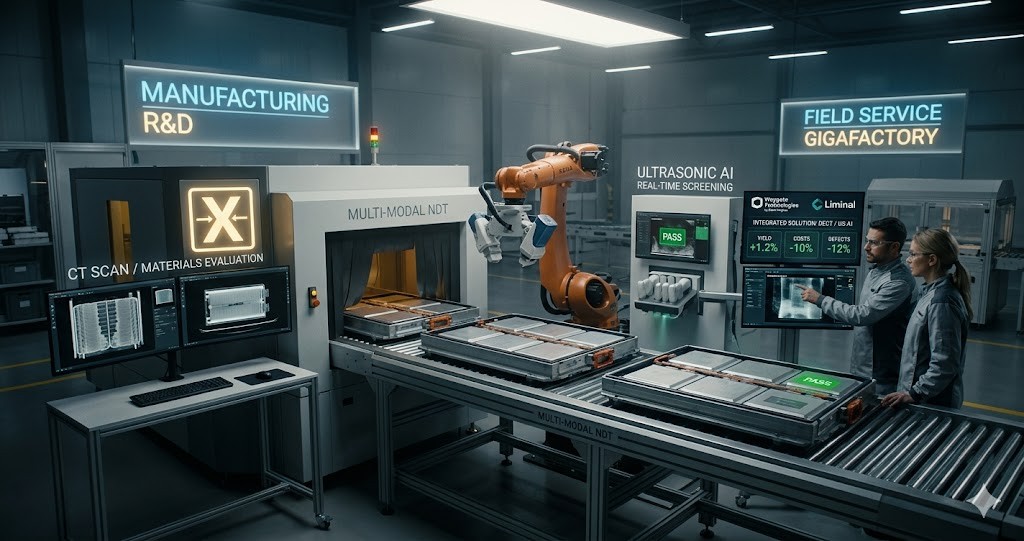
非破壊検査(NDT)の世界的リーダーであるWaygate Technologies(Baker Hughes傘下)と、AI超音波検査のスタートアップLiminal Insightsは、高性能二次電池(リチウムイオン電池等)のライフサイクル全体をカバーする業界初の統合型マルチモーダル検査ソリューションの開発・提供に向けた戦略的協業を発表しました。
- 協業の主要ポイントと技術的特徴
- 関連情報:背景と用語解説
- 発表の意義
- Waygate and Liminal Form Strategic Alliance: Revolutionizing Battery Yield through Multimodal Inspection Combining CT and Ultrasonic AI
- Key Points and Technical Features of the Collaboration
- Related Information: Background and Terminology
- Significance of the Announcement
協業の主要ポイントと技術的特徴
1. マルチモーダル検査の実現
従来の単一的な検査ではなく、複数の技術を組み合わせることで、電池の「健康状態」をより正確に把握します。
- 放射線・CT(Waygateの強み): 研究開発段階での材料評価や、内部構造の精密な故障解析、モジュールレベルの大型検査を担当。
- 超音波・AI(Liminalの強み): EchoStatプラットフォームを用いたリアルタイム解析。インライン(製造ライン上)での高速スクリーニングを担当。
2. ライフサイクル全体のカバー
- 製造段階: 電解液注入からフォーメーション(初充電)、エージング工程まで、リアルタイムで不具合を検出。
- 開発・現場サービス: R&D段階のnano CTによる微細構造解析から、市場に出た後のフィールドサービスまで一貫したデータ連携。
3. 定量的メリット(UKBICでの実証結果)
英国電池R&Dセンター(UKBIC)での400セル以上に及ぶ検証により、以下の効果が確認されました。
- コスト削減: 従来の検査手法と比較して10%以上の削減。
- 欠陥検出率: 単一の検査手法より12%向上。
- 歩留まり改善: ギガファクトリー規模では、1%未満の改善が年間数千万ドル(数十億円規模)の利益に直結します。
関連情報:背景と用語解説
背景:なぜ「マルチモーダル」が必要なのか?
電池製造において、内部の欠陥(電解液の浸透不足、電極の歪み、異物混入など)を一つのセンサーで全て捉えることは困難です。
- CT(X線)は「形」の異常を見るのに適していますが、インラインでの全数検査には時間がかかりすぎる場合があります。
- 超音波は「状態(密度や接着)」を見るのに適しており高速ですが、解析には高度なAI技術が必要です。 これらを組み合わせ、CTを「正解データ(グラウンドトゥルース)」としてAIを教育することで、高速かつ高精度な自動検査が可能になります。
用語解説
- 非破壊検査(NDT: Non-Destructive Testing): 対象物を破壊せずに内部の傷や劣化を調べる技術。
- ギガファクトリー: 電気自動車(EV)用などの電池を大規模(GWh単位)に生産する巨大工場。
- EchoStat: Liminal社が開発した、超音波信号をAIで解析し電池内部の状態を可視化する独自の検査プラットフォーム。
- UKBIC (UK Battery Industrialisation Centre): 英国政府が主導する、電池製造プロセスのスケールアップを支援する公的機関。
発表の意義
今回の協業により、電池メーカーは「研究室レベルの精密な検査(CT)」と「工場レベルの高速な検査(超音波)」をシームレスに連携させることができるようになります。これにより、不良品の早期排除による廃棄物(スクラップ)の削減と、EVシフトに伴う急速な増産体制(スケーリング)の安定化が期待されます。
出典:https://prtimes.jp/main/html/rd/p/000000004.000181095.html
Waygate and Liminal Form Strategic Alliance: Revolutionizing Battery Yield through Multimodal Inspection Combining CT and Ultrasonic AI
Waygate Technologies (a Baker Hughes business), a global leader in non-destructive testing (NDT), and Liminal Insights, an AI-powered ultrasonic inspection startup, have announced a strategic collaboration to develop and provide the industry’s first integrated multimodal inspection solution covering the entire lifecycle of high-performance rechargeable batteries, such as lithium-ion batteries.
Key Points and Technical Features of the Collaboration
1. Realizing Multimodal Inspection
By combining multiple technologies rather than relying on a single inspection method, the “health” of a battery can be captured more accurately.
- Radiography and CT (Waygate’s Strength): Responsible for material evaluation during the R&D stage, precise failure analysis of internal structures, and large-scale inspection at the module level.
- Ultrasonics and AI (Liminal’s Strength): Real-time analysis using the EchoStat platform. Responsible for high-speed inline screening on the production line.
2. Full Lifecycle Coverage
- Manufacturing Stage: Real-time defect detection from electrolyte injection to formation (initial charging) and aging processes.
- Development and Field Service: Seamless data integration from microstructure analysis using R&D-grade nano CT to field services after market entry.
3. Quantitative Benefits (UKBIC Validation Results)
Verification of over 400 cells at the UK Battery Industrialisation Centre (UKBIC) confirmed the following effects:
- Cost Reduction: Over 10% reduction compared to conventional inspection methods.
- Defect Detection Rate: 12% improvement over single-modality inspection methods.
- Yield Improvement: At gigafactory scale, an improvement of less than 1% directly translates to tens of millions of dollars in annual profit.
Related Information: Background and Terminology
Background: Why is “Multimodal” Necessary?
In battery manufacturing, it is difficult to capture all internal defects (e.g., poor electrolyte wetting, electrode distortion, contamination) with a single sensor.
- CT (X-ray) is ideal for detecting “structural” abnormalities, but 100% inline inspection can be too time-consuming.
- Ultrasonics are well-suited for checking “status” (density and bonding) and are fast, but require advanced AI for analysis. By combining these, using CT as the “ground truth” to train the AI, high-speed and high-precision automated inspection becomes possible.
Terminology
- NDT (Non-Destructive Testing): Technology used to inspect internal flaws or degradation without damaging the object.
- Gigafactory: Large-scale plants that produce batteries for electric vehicles (EVs) and other uses on a GWh scale.
- EchoStat: A proprietary inspection platform developed by Liminal that uses AI to analyze ultrasonic signals and visualize the internal state of a battery.
- UKBIC (UK Battery Industrialisation Centre): A public institution led by the UK government to support the scaling up of battery manufacturing processes.
Significance of the Announcement
Through this collaboration, battery manufacturers will be able to seamlessly link “lab-level precision inspection (CT)” with “factory-level high-speed inspection (ultrasonics).” This is expected to reduce waste (scrap) by eliminating defective products early and stabilize rapid production ramp-ups (scaling) associated with the global shift toward EVs.


コメント