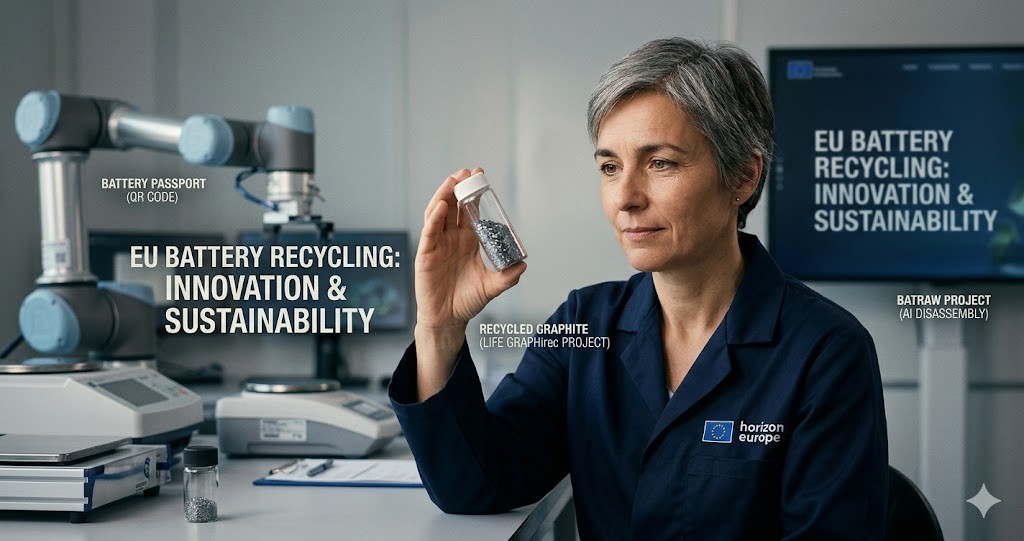
欧州連合(EU)は、強力な規制枠組み(バッテリー規則)と資金提供プロジェクトを通じて、バッテリーリサイクル業界の透明性、持続可能性、および技術革新を加速させています。これは、域内の資源自給率を高め、環境負荷を低減するための戦略的転換点となっています。
- 1. 欧州バッテリーパスポート規制:透明性の義務化
- 2. 技術革新を推進するEU資金提供プロジェクト
- 3. 関連情報:背景と補足(市場・政策の動向)
- Secondary Battery Lifecycle Management in Europe: Roadmap for Digital Passports and Minimum Recycled Content
- 1. EU Battery Passport Regulation: Mandatory Transparency
- 2. EU-Funded Projects Driving Technological Innovation
- 3. Related Information: Background and Market/Policy Trends
1. 欧州バッテリーパスポート規制:透明性の義務化
EU市場で販売される容量2kWhを超える産業用およびEV用バッテリーには、デジタル記録である「バッテリーパスポート」の取得が義務付けられます。
主要なスケジュールと要件
- 2027年:バッテリーパスポートの義務化
- 製品固有の識別子(QRコード等)の付帯。
- カーボンフットプリント、化学組成、耐久性、性能データの登録。
- 2028年8月:リサイクル含有量の報告義務
- コバルト、鉛、リチウム、ニッケルの使用量におけるリサイクル材の割合を記録。
- 2031年8月:最低リサイクル含有率の義務化
- リチウム: 6%
- コバルト: 16%
- ニッケル: 6%
- 鉛: 85%
材料回収率の法的ターゲット
使用済みバッテリーのリサイクルプロセスにおいて、以下の最低回収率が規定されています。
- リチウム: 50%以上
- 銅、ニッケル、コバルト: 90%以上
2. 技術革新を推進するEU資金提供プロジェクト
技術的な障壁を克服し、経済性を高めるために複数のパイロットプロジェクトが進行しています。
BATRAWプロジェクト(Horizon Europe資金提供)
17の組織が参加し、バッテリー部品のリサイクル率を最大98%まで引き上げることを目指しています。
- AIとロボティクス: AIベースの認識システムや協働ロボット(コボット)による半自動解体技術を開発。
- ブロックチェーン: サプライチェーン全体のトレーサビリティを保証するデジタルパスポート基盤を構築。
- 拠点: スペインとフランスに最新のパイロットプラントを設置。
LIFE GRAPhiRECプロジェクト(CINEA資金提供)
これまで注目度の低かった黒鉛(グラファイト)の回収に特化したプロジェクトです。
- LFP電池スクラップ: 製造廃棄物から純度の高い黒鉛を回収し、新品の電池へ再利用(目標回収率90%)。
- アルカリ電池: 使用済みアルカリ電池の残渣から黒鉛を抽出し、天然資源への依存を低減。
3. 関連情報:背景と補足(市場・政策の動向)
補足:新たなリサイクル効率の計算方法(EU 2025/606)
2025年に策定された補足規則により、リサイクル効率の検証方法が厳格化されました。
- 計算式: 暦年ごとのリサイクル出力分率(トン)を投入分率(トン)で割り、100を掛けて質量パーセント(質量%)を算出。
- これにより、メーカーによる「グリーンウォッシング(見せかけの環境配慮)」を防ぎ、正確なデータに基づく評価が可能になります。
業界へのインパクト
- 供給リスクの軽減: リチウム価格の高騰や地政学的リスクに対し、域内循環(サーキュラーエコノミー)を構築することで防波堤とします。
- サプライチェーンの透明性: 10年間の詳細なサプライチェーン記録の保管が求められ、一般公開も可能になるため、市場の信頼性が飛躍的に高まります。
欧州のこれらの取り組みは、世界のバッテリー市場における「事実上の標準(デファクトスタンダード)」となる可能性が高く、日本企業を含むグローバルメーカーにも対応が迫られています。
Secondary Battery Lifecycle Management in Europe: Roadmap for Digital Passports and Minimum Recycled Content
The European Union (EU) is accelerating transparency, sustainability, and technological innovation in the battery recycling industry through a robust regulatory framework (the Battery Regulation) and funded projects. This represents a strategic turning point aimed at increasing regional resource self-sufficiency and reducing environmental impact.
1. EU Battery Passport Regulation: Mandatory Transparency
Industrial and EV batteries with a capacity exceeding 2kWh sold in the EU market must obtain a “Battery Passport,” which serves as a digital record.
Key Schedules and Requirements
- 2027: Mandatory Battery Passports
- Attachment of a unique product identifier (such as a QR code).
- Registration of carbon footprint, chemical composition, durability, and performance data.
- August 2028: Mandatory Reporting of Recycled Content
- Recording the proportion of recycled materials used for cobalt, lead, lithium, and nickel.
- August 2031: Mandatory Minimum Recycled Content
- Lithium: 6%
- Cobalt: 16%
- Nickel: 6%
- Lead: 85%
Legal Targets for Material Recovery
The following minimum recovery rates are prescribed for the recycling process of end-of-life batteries:
- Lithium: 50% or more
- Copper, Nickel, and Cobalt: 90% or more
2. EU-Funded Projects Driving Technological Innovation
Multiple pilot projects are underway to overcome technical barriers and improve economic viability.
BATRAW Project (Funded by Horizon Europe)
Involving 17 organizations, this project aims to increase the recycling rate of battery components to up to 98%.
- AI and Robotics: Developing semi-automated dismantling technology using AI-based recognition systems and collaborative robots (cobots).
- Blockchain: Building a digital passport infrastructure to ensure full traceability across the entire supply chain.
- Locations: Establishment of state-of-the-art pilot plants in Spain and France.
LIFE GRAPhiREC Project (Funded by CINEA)
A project specialized in the recovery of graphite, which has previously received relatively little attention.
- LFP Battery Scrap: Recovering high-purity graphite from manufacturing waste for reuse in new batteries (target recovery rate: 90%).
- Alkaline Batteries: Extracting graphite from the residues of used alkaline batteries to reduce dependence on natural resources.
3. Related Information: Background and Market/Policy Trends
Supplemental: New Calculation Method for Recycling Efficiency (EU 2025/606)
A supplemental regulation established in 2025 has tightened the verification methods for recycling efficiency.
- Calculation Formula: Calculated as a mass percentage (mass %) by dividing the recycling output fraction (tonnes) per calendar year by the input fraction (tonnes) per calendar year, then multiplying by 100.
- This prevents “greenwashing” by manufacturers and enables evaluations based on accurate data.
Impact on the Industry
- Mitigation of Supply Risks: Building a circular economy within the region acts as a buffer against skyrocketing lithium prices and geopolitical risks.
- Supply Chain Transparency: Detailed supply chain records must be maintained for 10 years and can be made available to the public upon request, significantly increasing market trust.
These European initiatives are likely to become the “de facto standard” in the global battery market, requiring global manufacturers to adapt.


コメント