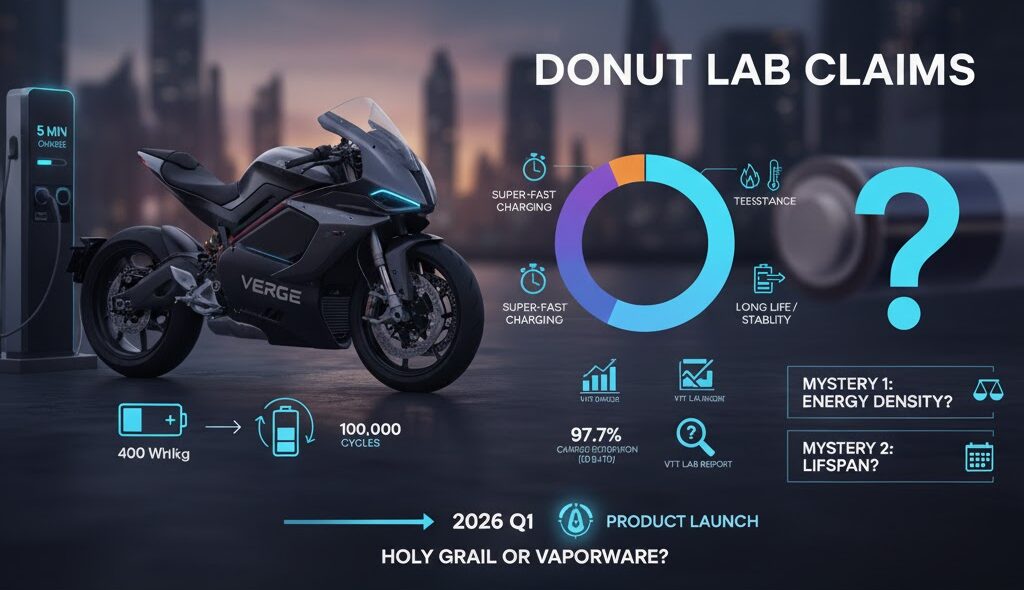
フィンランドの電動バイクメーカーVerge Motorcyclesの関連会社、Donut Labが開発した「全固体電池」を巡る議論が深まっています。公称スペック(400 Wh/kg、5分充電、10万サイクル寿命)が「物理的に不可能」と批判される中、第3次となる第三者機関の検証結果が公開されました。
1. 「スーパーキャパシタ説」への反証
Donut Labの主張する超急速充電や長寿命といった特性が、二次電池よりも「スーパーキャパシタ(大容量コンデンサ)」に近いとの疑念に対し、フィンランド国立VTT技術研究センターが自己放電テストを実施しました。
- 検証内容: 26.5 Ahのセル(DL1)を50%まで充電し、室温(摂氏22から28度)で240時間(10日間)放置。
- 結果: 10日後の電荷保持率は97.7%。電圧降下は最初の1時間で103 mVあったものの、その後の10日間ではわずか12 mV(3,745 mVから3,733 mV)に留まりました。
- 結論: 急激に自己放電するスーパーキャパシタとは異なり、電気化学的に極めて安定した「バッテリー」としての特性を持っていることが証明されました。
2. 意図的な情報公開戦略
Donut Labはこれまでに3段階の検証結果を公開し、全固体電池特有の「エンジニアリング上の利点」を証明してきました。
- 第1回: 11Cレートの超急速充電(4.5分で80%充電)
- 第2回: 高温耐性(摂氏100度での正常動作と熱暴走抑制)
- 第3回: 今回の自己放電特性(電荷保持の安定性)
これらは全固体電池であれば達成しうる項目ですが、専門家が最も注目する「物理的な限界」についての証明は避けているとの指摘もあります。
3. 残された「最大の謎」:エネルギー密度と寿命
今回の報告書を含め、これまで公開されたデータには、最も重要な2つの「物理的課題」に関する具体的な裏付けが欠落しています。
- エネルギー密度 (400 Wh/kg): 検証に使用されたセルの重量や寸法が非公開のため、外部からの逆算が不可能です。既存リチウムイオン電池(200から300 Wh/kg)を大幅に上回る数値の信憑性が問われています。
- サイクル寿命 (10万回): 一般的な電池(1,500から3,000回)を遥かに凌駕する寿命について、第三者による長期検証データは示されていません。
4. モビリティ市場への衝撃と迫る期限
Verge MotorcyclesのCEOは、この電池を搭載した「Verge TS Pro」を2026年第1四半期に出荷すると明言しています。
- 市場破壊の可能性: 主張が真実であれば、充電待ち、航続距離、火災リスクというEVの弱点を一掃し、数兆ドル規模のサプライチェーンを塗り替えます。
- 製造コストと環境: 希少金属(コバルト、ニッケル等)に依存せず低コストで量産可能としていますが、工場の所在地や具体的な化学組成は依然として不明です。
【関連情報】全固体電池とスーパーキャパシタの挙動の違い
本件の理解を深めるための、一般的な物理的特性の比較です。
| 特性 | スーパーキャパシタ | 一般的なリチウムイオン電池 | Donut Labの公称値 |
| エネルギー密度 | 低い (5から10 Wh/kg) | 中程度 (200から300 Wh/kg) | 極めて高い (400 Wh/kg) |
| 充電時間 | 秒単位 | 30分から数時間 | 5分以内 |
| サイクル寿命 | 数十万回 | 1,500から3,000回 | 100,000回 |
| 自己放電率 | 高い (数日で大幅減少) | 低い (月間1から3%) | 非常に低い (10日間で2.3%) |
今後の焦点:
Verge Motorcyclesが設定した2026年Q1のデッドラインは目前です。製品が実際に市場へ投入され、公称通りの性能が発揮されるかどうかが、この技術が「聖杯」か「ベーパーウェア(誇大宣伝)」かを決める最後の審判となります。
出典:https://xenospectrum.com/donut-lab-solid-state-battery-vtt-test-analysis-2/
Donut Lab Solid-State Battery Passes Self-Discharge Test: Supercapacitor Allegations Completely Refuted
Debate is intensifying over the “solid-state battery” developed by Donut Lab, an affiliate of the Finnish electric motorcycle manufacturer Verge Motorcycles. While critics have labeled its claimed specifications (400 Wh/kg, 5-minute charging, 100,000-cycle life) as “physically impossible,” the results of a third-party validation have been released.
1. Rebuttal to the “Supercapacitor Theory”
To address suspicions that Donut Lab’s technology is actually a supercapacitor rather than a secondary battery, the VTT Technical Research Centre of Finland conducted a self-discharge test.
- Test Methodology: A 26.5 Ah cell (DL1) was charged to 50% and left for 240 hours (10 days) at room temperature (22 to 28 degrees Celsius).
- Results: The charge retention rate after 10 days was 97.7%. While there was an initial voltage drop of 103 mV in the first hour, the subsequent drop over 10 days was only 12 mV (from 3,745 mV to 3,733 mV).
- Conclusion: The device demonstrated the electrochemical stability of a “battery,” contrasting sharply with supercapacitors, which typically discharge rapidly.
2. Strategic Information Disclosure
Donut Lab has released validation results in three stages, proving “engineering advantages” inherent to solid-state technology:
- Stage 1: Ultra-fast charging at an 11C rate (80% charge in 4.5 minutes).
- Stage 2: High-temperature resistance (normal operation at 100 degrees Celsius and suppression of thermal runaway).
- Stage 3: This self-discharge characteristic (stability of charge retention).
While these are impressive, experts point out that the company is still avoiding proof regarding the most controversial “physical limits.”
3. The “Greatest Mystery”: Energy Density and Longevity
The data released so far lacks concrete evidence for the two most critical physical challenges:
- Energy Density (400 Wh/kg): Since the weight and dimensions of the tested cells remain undisclosed, external verification is impossible. The credibility of this figure, which far exceeds current lithium-ion batteries (200 to 300 Wh/kg), remains in question.
- Cycle Life (100,000 cycles): No third-party long-term validation data has been provided for this lifespan, which dwarfs the 1,500 to 3,000 cycles of standard batteries.
4. Market Impact and Approaching Deadline
The CEO of Verge Motorcycles has publicly stated that the Verge TS Pro, equipped with this battery, will ship in Q1 2026.
- Market Disruption: If the claims are true, it would eliminate range anxiety, charging wait times, and fire risks, reshaping the multi-trillion-dollar EV supply chain.
- Cost and Environment: While the company claims low-cost mass production without relying on rare metals like cobalt or nickel, the factory location and chemical composition remain unknown.
[Related Information] Comparison: Supercapacitors vs. Solid-State Batteries
| Feature | Supercapacitor | Standard Li-ion Battery | Donut Lab (Claimed) |
| Energy Density | Low (5 to 10 Wh/kg) | Mid (200 to 300 Wh/kg) | Very High (400 Wh/kg) |
| Charging Time | Seconds | 30 mins to hours | Under 5 mins |
| Cycle Life | Hundreds of thousands | 1,500 to 3,000 | 100,000 |
| Self-discharge | High (days) | Low (1 to 3% per month) | Very Low (2.3% per 10 days) |
Future Outlook:
The Q1 2026 deadline set by Verge Motorcycles is nearly here. Whether the product actually hits the market and performs as claimed will be the final judgment on whether this technology is the “Holy Grail” or “Vaporware.”


コメント