全固体電池(ASSB)は、従来のリチウムイオン電池が抱えていた安全性の課題を克服する次世代のエネルギー貯蔵技術です。可燃性の液体電解質を、高いイオン伝導性と機械的強度を持つ本質的に安定なセラミック固体電解質(SE)(特に硫化物系材料)に置き換えることで、極めて安全で高出力な電池アーキテクチャが実現します。
さらに高いエネルギー密度を追求する中で、近年「アノードレス全固体電池(ALASSB)」という最先端設計が注目を集めています。これはアノード(負極)活物質を完全に取り除き、集電体に直接金属リチウム(Li)を析出させることで、エネルギー密度を最大化し、同時に製造プロセスを大幅に簡素化する技術です。
しかし、高容量システムにおけるALASSBの実用化は、充電時に金属Liが樹枝状に成長する「デンドライト現象」によって引き起こされる内部短絡(ショート)という深刻な課題に直面しています。これまでのアノード保護戦略では、リチウム親和性金属を用いて合金化反応を制御し、核生成過電圧を下げるアプローチが取られてきましたが、これらの層はリチウム貯蔵容量が本質的に限られており、高容量条件下での長期的な有効性に課題がありました。また、製造プロセスが複雑化し、アノードレス本来のメリットである「製造の簡素化」が損なわれるという矛盾も生じていました。
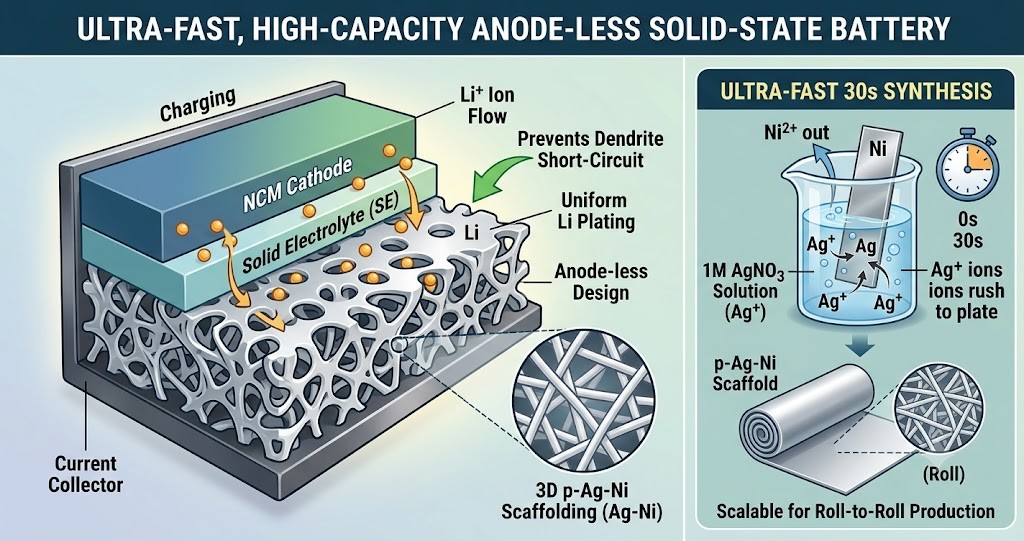
ソウル大学校(Seoul National University)を中心とする研究チームは、この課題を解決するため、単純かつスケーラブルな「イオン交換法」を用いた3次元(3D)リチウム親和性多孔質足場の合成技術を提案します。ニッケルと銀の酸化還元電位の差を利用することで、わずか30秒という超高速プロセスで高多孔性銀-ニッケル(p-Ag-Ni)足場を構築することに成功しました。この足場は、極めて広い電気化学的活性表面積と相互接続されたナノファイバーネットワークを提供し、均一なLi析出を促進してデンドライトの貫通を抑制します。これにより、実用的な高容量条件下や低スタック圧力下でも、極めて安定したサイクル特性を実現しています。
1. 合成プロセスと材料特性
- 超高速合成メカニズム: ニッケル(Ni)基板(-0.25 V vs. SHE)を、銀(Ag)イオン(0.8 V vs. SHE)を豊富に含む水溶液に浸漬するだけで、2つの金属の固有の還元電位差によって駆動される自発的なガルバニック置換反応(イオン交換反応)が始まります。これにより、わずか30秒以内にNi層上にAg金属が析出し、3D足場が形成されます。
- 水溶液濃度の最適化: 比較的高い濃度(1 M)の硝酸銀(AgNO3)溶液を使用することで反応速度が加速され、表面積の大きい樹枝状の成長(ナノファイバー化)が促進されます。これは、低濃度(0.5 M)溶液で作成した場合よりも、サイクル中の早期の内部短絡を効果的に防ぐことが実証されています。
- 微細構造と結晶性: * 走査型電子顕微鏡(SEM)およびX線回折(XRD)により、得られたp-Ag-Ni足場は、平均厚さ300 nmの不規則に配置されたAgナノファイバーで構成され、主にAg(111)面と(220)面で構成されていることが確認されました。
- p-Ag-Ni層の総厚は約20マイクロメートルであり、その内部は大部分が空隙(細孔)で構成された3Dネットワークとなっており、大量のLi析出を安定して収容するのに十分な容量を持っています。
2. 電気化学的性能とメカニズムの解明
- 驚異的なLi貯蔵能力: ハーフセル構成(Li6PS5Cl 硫化物固体電解質を使用)において、p-Ag-Ni足場は内部短絡を起こすことなく、35 mAh/cm2という極めて高い面積容量まで安定して連続的なLiめっき(析出)をサポートしました。
- インサイチュ(その場)抵抗モニタリング: リチウムの析出が進行する間、その場電気化学インピーダンス分光法(in situ EIS)およびクロノポテンショメトリーを用いて測定したところ、バルク抵抗(Rb)および全抵抗(Rtotal)はプロセス全体を通じて一貫して安定しており、デンドライトの侵入による抵抗の劇的な低下(短絡の兆候)は見られませんでした。
- 長期的サイクル安定性: 最適化されたp-Ag-Niフレームワークは、異なる容量レベルにおいて優れためっき-剥離(充放電)可逆性を示しました。
- 0.5 mAh/cm2: 550サイクルにわたり安定。
- 1.0 mAh/cm2: 300サイクルにわたり安定。
- 3.5 mAh/cm2: 100サイクルにわたり安定(初期クーロン効率 86.3%、電圧スパイクや短絡なしで700時間の動作を達成)。
- 5.0 mAh/cm2: 30サイクルにわたり安定(初期クーロン効率 89.4%)。
- 従来技術に対する優位性: スラリーキャスト法で作製したAgナノワイヤーやAgナノ粒子、およびマグネシウム(Mg)ナノ粒子を用いた代替システムと比較して、p-Ag-Niは圧倒的に高いクーロン効率と長寿命を示しました。これは、p-Ag-Niの高い表面積と明確な多孔質構造が、Liの安定した収容に不可欠であることを示しています。
3. フルセルおよびパウチセルによる実証
- 高負荷フルセル特性: LiNbO3でコーティングされたLiNi0.8Co0.1Mn0.1O2(NCM811)正極と組み合わせ、20 mg NCM/cm2という高い正極負荷量で実施したフルセル評価では、以下の優れた結果を示しました。
- 0.1C(1C = 4.0 mA/cm2)での初期形成サイクルにおいて、84.6%の良好な初期クーロン効率(ICE)と185 mAh/gの可逆容量を達成。
- 電流密度を0.5C(2.0 mA/cm2)に高めた高レートテストでも、128 mAh/gの高い容量を維持。
- 0.33Cでの100サイクルの連続充放電後も初期容量の81%を維持し、面積容量2.9 mAh/cm2の高容量ALASSBの実装に成功。
- 低スタック圧力下でのパウチセル動作: 通常、室温動作のALASSBは、Liの均一な析出と機械的接触を維持するために高スタック圧力(20 MPa以上)を必要とします。しかし、p-Ag-Ni足場を用いたパウチセルは、わずか3 MPaという非常に穏やかな圧力下(25度)でも正常に動作しました。
- 50サイクル動作後も84%の容量を維持し、2.7 mAh/cm2という高い面積容量を達成。
- これは、高い表面積が豊富なLi核生成サイトを提供し、3Dホスト構造がリチウムを内部に収容することでマクロな体積膨張を抑制し、低圧でもセル構造の完全性を保てるためです。
■ 関連情報の追加(背景と技術的文脈の解説)
1. なぜアノードレスにおいて「Ag(銀)ベースの3D足場」が有効なのか?
リチウム親和性(リチウムとなじみやすい)を持つ金属の中でも、銀(Ag)はリチウムとの間に広い固溶体(合金)領域を持つため、極めて優れた特性を示します。従来のカーボン-Ag複合体や、酸化亜鉛(ZnO)を用いた構造では、平面的、あるいは限られた表面積しか持たなかったため、保護層の上や下で局所的なLiの核生成が起こり、結果として不均一な成長を招いていました。
これを3次元の「足場(スカフォールド)」構造にすることで、リチウムが析出できる空間体積が飛躍的に広がります。本研究で行われたX線顕微鏡(XRM)による3D断層撮影とカラーマッピングでは、充電時にLiがp-Ag-Ni足場の下部領域から優先的に蓄積し、最上部にはまだ空隙が残されている様子が可視化されました。これは、設計された3D構造が高容量の負荷に対して十分な構造的マージン(ゆとり)を持っていることを証明しています。
2. 低圧動作における容量劣化メカニズムの考察
本研究のp-Ag-Ni足場は3 MPaという低圧で動作する点で画期的ですが、高圧動作時に比べると容量の劣化速度は速いままです。研究チームが30サイクル後のパウチセルを解析したところ、固体電解質層とAg層の界面はきれいに保たれているものの、完全放電後もAg表面に一部のLiが残留していることが判明しました。
これは、充放電に伴う局所的な体積変化により、リチウムの一部が電気的・イオン的な経路から孤立し、「デッドリチウム(不活性なリチウム)」に変化したことが容量劣化の主因であることを示唆しています。p-Ag-Niの多孔質構造は体積膨張を効果的に抑制しますが、低圧下でこの変化を完全に吸収するにはまだ不十分であり、今後の実用化に向けては、この足場に加えて「弾性緩衝層(クッション層)」を組み合わせるアプローチが有効であると考えられます。
3. 産業・商業的価値(スケールアップの容易さ)
従来の3D足場作製技術(エレクトロスピニング法など)は、プロセスが複雑で時間がかかるため、既存のリチウムイオン電池製造で標準となっているロールツーロール(Roll-to-Roll)方式の連続大量生産ラインに組み込むことが困難でした。しかし、本研究が提示した「30秒間の浸漬によるイオン交換プロセス」は、室温・短時間・簡便な化学反応のみで完結します。異種金属間の自然な電位差という熱力学的な駆動力を利用しているため、製造コストを低く抑えつつ、大面積の高性能アノードを高速に製造できる可能性を秘めており、ALASSBの商業化を大きく手繰り寄せ技術です。
■ 結論
本研究は、高容量アノードレス全固体電池(ALASSB)の実現に向け、3Dリチウム親和性多孔質足場を極めて迅速かつ効率的に合成する革新的なイオン交換戦略を実証しました。開発されたp-Ag-Ni足場は、35 mAh/cm2という卓越したリチウム貯蔵能力を示し、内部短絡を徹底的に防ぎながら、フルセルでの高負荷サイクルや、実用化の鍵となる低スタック圧力(3 MPa)でのパウチセル動作に成功しました。このシンプルかつ普遍的な合成手法は、他の様々な材料系にも応用可能であり、次世代の超高エネルギー密度・安全なエネルギー貯蔵デバイスの量産化に向けた明確な道筋を提示しています。
出典:https://pubs.rsc.org/en/content/articlelanding/2026/eb/d6eb00063k
Ultrafast Synthesis and Evaluation of p-Ag-Ni Porous Scaffolds for Anodeless All-Solid-State Batteries
All-solid-state batteries (ASSBs) represent a next-generation energy storage technology capable of overcoming the safety challenges inherent in conventional lithium-ion batteries. By replacing volatile, flammable liquid electrolytes with inherently stable ceramic solid electrolytes (SEs)—particularly sulfide-based materials featuring high ionic conductivity and mechanical strength—an exceptionally safe and high-power battery architecture can be realized.
In the pursuit of even higher energy densities, a cutting-edge design known as the “Anodeless All-Solid-State Battery (ALASSB)” has attracted significant attention in recent years. This technology completely eliminates the anode active material and deposits metallic lithium (Li) directly onto the current collector, thereby maximizing energy density while substantially streamlining the manufacturing process.
However, the practical application of high-capacity ALASSBs faces a severe bottleneck: internal short circuits caused by “dendrite formation,” where metallic Li grows in a needle-like fashion during charging. Conventional anode protection strategies have attempted to control alloying reactions and lower nucleation overpotential by utilizing lithiophilic metals. However, these layers suffer from inherently limited lithium storage capacity, presenting long-term effectiveness issues under high-capacity conditions. Furthermore, these complex fabrication methods compromise the manufacturing simplicity that makes anodeless architectures inherently attractive.
To address these challenges, a research team led by Seoul National University has proposed a simple and scalable synthesis technique for a three-dimensional (3D) lithiophilic porous scaffold using an “ion-exchange method.” By leveraging the redox potential difference between nickel and silver, they successfully constructed a highly porous silver-nickel (p-Ag-Ni) scaffold through an ultrafast process taking just 30 seconds. This scaffold delivers an exceptionally large electrochemically active surface area and an interconnected nanofiber network, promoting uniform Li deposition and suppressing dendrite penetration. As a result, it achieves remarkably stable cycling characteristics even under practical high-capacity conditions and low stack pressures.
1. Synthesis Process and Material Characteristics
- Ultrafast Synthesis Mechanism: Immersing a nickel (Ni) substrate (-0.25 V vs. SHE) into an aqueous solution rich in silver (Ag) ions (0.8 V vs. SHE) triggers a spontaneous galvanic replacement reaction (ion-exchange reaction) driven by the inherent reduction potential difference between the two metals. This results in the deposition of Ag metal onto the Ni layer within just 30 seconds, forming a 3D scaffold.
- Optimization of Solution Concentration: Utilizing a relatively high concentration (1 M) of silver nitrate (AgNO3) solution accelerates the reaction rate and promotes high-surface-area dendritic growth (nanofiber formation). This approach has been proven to effectively prevent premature internal short circuits during cycling compared to scaffolds fabricated with a lower concentration (0.5 M) solution.
- Microstructure and Crystallinity: Scanning electron microscopy (SEM) and X-ray diffraction (XRD) confirm that the resulting p-Ag-Ni scaffold consists of randomly arranged Ag nanofibers with an average thickness of 300 nm, predominantly exhibiting Ag(111) and (220) crystal planes. The total thickness of the p-Ag-Ni layer is approximately 20 micrometers, and its interior forms a 3D network composed mostly of voids (pores), providing ample capacity to stably accommodate large amounts of Li deposition.
2. Electrochemical Performance and Mechanistic Elucidation
- Exceptional Li Storage Capacity: In a half-cell configuration using a Li6PS5Cl sulfide solid electrolyte, the p-Ag-Ni scaffold successfully supported continuous, stable Li plating up to an ultra-high areal capacity of 35 mAh/cm2 without suffering from internal short circuits.
- In Situ Resistance Monitoring: In situ Electrochemical Impedance Spectroscopy (EIS) and chronopotentiometry conducted during ongoing lithium deposition revealed that both the bulk resistance (Rb) and total resistance (Rtotal) remained highly stable throughout the entire process. No sudden drops in resistance—which would indicate dendritic penetration or short circuits—were observed.
- Long-Term Cycling Stability: The optimized p-Ag-Ni framework demonstrated outstanding plating-stripping (charge-discharge) reversibility across various capacity thresholds:
- 0.5 mAh/cm2: Stable for 550 cycles.
- 1.0 mAh/cm2: Stable for 300 cycles.
- 3.5 mAh/cm2: Stable for 100 cycles (achieving an initial coulombic efficiency of 86.3% and operating successfully for 700 hours without overvoltage spikes or short circuits).
- 5.0 mAh/cm2: Stable for 30 cycles (initial coulombic efficiency of 89.4%).
- Superiority Over Conventional Technologies: Compared to alternative systems utilizing slurry-cast Ag nanowires, Ag nanoparticles, or magnesium (Mg) nanoparticles, the p-Ag-Ni scaffold exhibited overwhelmingly higher coulombic efficiency and longer lifespan. This demonstrates that the large surface area and distinct porous structure of p-Ag-Ni are indispensable for stable Li accommodation.
3. Full-Cell and Pouch-Cell Validation
- High-Loading Full-Cell Characteristics: When paired with a LiNbO3-coated LiNi0.8Co0.1Mn0.1O2 (NCM811) cathode at a high mass loading of 20 mg NCM/cm2, full-cell evaluations delivered the following outstanding results:
- Achieved a favorable Initial Coulombic Efficiency (ICE) of 84.6% and a reversible capacity of 185 mAh/g during the initial formation cycle at a 0.1C rate (1C = 4.0 mA/cm2).
- Maintained a high capacity of 128 mAh/g even in a high-rate test where the current density was increased to 0.5C (2.0 mA/cm2).
- Retained 81% of its initial capacity after 100 continuous charge-discharge cycles at 0.33C, successfully implementing a high-capacity ALASSB with an areal capacity of 2.9 mAh/cm2.
- Low Stack Pressure Pouch-Cell Operation: Standard room-temperature ALASSBs typically require high stack pressures (greater than 20 MPa) to maintain uniform Li deposition and mechanical contact. In contrast, the pouch cell using the p-Ag-Ni scaffold operated successfully under an exceptionally mild pressure of just 3 MPa at 25 degrees Celsius. It maintained 84% capacity after 50 cycles, achieving a high areal capacity of 2.7 mAh/cm2. This success is attributed to the large surface area providing abundant Li nucleation sites, and the 3D host structure accommodating lithium internally to suppress macroscopic volume expansion, thereby preserving cell structural integrity even under low pressure.
■ Additional Information: Background and Technical Context
1. Why Are Ag-Based 3D Scaffolds Effective in Anodeless Architectures?
Among various lithiophilic metals, silver (Ag) exhibits exceptional properties due to its broad solid-solubility (alloying) range with lithium. Conventional configurations, such as carbon-Ag composites or structures utilizing zinc oxide (ZnO), offered only planar or limited surface areas. This caused localized Li nucleation above or below the protective layer, ultimately leading to non-uniform growth.
Transforming this into a three-dimensional “scaffold” structure drastically expands the spatial volume available for lithium deposition. 3D tomography and color mapping via X-ray microscopy (XRM) performed in this study visualized that Li preferentially accumulates from the lower region of the p-Ag-Ni scaffold during charging, leaving open voids near the top. This proves that the engineered 3D structure possesses a robust structural margin capable of handling heavy areal loads.
2. Insights into the Capacity Degradation Mechanism under Low-Pressure Operation
While the p-Ag-Ni scaffold is groundbreaking for its ability to operate at a low pressure of 3 MPa, its capacity degradation rate remains faster compared to high-pressure operations. When the research team analyzed the pouch cell after 30 cycles, they found that although the interface between the solid electrolyte layer and the Ag layer remained clean, some Li was left behind on the Ag surface even after a full discharge.
This suggests that localized volume changes during charging and discharging isolate a portion of the lithium from its electrical and ionic pathways, converting it into “dead lithium” (inactive lithium), which serves as the primary cause of capacity degradation. Although the porous structure of p-Ag-Ni effectively curtails volume expansion, it is not yet sufficient to fully absorb these changes under low pressure. For future practical applications, an approach combining this scaffold with an “elastic buffer layer” (cushion layer) is considered highly promising.
3. Industrial and Commercial Value: Ease of Scaling Up
Traditional 3D scaffold fabrication techniques, such as electrospinning, involve complex and time-consuming processes, making them difficult to integrate into the continuous Roll-to-Roll mass production lines that are standard in conventional lithium-ion battery manufacturing. However, the immersion-based ion-exchange process presented in this study is completed entirely through a simple chemical reaction at room temperature in just 30 seconds. By harnessing the natural thermodynamic drive of potential differences between dissimilar metals, this technology holds the potential to rapidly manufacture large-area, high-performance anodes while keeping production costs low, significantly accelerating the commercialization of ALASSBs.
■ Conclusion
This study successfully demonstrates an innovative, highly rapid, and efficient ion-exchange strategy to synthesize a 3D lithiophilic porous scaffold, paving the way for high-capacity anodeless all-solid-state batteries (ALASSBs). The developed p-Ag-Ni scaffold delivers an outstanding lithium storage capacity of 35 mAh/cm2. While thoroughly preventing internal short circuits, it enables high-load cycling in full cells and achieves successful pouch-cell operation under a low stack pressure of 3 MPa, a vital key to practical implementation. This simple yet universal synthesis method can be applied to various other material systems, offering a clear path forward for the mass production of next-generation, ultra-high-energy-density, and safe energy storage devices.


コメント