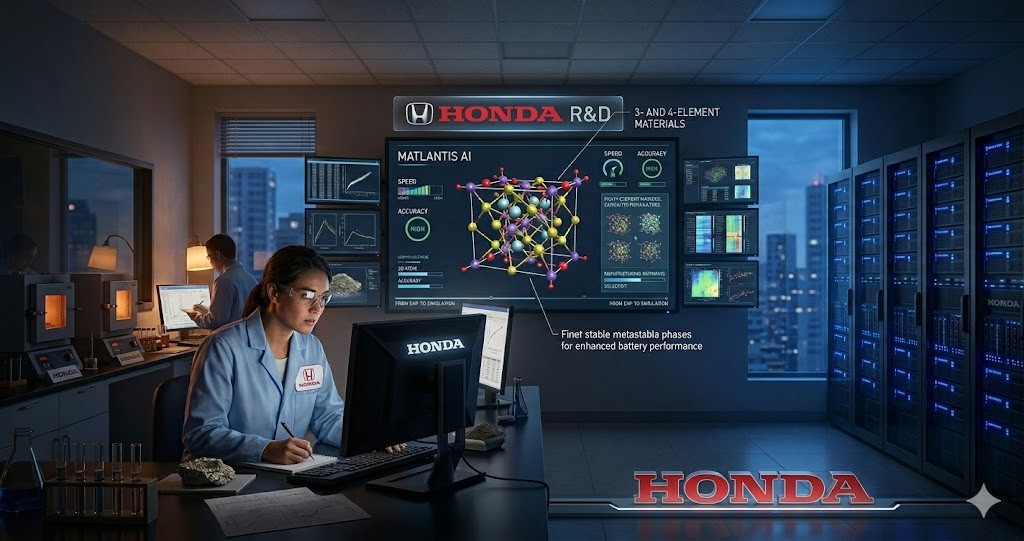
ホンダR&Dは、従来の「試行錯誤」による実験主導型の開発から、Matlantisとの協業を通じてAIと計算科学を駆使した「ハイスループットスクリーニング(高速自動選別)」へと舵を切っています。特に、三元系(3つの元素からなる)や四元系(4つの元素からなる)といった、より複雑で高性能な材料の探索に主眼を置いています。
1. 従来の課題とAIによる解決
従来の材料開発には、膨大な時間とコストがかかっていました。特に多成分系材料は組み合わせが天文学的数字になるため、すべてを実際に合成して試すことは不可能でした。
- Matlantisの役割: 汎用機械学習原子間ポテンシャル(MLIP)を活用した計算プラットフォームを提供。
- 技術的利点: 密度汎関数理論(DFT)と同等の高精度を維持しつつ、計算速度を飛躍的に向上。これにより、結晶構造のエネルギー評価を数秒から数分で完了させることが可能。
- 成果: 物理的な合成実験を行う前の極めて早い段階で、有望な候補を絞り込む「探索効率」が劇的に向上しました。
2. 注目される「三元系・四元系材料」と準安定相
ホンダが多成分系材料に注力する理由は、従来の単純な組成では到達できない「高エネルギー密度」と「安全性」の両立にあります。
- 三元系・四元系: 複数の元素を組み合わせることで、材料の安定性やリチウムイオンの伝導性を精密に制御。
- 準安定相の活用: 自然界で最も安定した状態ではないが、特定の条件下で存在し、優れた性能を発揮する「準安定相」の特定にAIが寄与。これにより、従来の常識を超えたバッテリー性能の引き出しを狙います。
3. 量産化と信頼性への橋渡し
AIは単なる「材料探し」だけでなく、工場での「作りやすさ(製造可能性)」の予測にも貢献します。
- 相分離と安定範囲の計算: 物理的な製造を開始する前に、どの温度や組成範囲で材料が安定するかを理論的に算出。
- 再現性の確保: 理論値を製造条件に反映させることで、複雑な多成分材料でも一貫した品質での量産を可能にします。
- 【補足】次世代バッテリー開発を巡る関連動向
- まとめ:ホンダの戦略的メリット
- Honda Dramatically Shortens EV Battery Development Time via AI: Shifting from Trial and Error to Computational Screening
【補足】次世代バッテリー開発を巡る関連動向
記事の内容をより深く理解するための、業界の技術背景と関連トレンドです。
三元系(NMCなど)と四元系(NCMAなど)の基礎
現在主流の三元系(Nickel Manganese Cobalt / NMC)に加え、アルミニウムなどを加えた四元系(Nickel Cobalt Manganese Aluminum / NCMA)が注目されています。
- メリット: ニッケル比率を高めて容量を増やしつつ、他元素で構造を安定させることで、熱暴走のリスクを抑え、サイクル寿命を延ばすことができます。
計算化学の進化:DFTからMLIPへ
- DFT (Density Functional Theory): 電子の動きを量子力学的に計算する手法。精度は高いが計算負荷が非常に高く、大規模なスクリーニングには不向きでした。
- MLIP (Machine Learning Interatomic Potentials): 過去の膨大なDFT計算結果をAIに学習させたもの。DFTに近い精度を保ちながら、計算速度を数万倍に高めることができるため、材料探索のゲームチェンジャーとなっています。
グローバルな競争とリサイクル
EV普及に伴い、リチウムやコバルトといった資源の確保が地政学的な課題となっています。EUなどの規制強化により、新材料の開発と同時に「リサイクルのしやすさ」や「低コバルト・コバルトフリー」の実現も、AI探索の重要な目的の一つとなっています。
まとめ:ホンダの戦略的メリット
ホンダはMatlantisとの協業により、以下の3点を実現しようとしています。
- スピード: 開発期間の大幅な短縮。
- 性能: 複雑な組成によるエネルギー密度の限界突破。
- 柔軟性: 車両仕様の変化に対し、最適な材料を計算によって迅速に提示できる体制の構築。
これにより、競争が激化するEV市場において、技術的な優位性を維持することを目指しています。
Honda Dramatically Shortens EV Battery Development Time via AI: Shifting from Trial and Error to Computational Screening
Honda R&D is shifting its focus from traditional “trial and error” experiment-led development to “high-throughput screening” powered by AI and computational science through its collaboration with Matlantis. The primary focus is on exploring complex, high-performance materials, specifically ternary systems (consisting of three elements) and quaternary systems (consisting of four elements).
1. Traditional Challenges and AI-Powered Solutions
Traditional material development required immense time and cost. In particular, the number of possible combinations for multi-component materials is astronomical, making it impossible to synthesize and test every option physically.
- Role of Matlantis: Provides a computational platform utilizing Universal Machine Learning Interatomic Potentials (MLIP).
- Technical Advantage: Dramatically increases calculation speed while maintaining high accuracy comparable to Density Functional Theory (DFT). This allows energy evaluations of crystal structures to be completed in seconds to minutes.
- Outcome: “Discovery efficiency”—the ability to narrow down promising candidates at an extremely early stage before physical synthesis—has improved drastically.
2. Focus on Ternary/Quaternary Materials and Metastable Phases
Honda is focusing on multi-component materials to achieve a balance between high energy density and safety, which cannot be reached with traditional simple compositions.
- Ternary and Quaternary Systems: Precise control of material stability and lithium-ion conductivity by combining multiple elements.
- Utilization of Metastable Phases: AI contributes to identifying “metastable phases”—states that are not the most stable in nature but exist under specific conditions and exhibit superior performance. This aims to unlock battery performance beyond conventional limits.
3. Bridging to Mass Production and Reliability
AI contributes not only to “material discovery” but also to predicting “manufacturability” at the factory level.
- Calculation of Phase Separation and Stability Ranges: Theoretically calculating the temperature and composition ranges where a material remains stable before starting physical production.
- Ensuring Reproducibility: By reflecting theoretical values into manufacturing conditions, Honda ensures consistent quality in the mass production of complex multi-component materials.
[Supplementary Information] Related Trends in Next-Generation Battery Development
To better understand the context, here are the technical backgrounds and industry trends:
Basics of Ternary (e.g., NMC) and Quaternary (e.g., NCMA) Systems
In addition to the currently mainstream ternary systems (Nickel Manganese Cobalt / NMC), quaternary systems (Nickel Cobalt Manganese Aluminum / NCMA), which add aluminum, are gaining attention.
- Benefits: By increasing the nickel ratio to boost capacity while stabilizing the structure with other elements, manufacturers can suppress thermal runaway risks and extend cycle life.
Evolution of Computational Chemistry: From DFT to MLIP
- DFT (Density Functional Theory): A method to calculate electron behavior based on quantum mechanics. While highly accurate, the computational load is extremely high, making it unsuitable for large-scale screening.
- MLIP (Machine Learning Interatomic Potentials): AI models trained on vast amounts of past DFT calculation results. They act as a game-changer in material exploration by maintaining accuracy close to DFT while increasing calculation speeds by tens of thousands of times.
Global Competition and Recycling
With the spread of EVs, securing resources like lithium and cobalt has become a geopolitical challenge. Due to stricter regulations (such as those in the EU), developing new materials while achieving “ease of recycling” and “low-cobalt or cobalt-free” compositions has become a key objective for AI-driven exploration.
Summary: Honda’s Strategic Advantages
Through its collaboration with Matlantis, Honda aims to achieve the following:
- Speed: Significant reduction in development lead times.
- Performance: Breaking through energy density limits using complex compositions.
- Flexibility: Establishing a system to quickly propose optimal materials via computation in response to changing vehicle specifications.
By doing so, Honda aims to maintain a technical advantage in the increasingly competitive EV market.


コメント