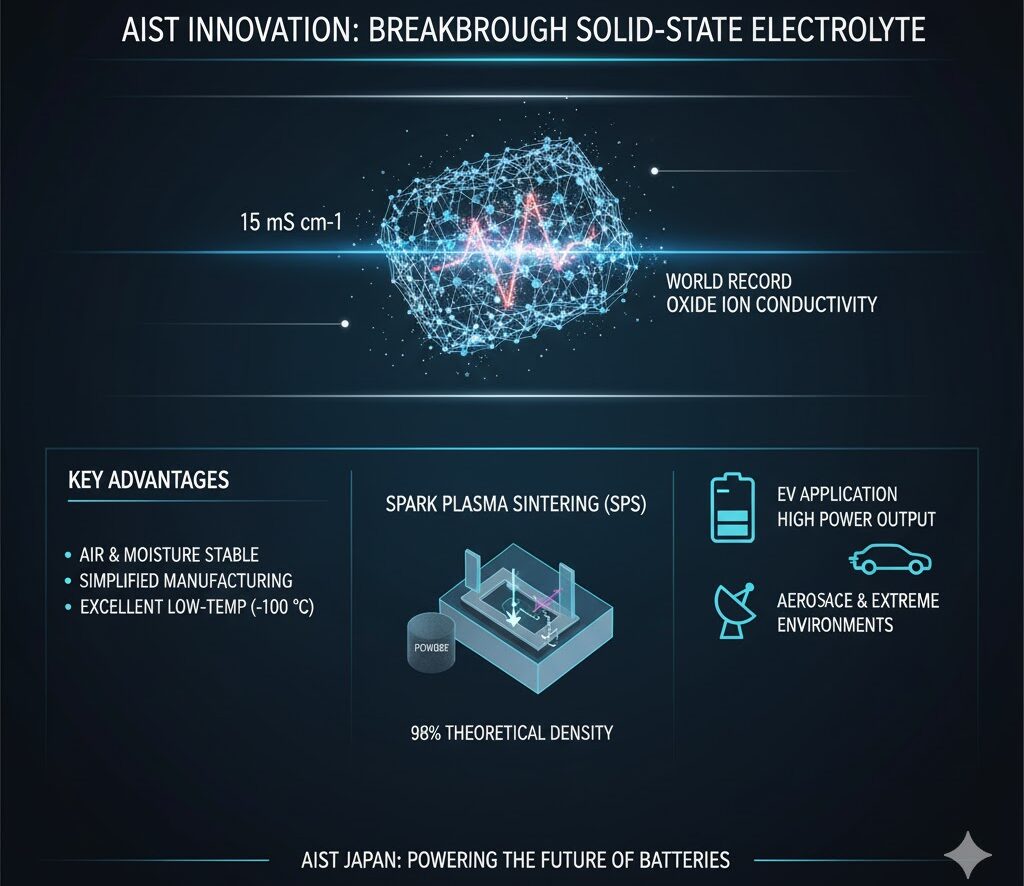
産総研の研究チームは、日本発の新材料であるパイロクロア型酸化物系固体電解質について、独自の焼結技術を用いることで、従来の常識を覆す高いイオン伝導率を実証しました。
1. 研究の核心と成果
- 世界最高の伝導率: パイロクロア型固体電解質(Li1.25La0.58Nb2O6F)において、室温で 15 mS cm-1 という、酸化物系として世界最高値を記録。これは現行のリチウムイオン電池(LIB)で使われる有機電解液に匹敵する数値です。
- 緻密化の成功: 従来、この材料は粒子間に隙間ができやすく性能を引き出せませんでしたが、通電焼結(SPS: Spark Plasma Sintering)法により、理論密度比98 %という極めて緻密な状態を実現しました。
- 優れた環境耐性: 硫化物系固体電解質とは異なり、大気や湿気に対して非常に安定しており、製造工程での厳格な雰囲気制御(ドライルーム等)を簡略化できる可能性があります。
2. 技術的背景と関連補足
酸化物系固体電解質は、安全性と寿命の面で期待されてきましたが、伝導率の低さが最大のネックでした。今回の成果は、そのボトルネックを解消するものです。
| 特性 | 硫化物系 (Sulfide) | 従来の酸化物系 (Oxide) | パイロクロア型 (本成果) |
| イオン伝導率 | 非常に高い (10-100 mS cm-1) | 低い (約1 mS cm-1) | 極めて高い (15 mS cm-1) |
| 大気安定性 | 低い (硫化水素発生リスク) | 高い | 極めて高い |
| 製造コスト | 高い (環境維持費) | 比較的低い | 低い (大気中ハンドリング可) |
3. 特筆すべき物理特性
- 低温特性: 図3のデータが示す通り、-100 ℃ といった極低温下でもイオン伝導率の低下が緩やかです。これにより、宇宙空間や極地、高高度航空機といった特殊環境下での電源としての活用が期待されます。
- 焼結技術の重要性: SPS法は粉末に圧力とパルス電流を直接流して加熱するため、短時間で結晶成長を抑制しつつ緻密化できます。これは材料のポテンシャルを最大限に引き出すための鍵となりました。
4. 今後の展望とビジネスへの影響
- EV市場への展開: 有機電解液並みの出力特性が得られることで、酸化物系全固体電池の弱点であった「出力不足」が解消され、大型EVへの搭載が現実味を帯びてきます。
- サプライチェーンの簡素化: 大気安定性が高いため、電池製造ラインの防爆・除湿設備の投資コストを大幅に抑制できる可能性があります。
- 次のステップ: 今後はこの電解質を用いたフルセルの試作、および正極・負極との界面抵抗の低減が実用化に向けた焦点となります。
出典:https://www.aist.go.jp/aist_j/press_release/pr2026/pr20260311/pr20260311.html
New World Record for Oxide-Based Solid Electrolytes: Achieving 15 mS cm-1 Comparable to Organic Electrolytes
A research team at AIST (National Institute of Advanced Industrial Science and Technology) has demonstrated an exceptionally high ionic conductivity that defies conventional wisdom for pyrochlore-type oxide-based solid electrolytes, a new material originating from Japan, by utilizing proprietary sintering technology.
1. Core Research Results
- World-Record Conductivity: Recorded a room-temperature ionic conductivity of 15 mS cm-1 for the pyrochlore-type solid electrolyte (Li1.25La0.58Nb2O6F), the highest in the world for an oxide-based system. This value is comparable to the organic liquid electrolytes used in current lithium-ion batteries (LIB).
- Successful Densification: Previously, this material struggled with gaps between particles, preventing it from reaching its full potential. However, using Spark Plasma Sintering (SPS), the team achieved an extremely dense state with a relative theoretical density of 98 %.
- Superior Environmental Stability: Unlike sulfide-based solid electrolytes, this material is highly stable against air and moisture, potentially simplifying manufacturing by reducing the need for strict atmospheric control (such as dry rooms).
2. Technical Background and Context
While oxide-based solid electrolytes have been promising for safety and longevity, their low conductivity was the primary obstacle. This achievement effectively resolves that bottleneck.
| Property | Sulfide-based | Conventional Oxide-based | Pyrochlore-type (This Result) |
| Ionic Conductivity | Very High (10-100 mS cm-1) | Low (approx. 1 mS cm-1) | Extremely High (15 mS cm-1) |
| Air Stability | Low (Risk of H2S generation) | High | Extremely High |
| Manufacturing Cost | High (Environmental maintenance) | Relatively Low | Low (Handleable in ambient air) |
3. Notable Physical Characteristics
- Low-Temperature Performance: As shown in the data, the decline in ionic conductivity is minimal even at extreme temperatures like -100 degC. This opens possibilities for use in specialized environments such as outer space, polar regions, and high-altitude aircraft.
- Importance of Sintering Technology: The SPS method applies pressure and pulsed current directly to the powder for heating, allowing for rapid densification while suppressing crystal grain growth. This was the key to unlocking the material’s latent potential.
4. Future Outlook and Business Impact
- Expansion into the EV Market: Achieving power output characteristics on par with liquid electrolytes addresses the “insufficient power” weakness of oxide-based all-solid-state batteries, making their integration into large electric vehicles (EVs) a reality.
- Supply Chain Simplification: Due to high air stability, it may be possible to significantly reduce investment costs for explosion-proof and dehumidification equipment on battery production lines.
- Next Steps: Future focus will be on prototyping full cells using this electrolyte and reducing interfacial resistance between the electrolyte and the cathode/anode for commercialization.


コメント