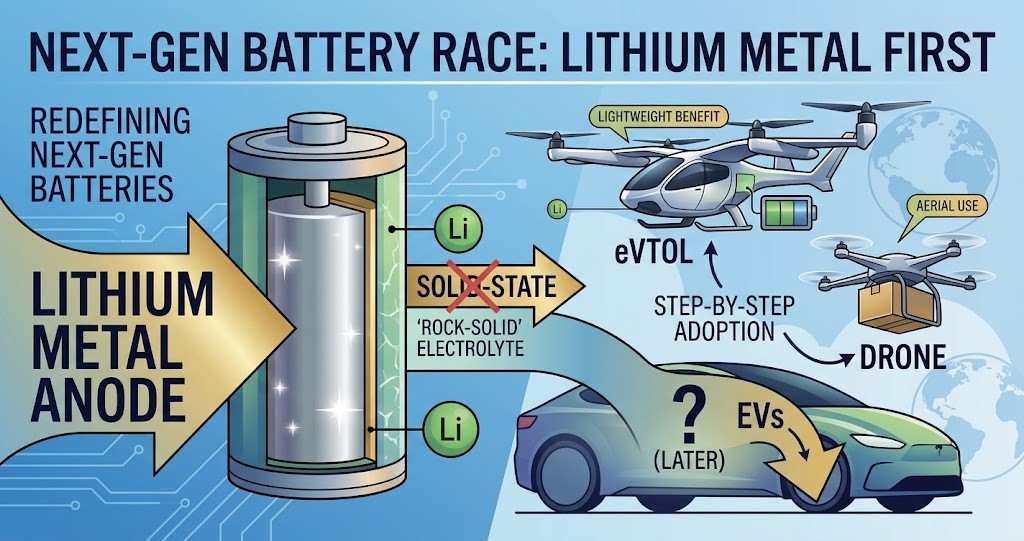
全固体電池が「次世代EV電池の最終本命」として日本や中国の自動車・電池大手を中心に過熱する中、開発のアプローチを再定義する動きが出ています。清華大学の張躍鋼教授は、電解質を固める「全固体化」のみに固執するのではなく、負極に「リチウム金属」を採用するリチウム金属電池の方が先に実用化される可能性を示唆しています。次世代バッテリーの普及は、EVよりも軽量化のメリットが即座に出るドローンやeVTOL(空飛ぶクルマ)などの航空用途から段階的に進む見通しです。
1. 全固体電池とリチウム金属電池の違い
- 分類軸の違い: 全固体電池は「電解質(液体から固体へ)」に着目した分類であり、リチウム金属電池は「負極材料(黒鉛等からリチウム金属へ)」に着目した分類です。両者は相反するものではなく、将来的に「全固体+リチウム金属負極」として組み合わせることも可能です。
- エネルギー密度の決定要因: 電池の容量(エネルギー密度)を大きく左右するのは正極・負極の材料です。単に電解液を固体に変えるだけでは高エネルギー密度化は達成できません。
2. 全固体電池が抱える「界面」の課題
全固体電池の開発が難航している大きな要因は、固体電解質と他材料との接触面(界面)にあります。
- 正極内部の接触不良: 液体電解質と異なり、固体電解質は正極活物質の微粒子隙間に浸透しにくく、イオン伝導性の確保が困難です。伝導性を高めるために固体電解質を増やせば、活物質の比率が下がりエネルギー密度が落ちるジレンマが生じます。
- デンドライト(樹状析出)とショート: 充放電の繰り返しに伴い、リチウムが枝状に成長して内部ショートを引き起こす「デンドライト」現象は、固体電解質内部の微細な欠陥に沿っても発生します。
3. リチウム金属電池のアプローチと実用化ロードマップ
液体の電解質を残したまま負極にリチウム金属を使う方式は、全固体化よりも早期の実用化が期待されています。
- 技術的課題: 電解液への添加剤投入でリチウム表面に保護膜を形成しデンドライトを抑制する研究が進んでいますが、充放電に伴う補修で電解液が消費されるため、サイクル寿命の延長が課題です。
- 性能の現状と評価基準:
- 重量当たりエネルギー密度500Wh/kg級で300回超、400Wh/kg級で約600回の充放電性能が実現しています。
- 今後2〜3年で400Wh/kg級の寿命が1000回以上に伸びれば自動車メーカーの評価段階へ移行し、500Wh/kg級で700〜800回に達すれば車両搭載試験が見えてきます。
4. 採用が進む市場の順序(関連背景)
バッテリーに求められる要件(重量、寿命、安全性、価格)の違いにより、順次投入される見込みです。
- 第1フェーズ(航空用途:ドローン・eVTOL): 電池の軽量化が航続距離や積載重量に直結するため、コストや超長期の寿命よりも「軽さとエネルギー密度」が最優先される空の移動体にまず採用されます。現在、空飛ぶクルマ(eVTOL)市場の急拡大に伴い高エネルギー密度電池の需要が急増しています。
- 第2フェーズ(ロボット): 稼働時間と重量のバランスが重要視されるヒューマノイドロボットや産業用ロボットへ展開されます。
- 第3フェーズ(電気自動車:EV): 自動車への搭載には数千回規模の耐久性や過酷な環境下での高い安全性・信頼性検証が必要となるため、最終段階での本格普及となります。
トヨタや日産、CATL、BYDが2027〜2028年の全固体電池実用化を目指して凌ぎを削る中、「電解質」だけでなく「負極材料の刷新」という視点は、次世代電池の市場投入スケジュールを前倒しする重要な鍵を握っています。用途に応じた段階的な実用化プロセスが、今後の次世代電池ビジネスの主流になると予想されます。
Next-Generation Battery Strategy Outlined by Tsinghua Professor: Challenges of All-Solid-State Batteries and Commercialization of Lithium Metal Batteries
While all-solid-state batteries are widely hyped as the ultimate solution for next-generation EV batteries—primarily by major automotive and battery companies in Japan and China—there is a growing movement to redefine the development approach. Professor Zhang Yuegang of Tsinghua University suggests that instead of focusing solely on all-solid-state technology by solidifying the electrolyte, lithium metal batteries—which utilize lithium metal for the anode—may actually achieve commercialization first. The adoption of next-generation batteries is expected to progress in stages, beginning with aviation applications such as drones and electric vertical takeoff and landing aircraft (eVTOLs), where the weight-reduction benefits are immediate, before reaching electric vehicles.
1. Differences Between All-Solid-State Batteries and Lithium Metal Batteries
- Different Classification Criteria: All-solid-state batteries are classified based on the electrolyte (shifting from liquid to solid), whereas lithium metal batteries are classified based on the anode material (shifting from graphite to lithium metal). These two approaches are not mutually exclusive and can eventually be combined into an all-solid-state battery with a lithium metal anode.
- Key Determinants of Energy Density: Battery capacity (energy density) is largely determined by the cathode and anode materials. Simply switching from a liquid electrolyte to a solid one does not automatically yield higher energy density.
2. The Interface Challenge Facing All-Solid-State Batteries
A major factor complicating the development of all-solid-state batteries lies in the contact surfaces (interfaces) between the solid electrolyte and other battery materials.
- Poor Contact Inside the Cathode: Unlike liquid electrolytes, solid electrolytes cannot easily penetrate the microscopic gaps between cathode active material particles, making it difficult to ensure sufficient ionic conductivity. Increasing the proportion of solid electrolyte to improve conductivity creates a dilemma, as it reduces the amount of active material and thereby lowers energy density.
- Dendrites and Short Circuits: Dendrites—tree-like lithium growths that form during repeated charging and discharging and cause internal short circuits—can still grow along microscopic defects within solid electrolytes.
3. Approach and Commercialization Roadmap for Lithium Metal Batteries
The approach of using a lithium metal anode while retaining a liquid electrolyte is expected to reach commercialization earlier than all-solid-state designs.
- Technical Challenges: Research is underway to suppress dendrite formation by adding additives to the liquid electrolyte, forming a protective film on the lithium surface. However, because this protective film consumes electrolyte during repeated self-repair, extending cycle life remains a key challenge.
- Current Performance and Evaluation Benchmarks:
- Products with an energy density of 500 Wh/kg have demonstrated over 300 charge-discharge cycles, while 400 Wh/kg-class products achieve around 600 cycles.
- If the cycle life of 400 Wh/kg-class batteries extends to over 1,000 cycles within the next two to three years, they will enter the evaluation stage by automakers. Reaching 700 to 800 cycles for 500 Wh/kg-class batteries will bring vehicle testing within sight.
4. Market Adoption Timeline (Related Context)
Deployment is expected to occur sequentially depending on the varying requirements of different applications, such as weight, cycle life, safety, and cost.
- Phase 1 (Aviation Applications: Drones and eVTOLs): Weight reduction directly impacts flight range and payload capacity, making lightness and energy density the top priorities over cost or ultra-long cycle life. Demand for high-energy-density batteries is surging alongside the rapid expansion of the eVTOL market.
- Phase 2 (Robotics): Adoption will expand to humanoid and industrial robots, where the balance between operating time and weight is critical.
- Phase 3 (Electric Vehicles: EVs): Full-scale adoption in automobiles will represent the final stage, as vehicle integration demands thousands of cycles of durability as well as rigorous safety and reliability testing under extreme conditions.
As companies like Toyota, Nissan, CATL, and BYD compete to commercialize all-solid-state batteries around 2027 to 2028, looking beyond the electrolyte to the innovation of anode materials holds the key to accelerating market introduction. A phased commercialization process tailored to specific applications is expected to become the dominant trend in the next-generation battery industry.


コメント