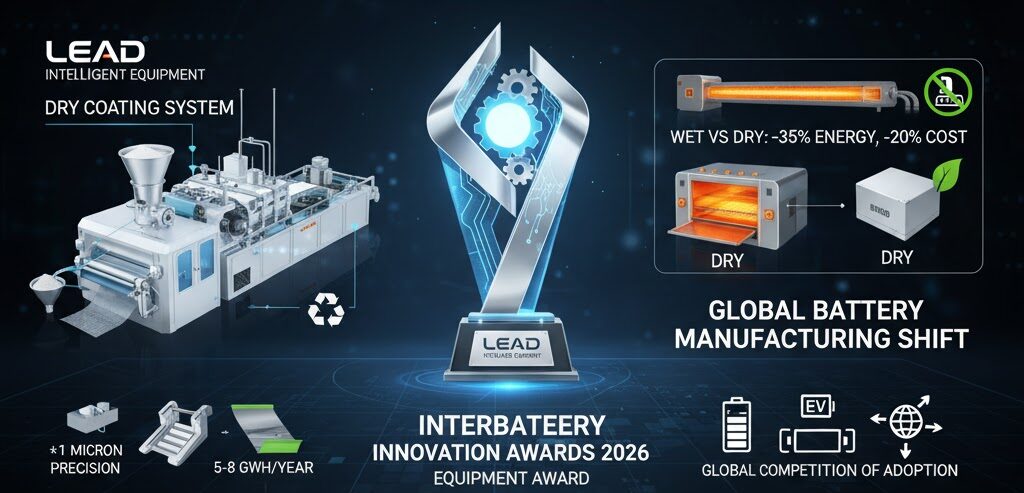
無錫リードインテリジェント設備有限公司(LEAD)が、韓国・ソウルで開催された「InterBattery Innovation Awards 2026」にて機器賞を受賞しました。これは、同賞の歴史上、初の中国企業による受賞であり、グローバルなバッテリー製造技術の勢力図に変化が起きていることを象徴する出来事です。
1. LEADの「乾式コーティングシステム」の技術的画期
LEADが受賞したこのシステムは、従来の製造工程の常識を覆す技術です。
- 統合設計: 粉体処理から精密計量、解繊、フィルム形成・ラミネーション、さらに廃棄物リサイクルまでを単一システムで完結。
- 高精度制御: ロールギャップ調整精度は±1マイクロメートルを実現し、電極表面密度の均一性を極限まで高めています。
- 生産効率: 電極幅は最大1000ミリメートルに対応し、単一ラインで年間5~8GWhの生産能力を誇ります。これは大量生産が必須となる次世代電池分野において非常に強力な競争力となります。
2. 業界へのインパクトと持続可能性
本技術は、従来のウェットコーティング(溶剤を使用するプロセス)が抱えていた大きな課題を解決しています。
- コストとエネルギーの削減: ウェット方式と比較してエネルギー消費量を35%以上削減し、材料および製造コストを約20%カットします。
- 次世代電池への対応: 現在主流のリチウムイオン電池(LFPおよび三元系材料)だけでなく、全固体電池の大量生産という難易度の高いニーズにも対応可能です。
- 環境負荷の低減: 溶剤を使用しない乾式プロセスは、環境規制の厳しい欧州や北米の市場においても「グリーン製造」のモデルケースとなります。
関連情報:市場のコンテキストと技術展望
「ウェット」から「ドライ」への転換
現在のバッテリー製造の主流は、溶剤を使って材料をドロドロの液体(スラリー)にし、それを金属箔に塗って乾燥させる「ウェットコーティング」です。しかし、これには以下のような欠点があります。
- 乾燥コスト: 巨大な乾燥炉が必要で、膨大なエネルギーを消費する。
- 環境リスク: 有機溶剤の回収や処理にコストがかかる。
- 空間効率: 長大な製造ラインを必要とし、工場面積を圧迫する。
これに対し、今回LEADが評価された「乾式コーティング」は、これらをほぼ解決するため、多くのバッテリーメーカーやEVメーカーが喉から手が出るほど欲しがっている技術です。
グローバル競争の新段階
今回の受賞は、これまで韓国勢や欧州勢が主導してきたバッテリー機器市場に、中国の技術力が明確に食い込んだことを意味します。特に韓国メーカーが強いインターバッテリー展で中国企業が認められたことは、単なる部品供給の枠を超え、製造プロセスそのものの主導権争いがより激化していることを示唆しています。
今後の展望
LEADは、A+H(上海および香港)の二重上場構造を持つ企業として、その豊富な資金力を背景にグローバル展開を加速させています。今回の受賞により、フォルクスワーゲン、BMW、メルセデス・ベンツといった欧州の自動車メーカーや、北米市場での採用がさらに進む可能性が高いと考えられます。
A Trump Card for Next-Generation Battery Production: LEAD’s Dry Coating Technology Receives International Acclaim
Wuxi Lead Intelligent Equipment Co., Ltd. (LEAD) has been awarded the Equipment Award at the InterBattery Innovation Awards 2026, held in Seoul, South Korea. This marks the first time in the history of the awards that a Chinese company has been recognized, symbolizing a significant shift in the global landscape of battery manufacturing technology.
1. Technological Breakthroughs of LEAD’s “Dry Coating System”
The system for which LEAD received the award is a technology that challenges conventional manufacturing processes:
- Integrated Design: The system completes the entire process in a single flow, ranging from powder processing, precision metering and feeding, and fibrillation, to film formation, lamination, and waste recycling.
- High-Precision Control: It achieves a roll gap adjustment accuracy of ±1 micrometer, ensuring maximum uniformity in electrode surface density.
- Production Efficiency: Supporting an electrode width of up to 1000 millimeters, the system boasts a production capacity of 5 to 8 GWh per single line. This provides a powerful competitive edge in the next-generation battery sector, where mass production is essential.
2. Industry Impact and Sustainability
This technology effectively solves the major challenges associated with conventional “wet coating” (a process using solvents):
- Cost and Energy Reduction: Compared to wet processes, the system reduces energy consumption by more than 35 percent and cuts material and manufacturing costs by approximately 20 percent.
- Compatibility with Next-Generation Batteries: It meets the demanding requirements for mass production of not only current mainstream lithium-ion batteries (LFP and ternary materials) but also all-solid-state batteries.
- Reduced Environmental Impact: By eliminating the use of solvents, the dry process serves as a model for “green manufacturing,” which is highly valued in markets with strict environmental regulations, such as Europe and North America.
Market Context and Technological Outlook
The Shift from “Wet” to “Dry”
Current battery manufacturing relies primarily on “wet coating,” where materials are mixed with solvents into a slurry, coated onto metal foil, and dried. However, this method has significant drawbacks:
- Drying Costs: Requires massive drying ovens that consume immense amounts of energy.
- Environmental Risks: Incurs costs for the recovery and treatment of organic solvents.
- Space Inefficiency: Requires long manufacturing lines, which increases the factory footprint.
In contrast, the “dry coating” technology recognized in LEAD’s award solves these issues, making it a highly sought-after solution for many battery and EV manufacturers.
A New Stage of Global Competition
This award signifies that Chinese technical prowess has clearly penetrated the battery equipment market, which has traditionally been dominated by South Korean and European firms. The recognition of a Chinese company at InterBattery—an event where South Korean manufacturers traditionally hold strong influence—suggests that the race for dominance has moved beyond simple component supply and into an intensified struggle for leadership in the manufacturing process itself.
Future Outlook
As a company with an A+H (Shanghai and Hong Kong) dual-listing structure, LEAD is leveraging its robust capital resources to accelerate its global expansion.

コメント