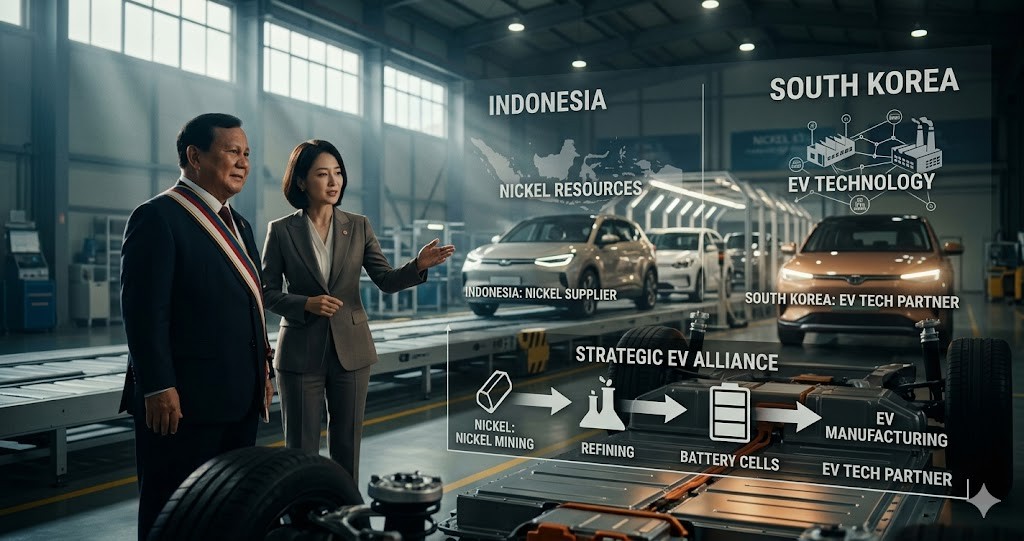
2026年4月、インドネシアのプラボウォ・スビアント大統領による訪韓と、それに同行した経済使節団の動向は、東南アジアにおけるEVサプライチェーンの勢力図を塗り替える象徴的な出来事となりました。
世界最大のニッケル埋蔵量を武器に、単なる「資源供給国」から「高度な製造拠点」への転換を狙うインドネシアにとって、韓国は技術と市場を繋ぐ最重要のゲートウェイです。本記事の内容を、背景情報とともに整理しました。
インドネシアEV普及の野望:韓国との戦略的提携
1. パートナーシップの核心
インドネシアは、自国内でニッケルの精錬から正極材、電池セル、パック製造、そしてリサイクルまでを完結させる「垂直統合型サプライチェーン」の構築を目指しています。
- 韓国の役割: 高度な製造技術(プロセス管理)、正極材等の化学技術、およびグローバルな自動車販売網の提供。
- インドネシアの役割: 豊富なニッケル資源、広大な国内市場、東南アジアにおける戦略的製造ハブとしての立地。
2. 具体的成果:HLI Green Powerの始動
現代自動車グループとLGエナジーソリューション(LGES)による50:50の合弁会社「HLI Green Power」が、この提携の先駆例となっています。
- 現状: 2024年に国内初の電池セル工場(年産10GWh)を稼働。
- 意義: これによりインドネシアは「原材料輸出」の段階を脱し、実際の電池セル製造国へと変貌を遂げました。
3. 2026年の市場転換と優遇措置
インドネシア政府は、EV普及を加速させるために強力な政策を打ち出しています。
- 現地生産の義務化: 2026年に輸入EVへの優遇措置を終了。これにより、外資メーカーに対して「国内での拠点構築」を強く迫っています。
- 普及率の推移: 2025年1月〜9月期には、EV販売台数が市場全体の約10%(約5万5200台)に達しました。
関連情報:2026年時点の背景と技術的視点
記事の内容を補完する、現在のグローバルな文脈と技術動向です。
① 中国依存からの脱却とIRA法対策
インドネシアが韓国を重視する最大の理由は、米国市場(IRA法)へのアクセスです。
- 中国資本主導の製品は米国の税制優遇から除外されるリスクがあるため、韓国企業をパートナーに据えることで「非中国系サプライチェーン」としての正当性を確保する狙いがあります。
② バッテリー技術の多様化
インドネシアはニッケル主体のNCM(ニッケル・コバルト・マンガン)系を推進していますが、低価格なLFP(リン酸鉄リチウム)系との競争が続いています。
- 韓国勢はLiNiO2(ニッケル酸リチウム)などのハイニッケル技術でエネルギー密度の優位性を保ち、高付加価値市場を狙っています。
③ バイオ・デジタル分野への拡大
バクリー氏が指摘した通り、協力関係はEV以外にも広がっています。
- バイオ: シングルユース(Single-Use)技術を用いたバイオ医薬品製造。
- デジタル: AIインフラやデータセンター、産業用ソフトウェアへの韓国資本の導入。
今後の課題と展望
インドネシアが2029年までに経済成長率8%を達成するためには、以下の課題解決が不可欠です。
| 課題カテゴリー | 具体的な内容 |
| 政策面 | 一貫性のある政策実施と、外資投資家に対する許認可手続きの迅速化。 |
| インフラ面 | 急速充電ネットワークの整備、および電池リサイクルエコシステムの構築。 |
| 物流面 | 島嶼国特有の物流コストを抑える、効率的なサプライチェーン・ロジスティクスの確立。 |
結論:
アニンディヤ・ノヴィヤン・バクリー氏が強調するように、韓国はもはや単なる投資国ではなく、インドネシアの産業構造そのものを近代化させるための「最も戦略的で信頼できるパートナー」としての地位を確立しています。
出典:https://www.koreaherald.com/article/10710144
South Korea × Indonesia: The Impact of a Vertically Integrated Battery Ecosystem
In April 2026, President Prabowo Subianto’s state visit to South Korea, accompanied by a high-level economic delegation, marked a symbolic turning point in reshaping the EV supply chain landscape in Southeast Asia.
Leveraging the world’s largest nickel reserves, Indonesia aims to transition from a mere “resource supplier” to a “high-tech manufacturing hub.” For Indonesia, South Korea serves as the most critical gateway connecting its technology to global markets. This report outlines the key points of the article alongside essential background context.
Indonesia’s EV Ambitions: A Strategic Alliance with South Korea
1. The Core of the Partnership
Indonesia aims to establish a “vertically integrated supply chain” within its borders, covering everything from nickel refining to cathode materials, battery cells, pack assembly, and recycling.
- South Korea’s Role: Providing advanced manufacturing technology (process management), chemical expertise in cathode materials, and access to global automotive sales networks.
- Indonesia’s Role: Providing abundant nickel resources, a vast domestic market, and a strategic position as a manufacturing hub for Southeast Asia.
2. Concrete Achievements: The Launch of HLI Green Power
The 50:50 joint venture between Hyundai Motor Group and LG Energy Solution (LGES), “HLI Green Power,” stands as the flagship of this collaboration.
- Current Status: The nation’s first battery cell plant (10GWh annual capacity) became operational in 2024.
- Significance: This move allowed Indonesia to move beyond the stage of “raw material exports” and transform into a legitimate battery cell manufacturing nation.
3. 2026 Market Shift and Incentives
The Indonesian government is implementing aggressive policies to accelerate EV adoption.
- Mandatory Localization: Incentives for imported EVs are set to end in 2026. This pressures foreign manufacturers to establish local production bases.
- Adoption Trends: In the first nine months of 2025, EV sales reached approximately 55,200 units, accounting for roughly 10% of the total automotive market.
Contextual Information: 2026 Background & Technical Perspectives
These points complement the article by highlighting the current global context and technical trends.
I. Diversification from China and IRA Compliance
A primary reason Indonesia prioritizes South Korea is access to the U.S. market (IRA compliance).
- By partnering with South Korean firms, Indonesia aims to secure legitimacy as a “non-Chinese-linked supply chain,” mitigating the risk of being excluded from U.S. tax incentives due to Chinese-led capital.
II. Diversification of Battery Chemistry
While Indonesia promotes nickel-based NCM (Nickel-Cobalt-Manganese) systems, competition with low-cost LFP (Lithium Iron Phosphate) remains fierce.
- South Korean players are targeting the high-value market by maintaining an energy density advantage through high-nickel technologies, such as LiNiO2.
III. Expansion into Bio and Digital Sectors
As noted by Mr. Bakrie, the partnership is expanding beyond EVs.
- Biotech: Manufacturing biopharmaceuticals using Single-Use technologies.
- Digital: Introduction of South Korean capital into AI infrastructure, data centers, and industrial software.
Future Challenges and Outlook
To achieve an 8% economic growth rate by 2029, Indonesia must address the following challenges:
| Category | Specific Requirements |
| Policy | Consistent policy implementation and streamlining permit processes for foreign investors. |
| Infrastructure | Expansion of fast-charging networks and the establishment of a battery recycling ecosystem. |
| Logistics | Establishing efficient supply chain logistics to offset high costs inherent to an archipelagic nation. |
Conclusion:
As emphasized by Anindya Novyan Bakrie, South Korea is no longer just an investor; it has become the most strategic and reliable partner for modernizing Indonesia’s industrial structure.
コメント