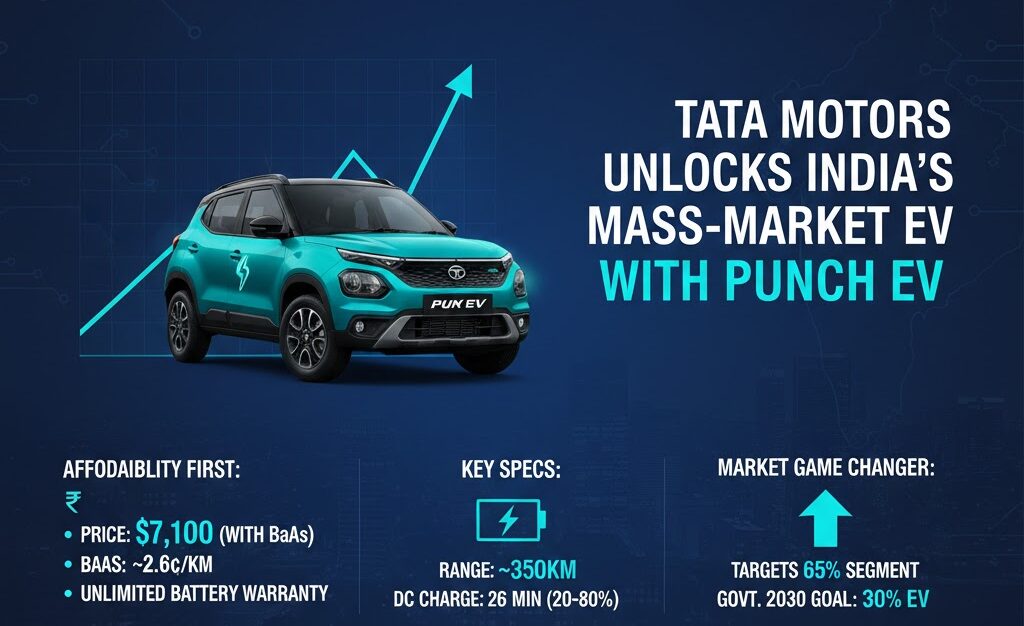
インド最大の電気自動車(EV)メーカーであるタタ・モーターズは、新型コンパクトSUV「パンチEV」を投入し、これまで伸び悩んでいた低価格層(エントリーセグメント)でのEV普及を加速させる戦略を打ち出しました。
主要な戦略とスペック
- 価格戦略: 基本価格を10,650ドル(約160万円)からに設定。さらに、車両価格とバッテリー価格を切り離す「BaaS(Battery-as-a-Service:電池サブスクリプション)」オプションを導入。これにより、初期費用を7,100ドル(約107万円)まで抑え、バッテリー使用料を1kmあたり2.6セント(約4円)で提供します。
- 航続距離と充電: 上位モデルは1回の充電で350kmから468km(規格による)の走行が可能。急速充電器(65kW DC)を使用すれば、26分で20%から80%まで充電可能です。
- 信頼性の担保: バッテリーの寿命に対する不安を払拭するため、バッテリー生涯保証(走行距離無制限)を付帯させています。
【関連情報】インドEV市場の現状と競合動向
- 市場の「1.6%」の壁:インドの自動車販売の約65%は13,200ドル以下の低価格車が占めていますが、この層でのEVシェアはわずか1.6%に留まっています(高価格帯では10%)。タタは「このエントリー層を攻略しなければEVは主流にならない」と判断し、利益率を一部犠牲にしてでも価格競争力を優先しています。
- 激化する競合環境:
- マルチ・スズキ: インド最大手のマルチ・スズキも、初のEVとなるSUV「e-Vitara(eビターラ)」で参入。BaaSモデルを活用し、約12,000ドルからの価格帯でタタを追撃しています。
- JSW MGモーター / マヒンドラ: 中国資本系のMGモーターや、地元大手のマヒンドラも低価格帯へのラインナップ拡充を急いでおり、市場はタタの独走状態から激戦区へと変化しています。
- 政府の野心的な目標:インド政府は、燃料輸入への依存脱却と大気汚染改善のため、2030年までに新車販売の30%をEVにする目標を掲げています。現在は市場全体の約5%程度ですが、今回のパンチEVのような低価格モデルがその成否を握ると見られています。
まとめの比較表
| 項目 | 詳細内容 |
| 車両価格(本体のみ) | 最安 7,100ドル(BaaS利用時) |
| バッテリー料金 | 1km走行あたり約2.6セント |
| 充電性能 | 20%-80%まで約26分(急速充電時) |
| 走行距離 | 実用域 約350km(上位モデル) |
| 主な競合モデル | マルチ・スズキ e-Vitara, MG Windsor EV |
The “Affordable EV” Arrives: How Tata’s Punch.ev is Transforming India’s Automotive Landscape
Tata Motors, India’s largest electric vehicle (EV) manufacturer, has launched the new Punch.ev, a compact SUV designed to accelerate EV adoption in the entry-level segment—a market that has previously struggled to gain traction.
Key Strategies and Specifications
- Pricing Strategy: The base price starts at 10,650 USD. Furthermore, Tata has introduced a “Battery-as-a-Service” (BaaS) option that separates the vehicle cost from the battery cost. This lowers the upfront price to 7,100 USD, with battery usage billed separately at approximately 2.6 cents per kilometer.
- Range and Charging: High-end variants offer a range of 350 km to 468 km per charge (depending on standards). Using a 65 kW DC fast charger, the battery can be charged from 20% to 80% in just 26 minutes.
- Ensuring Reliability: To eliminate concerns regarding battery longevity, Tata provides a lifetime battery warranty with unlimited mileage.
[Related Information] Market Status and Competition in India
- The “1.6%” Barrier: While low-cost cars (under 13,200 USD) account for about 65% of India’s total auto sales, EVs represent only 1.6% of this segment (compared to 10% in high-end segments). Tata believes that EVs cannot become mainstream without conquering this entry-level tier and is prioritizing price competitiveness even at the expense of profit margins.
- Intensifying Competition:
- Maruti Suzuki: India’s market leader has entered the fray with its first EV SUV, the e-Vitara, using a BaaS model to challenge Tata with a starting price of around 12,000 USD.
- JSW MG Motor / Mahindra: With Chinese-backed MG Motor and local giant Mahindra expanding their budget lineups, the market is shifting from Tata’s solo dominance to a fierce battleground.
- Government’s Ambitious Goals: The Indian government aims for EVs to make up 30% of new car sales by 2030 to reduce fuel import dependency and improve urban air quality. Currently, EVs account for about 5% of the total market, making affordable models like the Punch.ev critical to achieving this target.
Summary Comparison Table
| Item | Details |
| Vehicle Price (Body Only) | As low as 7,100 USD (with BaaS) |
| Battery Usage Fee | Approx. 2.6 cents per km |
| Charging Performance | 20% to 80% in approx. 26 mins (Fast Charging) |
| Driving Range | Approx. 350 km (Long Range Model) |
| Main Competitors | Maruti Suzuki e-Vitara, MG Windsor EV |

コメント