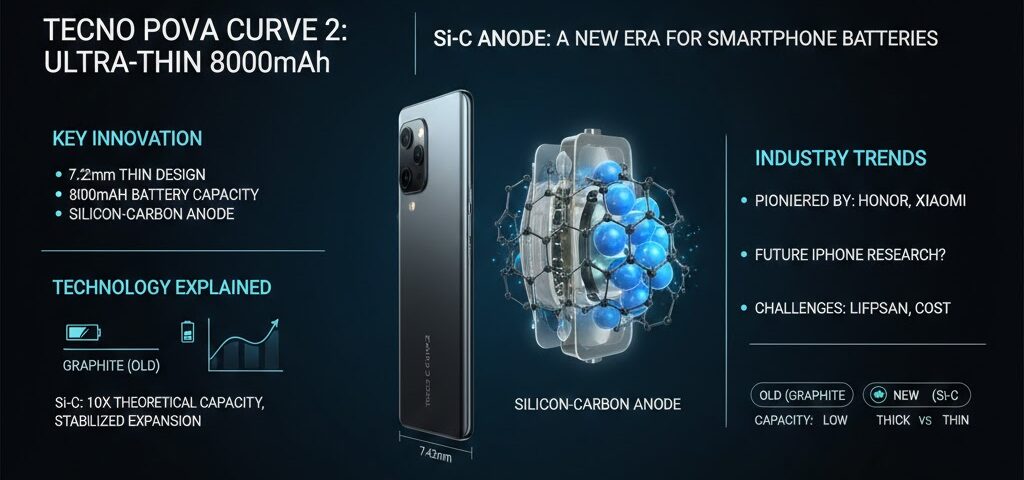
中国のTecno Mobileが発売した「Tecno Pova Curve 2」は、従来のスマートフォンの設計思想を大きく変えるモデルです。iPhoneやGalaxyなどの主要フラッグシップ機が厚みと容量のバランスから5000mAh前後を選択するなか、本機は7.42mmという極薄ボディに8000mAhという驚異的な容量を詰め込みました。
これを可能にしたのが、次世代のバッテリー技術「シリコンカーボン(Si-C)負極」です。
技術解説:なぜ「シリコン」なのか?
現在主流のリチウムイオン電池は、負極にグラファイト(黒鉛)を使用しています。安定性は高いものの、エネルギー密度の向上は物理的な限界(理論容量 372 mAh/g)に達していました。
- シリコンのポテンシャル: シリコンは理論上、グラファイトの約10倍(約4200 mAh/g)のリチウムを蓄えることができます。
- 最大の壁「膨張」: シリコンは充電時にリチウムを取り込むと、体積が最大300%以上も膨張し、構造が崩壊(劣化)しやすいという致命的な弱点がありました。
- 解決策としての「シリコンカーボン」: シリコン粒子を炭素(カーボン)で包み込み、混合することで膨張による応力を緩和。高いエネルギー密度を維持しつつ、実用的な耐久性を確保しました。
【関連情報】バッテリー業界のトレンドと課題
この技術はTecno社独自のものではなく、現在のスマートフォン業界における最先端トレンドとなっています。
- 業界の動向:
- Honor(オナー)やXiaomi(シャオミ)といった中国メーカーが先行してフラッグシップ機に採用を開始しており、2024年後半から2025年にかけて「薄型かつ大容量」なスマホが急増しています。
- 一部の噂では、Appleも将来のiPhoneに向けてシリコン負極技術の研究を進めていると報じられています。
- 急速充電との兼ね合い:
- 大容量化の一方で、高密度なシリコンカーボン電池は内部抵抗の制御が難しく、100Wを超えるような超高速充電とは相性が難しい側面もありましたが、現在はその両立も進んでいます。
- 今後の期待と懸念:
- 寿命: グラファイトと比較して、充放電サイクルによる劣化(容量低下)がどの程度抑えられているかが長期的な評価の分かれ目となります。
- コスト: 特殊なナノ構造の製造が必要なため、従来の電池よりもコストが高くなる傾向にあります。
まとめ
| 項目 | 従来の電池 (グラファイト) | 新世代の電池 (シリコンカーボン) |
| 主な特徴 | 安定、安価、膨張が少ない | 高エネルギー密度、薄型化に有利 |
| 容量の限界 | 物理的に限界に近い | 大幅な向上が可能 (8000mAhクラスも可能) |
| 課題 | 本体が厚く、重くなる | 膨張制御、長期耐久性の確保 |
「スマホの電池持ちは1日が限界」という常識が、この材料工学の進化によって「数日間持つのに極薄」という新しいフェーズへ移行しようとしています。
出典:https://news.livedoor.com/article/detail/30636568/
The Smartphone Battery Revolution: The Power of “Silicon-Carbon,” the Magic Material Balancing Thinness and High Capacity
The Tecno Pova Curve 2, released by China’s Tecno Mobile, is a model that fundamentally changes conventional smartphone design philosophy. While major flagship devices like iPhone and Galaxy typically settle for around 5000 mAh to balance thickness and capacity, this device packs an incredible 8000 mAh into an ultra-slim 7.42 mm body.
This feat was made possible by next-generation battery technology: the Silicon-Carbon (Si-C) anode.
Technical Insight: Why “Silicon”?
Current mainstream lithium-ion batteries use graphite for the anode. While highly stable, their energy density has reached a physical limit (theoretical capacity of 372 mAh/g).
- Silicon’s Potential: Theoretically, silicon can store about 10 times more lithium than graphite (approximately 4200 mAh/g).
- The Biggest Barrier – “Expansion”: A fatal weakness of silicon is that it expands by up to 300% or more when absorbing lithium during charging, which easily leads to structural collapse and degradation.
- The Solution – “Silicon-Carbon”: By encasing silicon particles in carbon and mixing them, the stress from expansion is mitigated. This ensures practical durability while maintaining high energy density.
[Related Information] Industry Trends and Challenges
This technology is not exclusive to Tecno; it is the cutting-edge trend in the current smartphone industry.
- Industry Movement: Chinese manufacturers like Honor and Xiaomi have pioneered the adoption of this technology in their flagships. Consequently, “slim yet high-capacity” smartphones have surged between late 2024 and 2025.
- Apple Rumors: Some reports suggest that Apple is also researching silicon anode technology for future iPhones.
- Fast Charging Trade-offs: While increasing capacity, high-density Si-C batteries initially struggled with internal resistance, making them difficult to pair with ultra-fast charging (over 100W). However, compatibility is now improving.
- Future Outlook & Concerns:
- Lifespan: A key factor for long-term evaluation will be how well degradation (capacity loss) over charge cycles is suppressed compared to graphite.
- Cost: Due to the need for specialized nano-structure manufacturing, costs tend to be higher than conventional batteries.
Summary
| Item | Conventional Battery (Graphite) | Next-Gen Battery (Silicon-Carbon) |
| Main Features | Stable, affordable, low expansion | High energy density, ideal for slimming |
| Capacity Limit | Near physical limits | Significant growth (8000 mAh class possible) |
| Challenges | Bodies become thick and heavy | Expansion control, long-term durability |
The common assumption that “smartphone battery life is limited to one day” is shifting into a new phase: “ultra-thin yet lasting for several days,” thanks to this evolution in materials engineering.

コメント