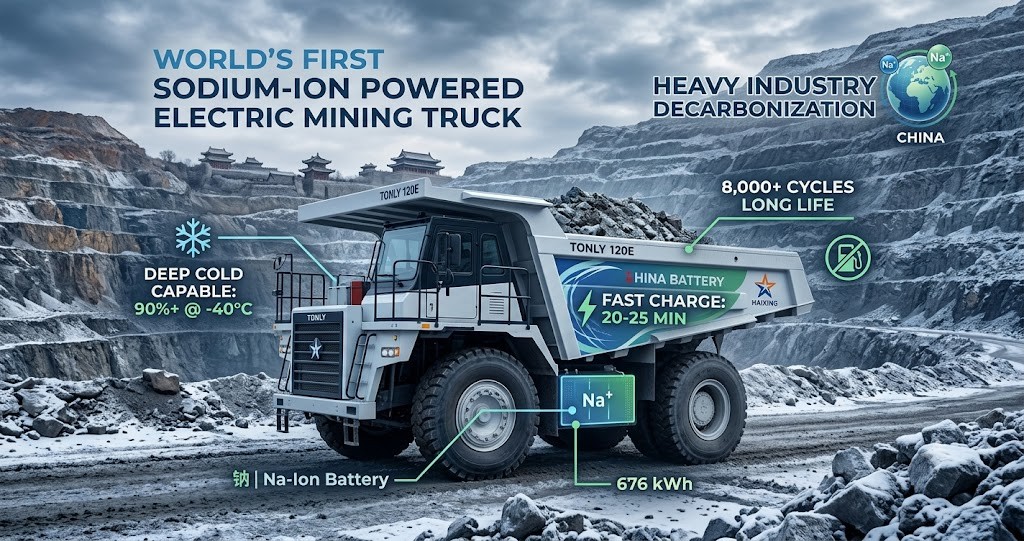
中国における電池産業では、リチウム資源依存度の低減や過酷環境下での稼働性能向上を目指し、ナトリウムイオン電池の実用化および商用車・重機領域への適用が急速に進展しています。特に、低温特性や急速充電性能に優れるナトリウムイオン電池は、乗用車や定置用蓄電池にとどまらず、採掘現場や大型輸送などの重機分野における脱炭素化の重要ソリューションとして注目を集めています。
こうした背景のもと、中国で発表された「世界初のナトリウムイオン電池搭載電気鉱山トラック納入」に関するニュースの概要と関連情報は以下の通りです。
ナトリウムイオン電池搭載・大型電気鉱山トラックの納入概要
1. 世界初のナトリウムイオン電池搭載鉱山トラックの納入
中国のナトリウムイオン電池メーカーであるHina Battery(日奈電池)と陝西トンリー重工業(Shaanxi Tonly Heavy Industries)は、共同開発したナトリウムイオン電池搭載の鉱山用トラックを三友グループ傘下の三友鉱業(河北省唐山市)へ納入しました。本車両はTonlyの120Eシリーズプラットフォームをベースに開発され、世界初のナトリウムイオン駆動鉱山トラックとなります。
2. 車両・バッテリーシステム仕様と主要性能
- 搭載容量:Hina Battery自社開発の「Haixing(海星)」シリーズバッテリーシステム(総容量676kWh)を搭載。
- エネルギー密度:セル単体で165Wh/kg超(2025年3月発表時)。
- 充電と寿命:20〜25分でのフル充電(急速充電)に対応し、急速充電条件下でも8,000サイクル以上の長寿命を実現。
- 動作環境:マイナス40度の極低温環境下でも使用可能容量の90%以上を保持。
3. 鉱山現場への適用メリット
鉱山現場は粉塵が多く過酷な温調環境であり、従来は大量のディーゼル燃料を消費していました。低温特性・高レート性能・長寿命を備えるナトリウムイオン電池の導入により、小型パック化・急速充電・高稼働率を両立し、ディーゼルエンジンからの電動化(パワートレイン転換)を加速させます。
4. 商用車分野における導入事例の拡大
Hina Batteryは2026年6月にも、FAW Jiefang(一汽解放)と共同開発した大型トラクター(339kWh搭載)で7ヶ月間・1万5,000kmにおよぶ公道走行試験を完了しており、重機・商用車領域への採用を急速に広げています。
5. 中国各社の開発動向とコスト課題
- 大手各社の動向:CATLは50億元(約7億3,650万ドル)を投じて福建省に40GWh規模の生産能力を建設するほか、長安汽車等と連携し量産車への搭載を推進。BYDは1万サイクル寿命のセル、BAICは170Wh/kg超のサンプルを発表。
- コストの現状と見通し:現時点でのナトリウムイオン電池の製造コストは1Whあたり0.5元〜0.7元と、リチウムイオン電池(1Whあたり0.3元〜0.5元)より高価ですが、規模の経済化が進む2027年〜2028年には価格が収束し、2028年には1Whあたり0.3元まで低下すると試算されています。
【関連情報】背景と業界動向
- 過酷環境での優位性(熱暴走リスク抑制と耐寒性):ナトリウムイオン電池は、構造上マイナス20度〜マイナス40度といった極寒環境でも容量低下が少なく、熱暴走を起こしにくい高い安全性を持ちます。そのため、寒冷地での稼働や高負荷が連続する大型トラクター・建設機械・鉱山車両において、リチウムイオン電池(LFP等)を補完または上回る適性を備えています。
- 資源地政学リスクの回避:リチウムやコバルトなどの主要金属の不均衡な埋蔵量・供給網依存からの脱却を目指し、地球上に豊富に存在するナトリウム(塩資源等)を活用する技術開発が中国主導で急ピッチで進んでいます。
- 用途に応じた材料特性の棲み分け:現在、乗用車や商用車などの車載用途にはエネルギ一密度の高い「層状酸化物系」正極が主流となり、定置用蓄電池(ESS)など長寿命を重視する用途には「ポリアニオン系」正極が採用されるなど、材料開発の棲み分けが進んでいます。
出典:https://cnevpost.com/2026/08/05/china-1st-sodium-ion-electric-mining-truck-delivery/
Accelerating Commercialization of Sodium-Ion Batteries in China: Expansion into Mining Heavy Machinery and Heavy-Duty Trucks
In China’s battery industry, the commercialization of sodium-ion batteries and their application in commercial vehicles and heavy machinery are progressing rapidly, aiming to reduce dependence on lithium resources and improve operational performance under extreme environments. In particular, sodium-ion batteries, with their excellent low-temperature characteristics and fast-charging performance, are gaining attention as a key solution for decarbonization not only in passenger cars and stationary energy storage systems, but also in heavy machinery sectors such as mining sites and heavy transport.
Against this backdrop, the overview and related information regarding the news announced in China on the “Delivery of the World’s First Sodium-Ion Battery-Powered Electric Mining Truck” are as follows:
Overview of the Delivery of the Large Electric Mining Truck Powered by Sodium-Ion Batteries
- Delivery of the World’s First Sodium-Ion Battery-Powered Mining Truck Chinese sodium-ion battery manufacturer Hina Battery and Shaanxi Tonly Heavy Industries delivered a co-developed sodium-ion battery-powered mining truck to Sanyou Mining (Tangshan City, Hebei Province), a subsidiary of the Sanyou Group. Developed based on Tonly’s 120E series platform, this vehicle marks the world’s first sodium-ion-driven mining truck.
- Vehicle and Battery System Specifications and Key Performance Installed Capacity: Equipped with Hina Battery’s self-developed “Haixing” series battery system, featuring a total capacity of 676 kWh. Energy Density: Over 165 Wh/kg at the single-cell level (as announced in March 2025). Charging and Lifespan: Supports full charging in 20 to 25 minutes (fast charging) and achieves a long cycle life of over 8,000 cycles even under fast-charging conditions. Operating Environment: Retains over 90 percent of usable capacity even in extreme cold environments of minus 40 degrees Celsius.
- Benefits of Application to Mining Sites Mining sites involve dusty, harsh temperature-controlled environments that traditionally consumed large amounts of diesel fuel. By introducing sodium-ion batteries featuring low-temperature performance, high-rate capabilities, and long cycle life, operators can achieve smaller pack sizes, fast charging, and high operational rates simultaneously, accelerating the transition from diesel engines to electric powertrains.
- Expansion of Adoption Cases in the Commercial Vehicle Sector In June 2026, Hina Battery also completed seven months and over 15,000 kilometers of public road testing on a heavy-duty tractor (equipped with 339 kWh) co-developed with FAW Jiefang, rapidly expanding adoption across heavy machinery and commercial vehicle domains.
- Development Trends of Chinese Companies and Cost Challenges Major Player Trends: CATL is investing 5 billion yuan (approximately 736.5 million USD) to build a 40 GWh production capacity in Fujian Province while collaborating with Changan Automobile and others to promote installation in mass-production vehicles. BYD announced a cell with a 10,000-cycle life, and BAIC presented a sample exceeding 170 Wh/kg. Current Cost and Outlook: Current manufacturing costs for sodium-ion batteries stand at 0.5 yuan to 0.7 yuan per Wh, higher than lithium-ion batteries (0.3 yuan to 0.5 yuan per Wh). However, as economies of scale progress, prices are expected to converge between 2027 and 2028, dropping to 0.3 yuan per Wh by 2028.
[Related Information] Background and Industry Trends Advantages in Extreme Environments (Thermal Runaway Risk Suppression and Cold Resistance): Due to their structural properties, sodium-ion batteries show minimal capacity degradation even in extreme cold environments of minus 20 degrees to minus 40 degrees Celsius, alongside high safety against thermal runaway. Therefore, they offer suitable characteristics to complement or surpass lithium-ion batteries (such as LFP) in cold-region operations and high-load continuous operations of heavy tractors, construction machinery, and mining vehicles. Mitigation of Resource Geopolitical Risks: Aiming to break away from unevenly distributed reserves and supply chain reliance on key metals like lithium and cobalt, technology development utilizing abundant sodium (such as salt resources) is proceeding at a rapid pace led by China. Application-Specific Material Differentiation: Currently, high-energy-density “layered oxide” cathodes are becoming mainstream for automotive applications such as passenger cars and commercial vehicles, while “polyanion” cathodes emphasizing long cycle life are adopted for applications like stationary energy storage systems (ESS), showing clear differentiation in material development.
コメント