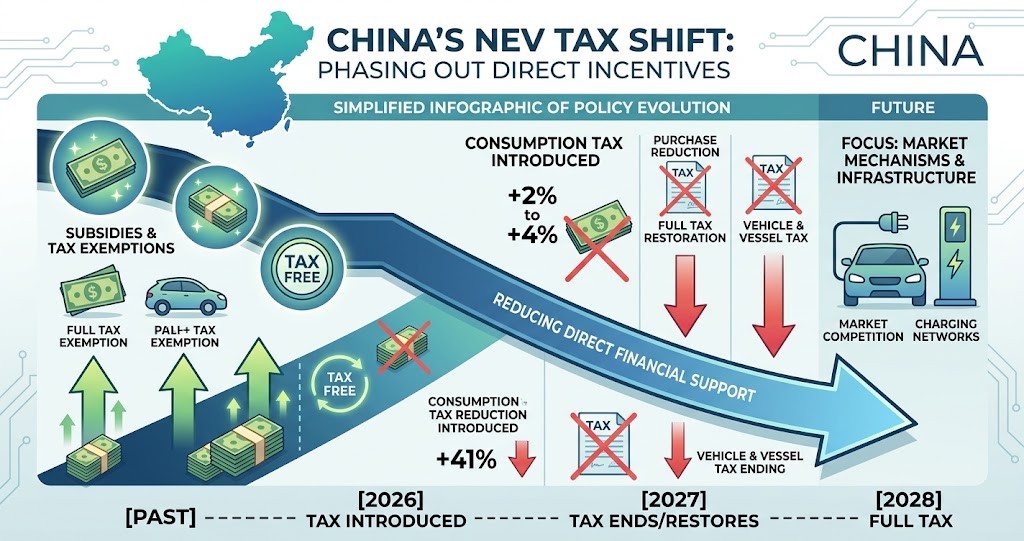
中国は近年、新エネルギー車(NEV: New Energy Vehicles)市場の急速な成長と自立的な市場形成を背景に、長年導入してきた優遇措置や補助金制度の段階的な縮小・廃止(いわゆる「退坡」政策)を推進しています。かつて市場拡大を後押しした直接補助金や優遇税制を徐々に撤廃する一方で、次世代技術(全固体電池やナトリウムイオン電池など)へのシフトや、充電インフラの整備といった間接的・基盤的な支援へ舵を切る姿勢を強めています。
中国における新エネルギー車優遇措置の段階的廃止と現状
1. リチウムイオン電池に対する消費税免除の廃止
- 国家税務総局等の発表により、長年続いてきたリチウム一次電池およびリチウムイオン二次電池への消費税免除が終了します。
- 2026年9月1日より2%の消費税が適用され、2027年9月1日には4%へ引き上げられます。
- 2026年8月時点で、国内の314Ah LFP(リン酸鉄リチウム)蓄電池の平均価格は約0.365元/Wh(0.072 USD/Wh)となっています。
- 60kWhのバッテリーを搭載した車両の場合、コストの増加見込みは以下の通りです。
- 2%課税時: 車両1台あたり約438元(62 USD)の増加
- 4%課税時: 車両1台あたり約876元(125 USD)の増加
- 一方で、ナトリウムイオン電池、全固体電池、燃料電池については、技術開発および普及の促進を目的として、2028年12月31日まで免税措置が維持されます。
2. 車両購入税(自動車取得税)の縮小
- 2026年1月1日より、従来の完全免除から50%減税(実効税率5%)へ引き下げられました。
- 減税額の上限は車両1台あたり15,000元(2,200 USD)に設定されています。
- 30万元(44,700 USD)以下のNEVを購入する場合、ガソリン車などの内燃機関車と比較して5%相当の節約となりますが、市場浸透率の高まりに伴い、今後数年以内(早ければ2027〜2028年頃)に本措置も全面廃止される見通しです。
3. 車両・船舶税優遇の廃止
- 財政部、国家税務総局、工業情報化部による2026年7月の発表に基づき、省エネ車両および一部のNEVに対する車両・船舶税(車船税)の優遇措置が2027年1月1日に廃止されます。
- 対象となるのは、省エネ車両への50%減税措置、ならびにプラグインハイブリッド車(PHEV)、レンジエクステンダー車(EREV)、一部の商用EV・燃料電池車への免除措置です。
- この影響により、PHEVおよびEREVの年間税金コストは約300元(45 USD)増加し、660元(100 USD)程度になると試算されます(純粋な電気自動車/BEV乗用車は構造上排気量を持たないため、本税法の課税対象外として影響を受けません)。
4. 海外ブランドへの適用と残存する広範な支援策
- 上記の税制変更は、BYDや吉利などの中国本土ブランドだけでなく、テスラ、フォルクスワーゲン、トヨタなど中国国内で生産・販売を行うすべての自動車メーカーに一律で適用されます。
- 車両本体への優遇措置が縮小する一方で、NEV利用者は依然として以下の優過環境を享受しています。
- 道路維持費の実質的免除: 道路維持費用がガソリン・ディーゼル燃料費に上乗せされている構造上、燃料を使用しないEVは同費用の負担が発生しません。
- 充電・バッテリー交換インフラへの大規模投資: 国有資本を含む手厚いインフラ整備政策により、電力網や公共充電ステーション、バッテリー交換ステーションが急速に拡充されています。
- これらの基盤整備により、航続距離310km(CLTC基準)/251km(WLTP基準)程度の小型EV(例: Geely Xingyuan / EX2)でも日常的な電欠の不安なく運用が可能であり、走行コストは1kmあたり約1セント程度に抑えられています。
出典:https://batteryindustry.net/china-is-gradually-phasing-out-sudsidies-for-new-energy-vehicles/
Phasing Out China’s NEV Tax Incentives and Its Market Impact
Against the backdrop of rapid growth and self-sustaining expansion in the New Energy Vehicle (NEV) market, China has been advancing the gradual phase-out and reduction of its long-standing preferential policies and subsidies (known as the “tuipo” or subsidy reduction policy). While directly phasing out direct subsidies and tax incentives that once fueled market expansion, the government is shifting its focus toward indirect and structural support, such as accelerating the transition to next-generation technologies (e.g., solid-state and sodium-ion batteries) and expanding charging infrastructure.
Phasing Out China’s NEV Incentives: Current Status
1. End of Consumption Tax Exemption for Lithium-ion Batteries
- According to an announcement by the State Taxation Administration and other government agencies, the long-standing consumption tax exemption for primary lithium batteries and lithium-ion rechargeable batteries is coming to an end.
- A 2% consumption tax applies starting September 1, 2026, which will increase to 4% on September 1, 2027.
- As of August 2026, the average domestic price of 314Ah lithium iron phosphate (LFP) energy storage cells stands at approximately 0.365 RMB/Wh (0.072 USD/Wh).
- For a vehicle equipped with a 60 kWh battery, the estimated cost increase is as follows:
- At a 2% tax rate: An increase of approximately 438 RMB (62 USD) per vehicle
- At a 4% tax rate: An increase of approximately 876 RMB (125 USD) per vehicle
- In contrast, sodium-ion batteries, solid-state batteries, and fuel cells will remain tax-exempt through December 31, 2028, to promote technological development and adoption.
2. Reduction of Vehicle Purchase Tax
- Effective January 1, 2026, the previous full exemption was reduced to a 50% tax cut, resulting in an effective tax rate of 5%.
- The maximum tax reduction is capped at 15,000 RMB (2,200 USD) per vehicle.
- Purchasing an NEV priced under 300,000 RMB (44,700 USD) saves buyers 5% compared to internal combustion engine (ICE) vehicles. However, with rising market penetration, this tax reduction is expected to be fully phased out within a few years (as early as 2027–2028).
3. Expiration of Vehicle and Vessel Tax Incentives
- Based on a July 2026 announcement by the Ministry of Finance, the State Taxation Administration, and the Ministry of Industry and Information Technology, preferential vehicle and vessel tax policy for energy-efficient vehicles and certain NEVs will end on January 1, 2027.
- This applies to the 50% tax reduction for energy-efficient vehicles, as well as exemptions for plug-in hybrid electric vehicles (PHEVs), extended-range electric vehicles (EREVs), and select commercial EVs and fuel cell vehicles.
- As a result, the annual tax cost for PHEVs and EREVs is estimated to increase by about 300 RMB (45 USD), bringing total annual tax to around 660 RMB (100 USD). Battery electric passenger vehicles (BEVs) remain unaffected by this tax law as they have no engine displacement.
4. Application to Foreign Brands and Remaining Broader Support
- These tax policy changes apply equally to all automakers producing and selling vehicles within China, including foreign brands such as Tesla, Volkswagen, and Toyota, as well as domestic Chinese manufacturers like BYD and Geely.
- While direct vehicle-level incentives are diminishing, NEV owners continue to benefit from broader advantages:
- Practical exemption from road maintenance fees: Because road maintenance costs are bundled into gasoline and diesel prices, fuel-free EVs incur no such fees.
- Massive investment in charging and battery-swapping infrastructure: Strong infrastructure policies supported by state capital are rapidly expanding the power grid, public charging stations, and battery-swapping networks.
- Thanks to this foundational infrastructure, drivers of compact EVs with a range of around 310 km (CLTC) / 251 km (WLTP)—such as the Geely Xingyuan (EX2)—can operate without range anxiety, keeping running costs down to roughly 1 cent per kilometer.

コメント