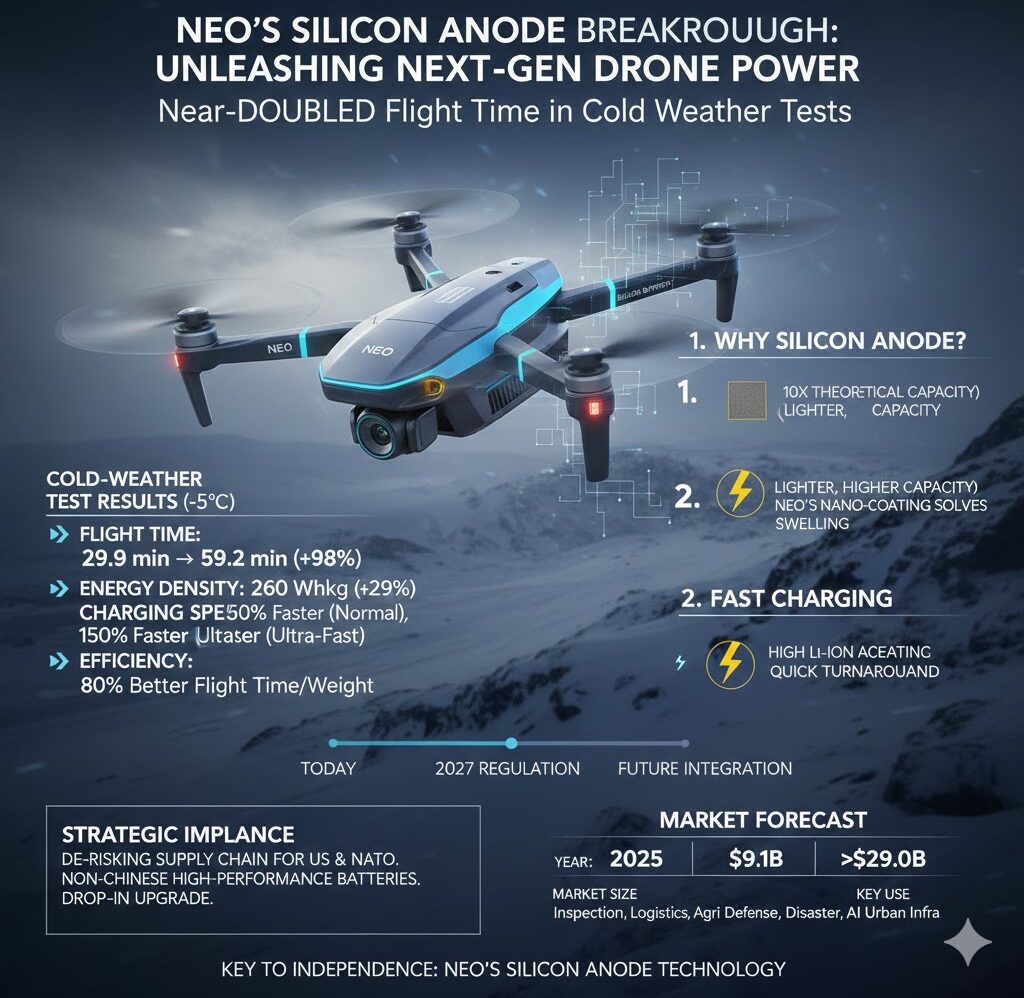
NEO社が開発したシリコンアノード(負極材)技術を投入した新型バッテリーが、実機テストにおいて中国製の標準的なバッテリーを圧倒するパフォーマンスを記録しました。
実地試験の主な結果
韓国のOEM顧客協力のもと、気温マイナス5度からマイナス3度という過酷な寒冷条件下で行われたテスト結果は以下の通りです。
- 飛行時間の延長: 従来の29.9分から59.2分へ(約98%向上)。
- エネルギー密度の向上: パックレベルで260Wh/kgを実現し、ベンチマーク比で29%向上。
- 充電速度の改善: シリコンアノードの採用により、通常充電で50%高速化。超急速充電プロトコルでは最大150%の向上が可能。
- 効率性の最適化: 重量あたりの飛行時間が約80%向上し、システム全体のエネルギー利用効率が劇的に改善。
戦略的意義:脱・中国依存のサプライチェーン
現在、ドローン用バッテリー市場は中国メーカーが独占状態にあります。
NEO社の技術は、「非中国製」の高性能バッテリーを求める米国やNATO加盟国の国防・産業ニーズに応えるものであり、ドローンの機体設計を変更せずに性能を底上げできる点が大きな強みです。
関連補足:なぜ「シリコンアノード」が重要なのか?
今回の飛躍的な性能向上の鍵は、NEO社が注力するシリコンアノード技術にあります。
1. グラファイト(黒鉛)との違い
従来のリチウムイオン電池の負極には主にグラファイトが使われていますが、シリコンはグラファイトの約10倍の理論容量を持ちます。
- メリット: バッテリーの軽量化と大容量化が同時に可能。
- 課題と克服: シリコンは充放電時に激しく膨張・収縮するため壊れやすい欠点がありますが、NEO社は独自のナノコーティング技術等により、低コストでこの耐久性課題を解決しています。
2. 急速充電性能
シリコン材料はリチウムイオンの受け入れ性が高いため、電気自動車(EV)やドローンのように「短時間で充電し、即座に任務に戻る」必要があるデバイスに最適です。
ドローンバッテリーの市場予測
記事内でも触れられている通り、ドローン用バッテリー市場は急成長を遂げています。
| 項目 | 2025年(推定) | 2032年(予測) |
| 市場規模 | 約91億米ドル | 290億米ドル超 |
| 主な用途 | 産業点検、物流、農業 | 国防(UAS)、災害対応、AI都市インフラ |
NEO社の今後の動向と体制
- 商用化へのステップ: 現在、BMS(バッテリー管理システム)の統合や、筐体材料の最適化を進めており、プロトタイプから量産レベルへの移行を急いでいます。
- 経営体制の強化: ナンシー・チャオ(Nancy Zhao)氏がCFO(最高財務責任者)に復帰。製造・テクノロジー分野での豊富な経験を活かし、商用化フェーズにおける財務基盤を固める狙いがあります。
注記: 本レポート中の数値(Wh/kg、Cレートなど)は、NEO社が公表した実地テストに基づくデータです。
出典:https://finance.yahoo.com/news/neo-battery-achieves-near-double-120000495.html?guccounter=1
[Drone Revolution] Overwhelming Performance: NEO’s Silicon Anode Battery Extends Flight Time from 30 to 60 Minutes
NEO Battery Materials Ltd. has developed a new battery utilizing proprietary silicon anode technology. In real-world flight tests, it recorded performance that far exceeded standard Chinese-made battery benchmarks.
Key Results of Field Testing
Conducted in collaboration with a South Korean OEM customer under harsh cold conditions (minus 5 to minus 3 degrees Celsius), the results are as follows:
- Extended Flight Time: Increased from 29.9 minutes to 59.2 minutes (approx. 98% improvement).
- Higher Energy Density: Achieved 260 Wh/kg at the pack level, a 29% increase over the benchmark.
- Improved Charging Speed: Silicon anode integration accelerated standard charging by 50%, with up to 150% improvement possible using ultra-fast charging protocols.
- Efficiency Optimization: Flight time per unit weight improved by approximately 80%, demonstrating a dramatic leap in system-level energy utilization.
Strategic Significance: De-risking the Supply Chain from China
Currently, the drone battery market is dominated by Chinese manufacturers. NEO’s technology meets the defense and industrial demands of the U.S. and NATO members seeking high-performance, non-Chinese battery solutions. A major advantage is the ability to boost performance without requiring a redesign of the drone’s airframe.
Related Insight: Why is “Silicon Anode” Crucial?
The key to this breakthrough lies in the silicon anode technology NEO is focusing on.
1. Difference from Graphite
Traditional lithium-ion batteries primarily use graphite for the anode. However, silicon has a theoretical capacity roughly 10 times higher than graphite.
- Benefit: Enables lighter batteries with much higher capacities.
- Challenge and Solution: Silicon tends to expand and contract during charging/discharging, making it fragile. NEO has solved this durability issue at a low cost through its unique nano-coating technology.
2. Fast Charging Capability
Silicon materials have a high affinity for lithium-ion acceptance, making them ideal for devices that need to “charge quickly and return to mission immediately,” such as Electric Vehicles (EVs) and drones.
Drone Battery Market Forecast
As mentioned in the report, the drone battery market is experiencing rapid growth.
| Item | 2025 (Estimated) | 2032 (Projected) |
| Market Size | Approx. 9.1 Billion USD | Over 29 Billion USD |
| Primary Uses | Industrial inspection, Logistics, Agriculture | Defense (UAS), Disaster response, AI city infra |
NEO’s Future Outlook and Structure
- Steps Toward Commercialization: The company is fast-tracking the transition from prototype to mass production by integrating Battery Management System (BMS) software and optimizing pack-level casing materials.
- Strengthening Management: Nancy Zhao has returned as CFO. Leveraging her extensive experience in manufacturing and technology, she aims to solidify the financial foundation for the commercialization phase.
Note: Figures in this report (Wh/kg, C-rate, etc.) are based on field test data released by NEO Battery Materials Ltd.

コメント