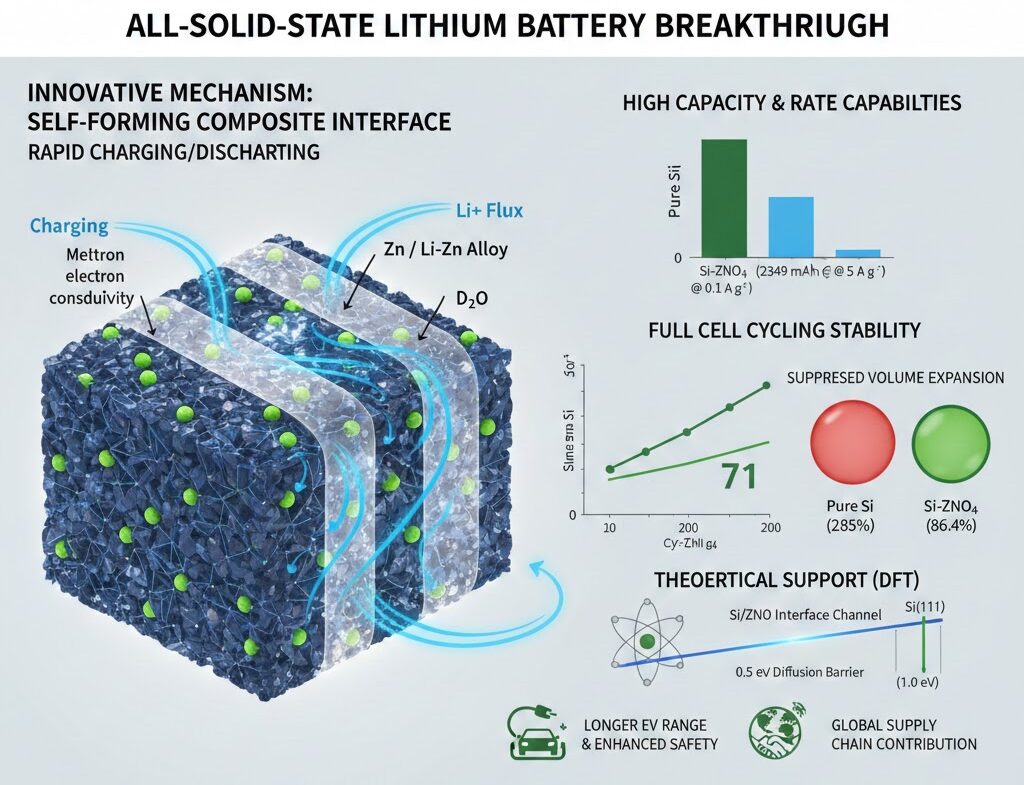
全固体リチウム電池(ASSLB)の実用化において、高容量なシリコン(Si)アノードは期待されていますが、低い導電性とリチウム(Li)イオンの拡散の遅さが課題でした。本研究では、市販のSiマイクロシートにZnOナノ粒子を導入することで、これらの課題を劇的に解決する手法を提案しています。
1. 革新的なメカニズム:自己形成する複合界面
リチウム化(充電)の過程で、導入されたZnOは、Liと反応して以下の物質に変化します。
- Zn(亜鉛) / Li-Zn合金: 電子伝導性を向上させます。
- Li2O(酸化リチウム): 高いリチウムイオン伝導性を提供します。
この「Zn / Li-Zn + Li2O」の混合体が界面に均一なリチウムイオン流束(フラックス)を生み出し、Si単体では困難だった高速な充放電を可能にしました。
2. 主な研究成果と性能指標
Si-ZnO4(酸化亜鉛を最適化した組成)は固体電解質LPSClを使用したセルで、以下の優れた数値を示しました。
- 高容量とレート特性(ハーフセル):
- 低電流(0.1 A g-1)時:2349 mAh g-1
- 高電流(5 A g-1)時:1125 mAh g-1(純粋なSiの約2倍)
- フルセル(NCM811正極との組み合わせ):
- 0.1Cにて 185 mAh g-1 の可逆容量。
- 0.5Cでの200サイクル後も 71% の容量を維持。
- 体積膨張の抑制:
- 合金化後の膨張率は 86.4% に留まり、純粋なSiの285%と比較して大幅に改善。
3. 理論的裏付け(DFT計算)
密度汎関数理論(DFT)を用いた解析により、原子レベルでの性能向上が証明されました。
- 急速輸送経路: SiとZnOの界面に形成される構造的チャネルが、リチウムイオンの拡散障壁を大幅に下げます。
- 拡散障壁の比較:
- Si(111) 表面:約 1.0 eV
- Si/ZnO 界面チャネル:約 0.5 eV(拡散が非常にスムーズ)
4. 業界への影響と今後の展望
- コストと量産性: 市販のSi粉末と酢酸亜鉛を用いた簡便な合成プロセス(熱分解法)であるため、低コストでの大規模生産が期待されます。
- 安全性と走行距離: 全固体電池の安全性に加え、Siアノードによる高エネルギー密度化が実現することで、電気自動車(EV)の航続距離延長に直結します。
- サプライチェーンへの貢献: 米国を中心とした「脱・中国依存」の動きの中で、韓国や日本、欧米のメーカーが活用できる実用的なアノード技術としての価値が高まっています。
専門用語の補足:
- NCM811: ニッケル・コバルト・マンガン(8:1:1)の三元系正極材料。
- LPSCl: Li5.5PS4.5Cl1.5。優れたイオン伝導性を持つ硫化物系固体電解質。
出典:https://pubs.rsc.org/en/content/articlelanding/2026/eb/d5eb00238a
Development of Si-ZnO Composite Anodes for All-Solid-State Batteries: Dramatic Improvement of Interfacial Conductivity via Zn/Li2O Mixture
In the practical application of All-Solid-State Lithium Batteries (ASSLBs), high-capacity Silicon (Si) anodes are highly promising; however, low electrical conductivity and slow Lithium (Li) ion diffusion have remained significant challenges. This study proposes a method to dramatically resolve these issues by introducing ZnO nanoparticles into commercially available Si microsheets.
1. Innovative Mechanism: Self-Forming Composite Interface
During the lithiation (charging) process, the introduced ZnO reacts with Li and transforms into the following substances:
- Zn (Zinc) / Li-Zn Alloy: Improves electronic conductivity.
- Li2O (Lithium Oxide): Provides high lithium-ion conductivity.
This “Zn / Li-Zn + Li2O” mixture creates a uniform lithium-ion flux at the interface, enabling high-speed charging and discharging that was previously difficult with Si alone.
2. Main Research Results and Performance Indicators
Si-ZnO4 (the composition with optimized zinc oxide) demonstrated the following excellent figures in cells using LPSCl solid electrolyte:
- High Capacity and Rate Capability (Half-Cell):
- At low current (0.1 A g-1): 2349 mAh g-1
- At high current (5 A g-1): 1125 mAh g-1 (Approximately double that of pure Si)
- Full-Cell (Paired with NCM811 Cathode):
- Reversible capacity of 185 mAh g-1 at 0.1C.
- Maintained 71% capacity even after 200 cycles at 0.5C.
- Suppression of Volumetric Expansion:
- The expansion rate after alloying remained at 86.4%, a major improvement compared to the 285% seen in pure Si.
3. Theoretical Support (DFT Calculation)
Analysis using Density Functional Theory (DFT) proved the performance improvement at the atomic level.
- Rapid Transport Pathways: Structural channels formed at the interface between Si and ZnO significantly lower the diffusion barrier for lithium ions.
- Comparison of Diffusion Barriers:
- Si(111) surface: Approximately 1.0 eV
- Si/ZnO interface channel: Approximately 0.5 eV (Extremely smooth diffusion)
4. Industry Impact and Future Outlook
- Cost and Mass Production: The simple synthesis process (pyrolysis method) using commercial Si powder and zinc acetate suggests high potential for low-cost, large-scale production.
- Safety and Range: In addition to the inherent safety of all-solid-state batteries, the high energy density achieved by the Si anode directly contributes to extending the cruising range of Electric Vehicles (EVs).
- Supply Chain Contribution: Amidst global efforts to reduce dependence on specific regions for battery materials, this practical anode technology holds high value for manufacturers in South Korea, Japan, the US, and Europe.
Supplementary Technical Terms:
- NCM811: A ternary cathode material composed of Nickel, Cobalt, and Manganese in an 8:1:1 ratio.
- LPSCl: Li5.5PS4.5Cl1.5. A sulfide-based solid electrolyte known for excellent ion conductivity.


コメント