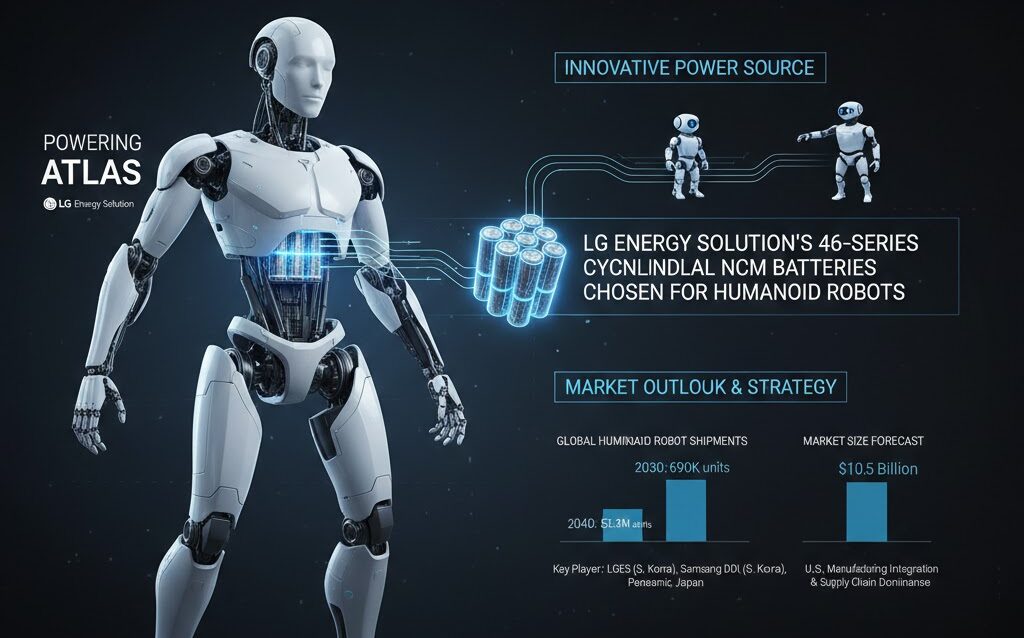
2026年2月、長らく謎に包まれていた人型ロボットAtlas(アトラス)の動力源が、韓国LGエナジーソリューション(LGES)製のバッテリーであることが業界筋により明らかになりました。
主なトピックス
- 供給メーカーの特定: CES 2026での発表後、供給元について憶測が飛び交っていましたが、かつて四足歩行ロボット「Spot」でも実績のあったLGESが選定されました。
- 採用技術: 高エネルギー密度を誇る46シリーズの円筒形三元系(NCM)電池セルが搭載されています。
- 主要顧客の独占: LGESは、テスラの「Optimus(オプティマス)」にもバッテリーを供給しており、人型ロボット界の2強(ヒュンダイ・テスラ)を顧客に抱えることになります。
技術的背景と重要性
なぜ三元系円筒形電池なのか?
人型ロボットは、電気自動車(EV)とは異なり、バッテリーを収納できるスペースが極めて限られています。
- 高エネルギー密度: 人間の胴体と同等のサイズで動力を確保するため、体積あたりの出力が高い三元系電池が不可欠です。
- 46シリーズの利点: 直径46mmの次世代円筒形規格は、従来のセルよりも容量と出力が大幅に向上しており、高負荷な動きが求められるAtlasのようなロボットに最適です。
競合状況
現在、高性能な三元系電池を大規模に量産できるメーカーは世界でも限られています。
- LGエナジーソリューション(韓国)
- サムスンSDI(韓国)
- パナソニック(日本)
市場の展望と将来予測
ロボット用バッテリー市場の成長
EV市場の成長鈍化が続く中、バッテリー業界はロボット分野を「次なる成長の柱」と位置づけています。
| 項目 | 2030年予測 | 2040年予測 |
| 世界出荷台数 | 69万台 | 5330万台 |
| 市場規模 | – | 105億ドル |
今後の展開
- 工場導入: Atlasは2028年からヒュンダイの米国工場に導入される予定です。サービス・エンタメ志向の他社ロボットに比べ、より実用的な製造現場での活用が期待されています。
- 地政学的影響: 米国が中国製バッテリーへの依存を減らそうとする動き(IRA法関連など)を受け、韓国メーカーは米国主導のロボット・サプライチェーンにおいて有利な立場を築いています。
補足: LGESは、テスラやヒュンダイ以外にも中国メーカーを含む6社以上のロボット関連企業に供給していることを示唆しており、同分野でのデファクトスタンダード(事実上の標準)化を狙っています。
Winning Both Tesla and Boston Dynamics: Is LGES Set to Dominate the Robot Battery Market?
In February 2026, industry sources revealed that the power source for the humanoid robot Atlas, which had long been shrouded in mystery, is a battery manufactured by South Korea’s LG Energy Solution (LGES).
Key Highlights
- Identification of the Supplier: Following the announcement at CES 2026, there was much speculation regarding the supplier. LGES, which has a proven track record with the quadruped robot “Spot,” was ultimately selected.
- Technology Adopted: Atlas is equipped with 46-series cylindrical ternary (NCM) battery cells, boasting high energy density.
- Securing Major Clients: By supplying batteries to both Tesla’s “Optimus” and Boston Dynamics’ Atlas, LGES now counts the two titans of the humanoid robot world (Hyundai and Tesla) as its customers.
Technical Background and Significance
Why Cylindrical Ternary Batteries?
Unlike Electric Vehicles (EVs), humanoid robots have extremely limited space for battery storage.
- High Energy Density: To ensure sufficient power within a volume comparable to a human torso, ternary batteries with high volumetric output are essential.
- Advantages of the 46-series: The next-generation 46mm diameter cylindrical standard offers significantly higher capacity and output compared to conventional cells, making it ideal for robots like Atlas that require high-load movements.
Competitive Landscape
Currently, only a handful of manufacturers can mass-produce high-performance ternary batteries:
- LG Energy Solution (South Korea)
- Samsung SDI (South Korea)
- Panasonic (Japan)
Market Outlook and Future Projections
Growth of the Robot Battery Market
As the growth of the EV market slows, the battery industry views the robotics sector as its next pillar of growth.
| Item | 2030 Forecast | 2040 Forecast |
| Global Shipments | 690,000 units | 53.3 million units |
| Market Size | – | 10.5 billion dollars |
Future Developments
- Factory Integration: Atlas is scheduled for deployment at Hyundai’s U.S. plants starting in 2028. Compared to service- or entertainment-oriented robots from other companies, Atlas is expected to be more practical for manufacturing environments.
- Geopolitical Impact: As the U.S. seeks to reduce dependence on Chinese-made batteries (partly due to the IRA and related policies), South Korean battery makers are finding new opportunities within the U.S.-led humanoid robot supply chain.
Note: LGES has hinted that it supplies batteries to more than six robotics-related companies, including Chinese manufacturers, aiming to establish its technology as the “de facto standard” in the field.
コメント