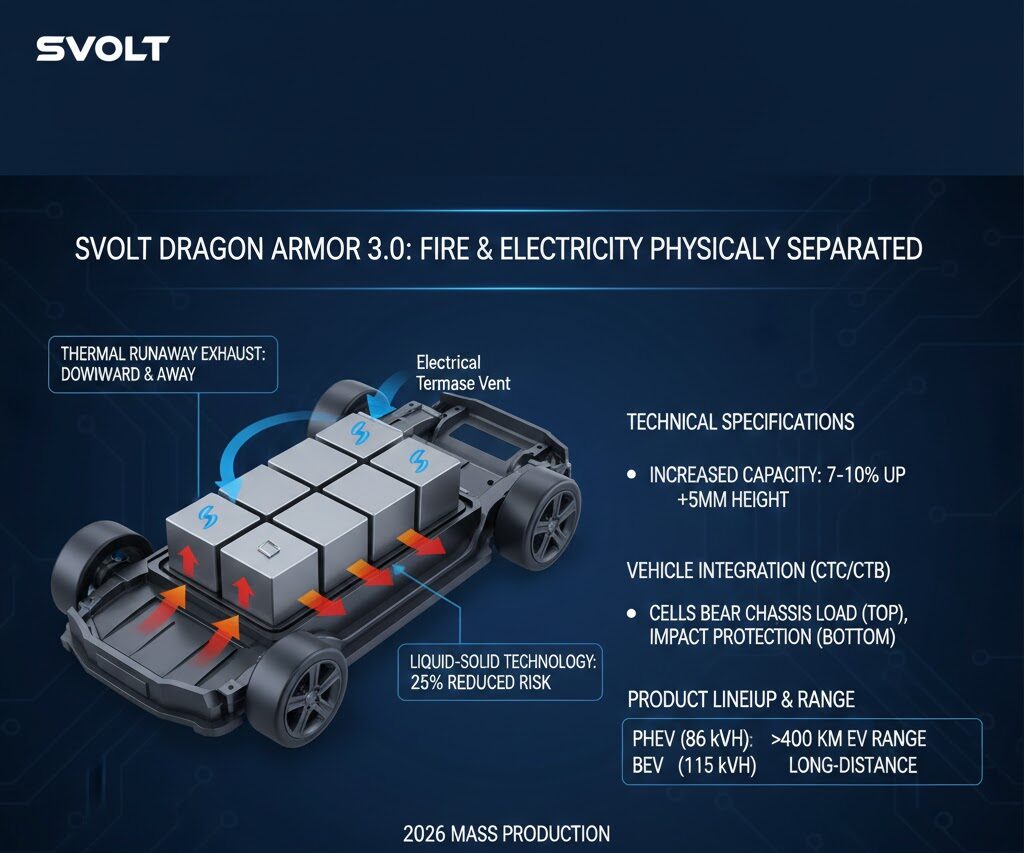
Svoltは、新型バッテリー「Dragon Armor 3.0」において、業界で初めて火と電気の物理的分離を実現したと主張しています。
- 革新的な配置: 従来は近接していた「電気端子」と「ガス排出弁(圧力逃がしチャネル)」をセルの反対側に配置しました。
- 安全性の向上: 熱暴走(異常発熱)が発生した際、炎や高温ガスは乗員室とは反対の下方へ指向性を持って排出されます。これにより、火が車内へ到達するのを防ぎ、乗員の避難時間を確保します。
- リスク低減: 液体固体技術(半固体電池技術)の採用により、熱暴走の発生確率を 25% 減少させています。
技術的な特徴とスペック
このバッテリーは安全面だけでなく、エネルギー密度や車両への統合技術においても進化しています。
1. スペックの向上
- 容量アップ: パッケージサイズを変えずに、容量を 7% から 10% 増加。
- セルの形状: 角形(プリズマティック)セルを採用。セルの高さは従来より 5mm 高くなっています。
2. 車両統合技術(CTC/CTB)
- 効率的な構造: CTC (Cell-to-Chassis) や CTB (Cell-to-Body) と呼ばれる、電池を車体構造の一部として組み込む技術を採用。
- 堅牢性: セルの上部は車体の荷重を支える強度を持ち、下部は衝突時の保護と圧力緩和の役割を担う設計です。
3. ラインナップと航続距離
現在、以下の2つのパックオプションが計画されています。
| 用途 | バッテリー容量 | 航続距離 / 特徴 |
| PHEV (プラグインハイブリッド) | 86 kWh | EV走行で 400 km 以上 |
| BEV (電気自動車) | 115 kWh | 長距離走行に対応 |
背景と今後の展望
- 開発の歴史: 初代Dragon Armorは2022年12月に発表されました。今回の3.0はそのコンセプトをさらに進化させた量産モデルです。
- 量産時期: 2026年内に本格的な量産が開始される見込みで、複数の自動車メーカーの新型プラットフォームへの採用が決まっています。
- Svoltについて: 中国の自動車メーカー、長城汽車 (Great Wall Motor) からスピンオフした企業であり、世界トップ10に入るバッテリーサプライヤーです。
補足: Svoltの技術は、LFP(リン酸鉄リチウム)で最大 800 km、NCM(三元系)では 4C 急速充電(約15分で満充電に近い充電が可能)をサポートするなど、高い汎用性を持っています。
Directing Fire Downward: Svolt Dragon Armor 3.0 Realizes the Ultimate in EV Safety
Svolt claims that its new Dragon Armor 3.0 battery has achieved the industry’s first physical separation of fire and electricity.
- Innovative Layout: The electrical terminals and the pressure relief channels (gas vents), which were traditionally close to each other, are now positioned on opposite sides of the cell.
- Enhanced Safety: In the event of thermal runaway (abnormal overheating), flames and high-temperature gases are discharged directionally downward, away from the passenger compartment. This prevents fire from entering the cabin and secures critical evacuation time for passengers.
- Risk Reduction: By adopting liquid-solid technology (semi-solid battery technology), the probability of thermal runaway has been reduced by 25 percent.
Technical Features and Specifications
This battery has evolved not only in safety but also in energy density and vehicle integration technology.
1. Improved Specifications
- Increased Capacity: Battery capacity has increased by 7 percent to 10 percent without changing the overall package size.
- Cell Design: Uses prismatic cells. The cell height is 5 mm taller than previous versions.
2. Vehicle Integration (CTC/CTB)
- Efficient Structure: Utilizes CTC (Cell-to-Chassis) and CTB (Cell-to-Body) technologies, where the battery is integrated as a structural part of the vehicle.
- Robustness: The top of the cell is designed to be load-bearing for the vehicle, while the bottom is designed for pressure relief and crash protection.
3. Lineup and Range
Two battery pack options are currently planned:
| Application | Battery Capacity | Range / Features |
| PHEV (Plug-in Hybrid) | 86 kWh | Over 400 km in pure electric mode |
| BEV (Electric Vehicle) | 115 kWh | Designed for long-range driving |
Background and Future Outlook
- Development History: The first-generation Dragon Armor was launched in December 2022. Version 3.0 is a mass-production model that further evolves that original concept.
- Mass Production: Full-scale production is expected to begin within 2026, with adoption already confirmed for the new platforms of several automakers.
- About Svolt: A spin-off from the Chinese automaker Great Wall Motor, Svolt is now a top 10 global battery supplier.
Note: Svolt’s technology offers high versatility, supporting a range of up to 800 km for LFP (Lithium Iron Phosphate) applications and 4C fast charging for NCM (Nickel Cobalt Manganese) applications (allowing a near-full charge in approximately 15 minutes).
コメント