世界的な脱炭素化の流れを受け、電気自動車(EV)の普及が加速しています。特にカナダ・ブリティッシュコロンビア州では、2024年の新車登録の約23%をゼロエミッション車が占めるなど、北米でもトップクラスの導入率を誇ります。これに伴い、現場で車両を扱う整備士には、従来とは異なる高度な安全知識が求められるようになりました。
こうした背景の中、教育機関と技術メーカーがタッグを組み、リチウムイオンバッテリーの火災リスクを劇的に低減させる新技術をカリキュラムに導入する動きが注目を集めています。
1. BCITとPACTによる戦略的提携
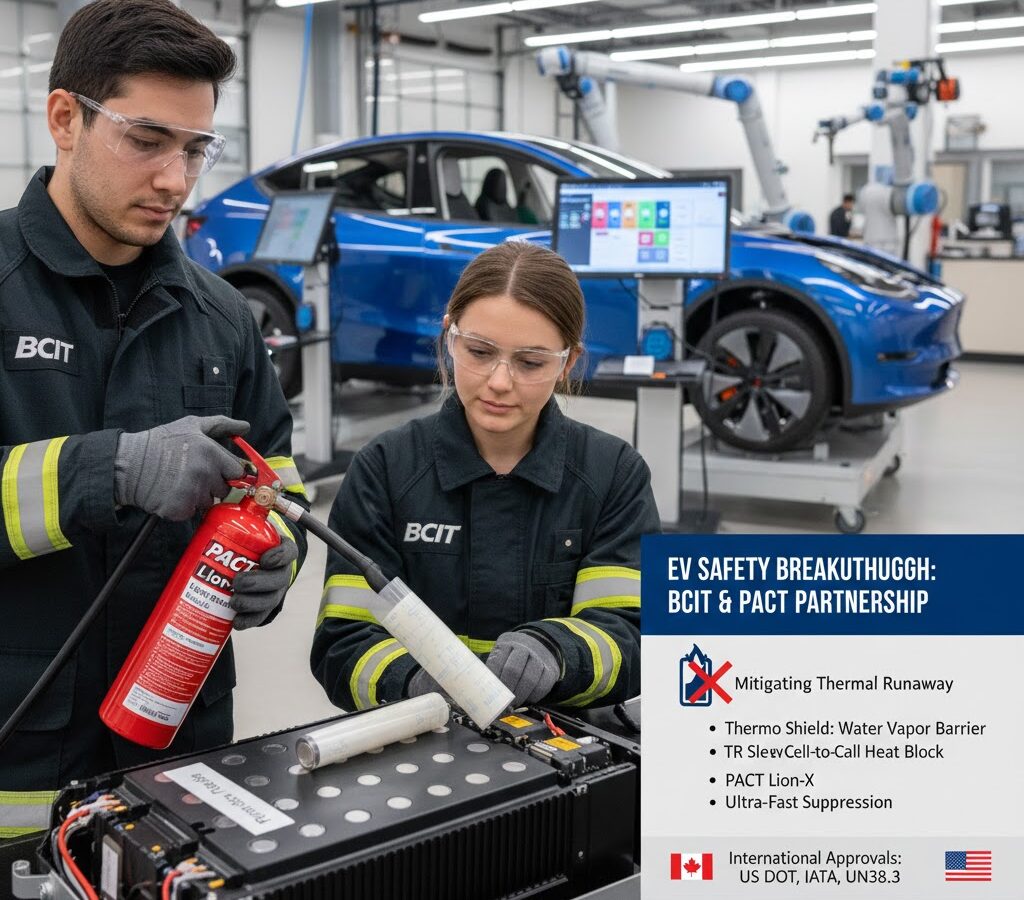
カナダのブリティッシュコロンビア工科大学(BCIT)は、米国の包装技術メーカーであるPackaging And Crating Technologies(PACT)と提携しました。BCITの自動車整備コースにおいて、PACTが開発した特許技術「Thermo Shield」および「TR Sleeve」を教材および安全対策として採用し、次世代のEV整備士を育成します。
2. 革新的な防火技術の仕組み
リチウムイオンバッテリーの最大の懸念は、衝撃や短絡によって温度が急上昇し、消火が困難になる「熱暴走」です。PACTの製品は以下の仕組みでこれを制御します。
- Thermo Shield(防火紙ラップ): 特殊なインクを塗布した軽量な紙素材。熱暴走が発生するとインクから水分バリアが放出され、蒸気によって内容物を冷却します。
- 温度制御: バッテリー温度が華氏1,500度(摂氏約840度)に達するのを防ぎます。この温度を超えると人体に致命的なガスが発生するため、その抑制は極めて重要です。
- TR Sleeve: バッテリーセルを個別に包む超薄型スリーブ。セル間の熱伝播を食い止め、パック全体の火災を防ぎつつ、高いエネルギー密度を維持します。
3. 国際的な信頼性と今後の展開
これらの技術は、米国国防総省や米国運輸省(DOT)から承認・特別許可を得ているほか、国際航空運搬協会(IATA)などの主要機関からも高く評価されています。
さらに、2026年内には新製品PACT Lion-X消火器の導入も予定されています。これは、摂氏1,600度を超えるリチウム電池火災を数秒で消火し、有毒ガスの放出を抑える世界初の水ベース消火剤です。
【関連情報】リチウムイオンバッテリー安全性の国際動向
この記事の内容を補足する、現在の国際的な安全基準や業界の動向は以下の通りです。
- UN38.3試験: リチウムバッテリーを輸送する際に必須となる国連勧告の試験規格。高度シミュレーション、熱試験、衝撃試験など、厳しい基準をクリアする必要があります。
- 固体電池への期待: 現在の液体電解質に代わり、燃えにくい固体の電解質を用いる「全固体電池」の開発が世界中で進んでいます。これが実用化されれば、熱暴走のリスクは根本から低減されると期待されています。
- バッテリーパスポート: 欧州(EU)を中心に導入が進む制度。製造履歴や材料、リサイクル情報をデジタルで管理し、安全な再利用や廃棄を促進する仕組みです。
[2026 Update] New Technology to Prevent EV Battery Fires Becomes Standard in North American Education
Driven by the global push for decarbonization, the adoption of electric vehicles (EVs) is accelerating. British Columbia, Canada, stands at the forefront of this movement in North America, with zero-emission vehicles accounting for approximately 23% of new vehicle registrations in 2024. Consequently, automotive technicians are now required to possess advanced safety knowledge that differs significantly from traditional mechanical training.
In response to this shift, a high-profile collaboration between an educational institution and a technology manufacturer is integrating groundbreaking fire-mitigation solutions into the curriculum to drastically reduce lithium-ion battery risks.
1. Strategic Partnership Between BCIT and PACT
The British Columbia Institute of Technology (BCIT) has partnered with Packaging And Crating Technologies (PACT), a US-based manufacturer of sustainable packaging. BCIT’s automotive service courses will now utilize PACT’s patented “Thermo Shield” and “TR Sleeve” technologies as both educational tools and safety measures to train the next generation of EV technicians.
2. How the Innovative Fire Prevention Technology Works
The primary concern with lithium-ion batteries is “thermal runaway,” a state where internal temperatures spike due to impact or short circuits, making fires extremely difficult to extinguish. PACT’s products control this phenomenon as follows:
- Thermo Shield (Fire-Resistant Paper Wrap): A lightweight paper material coated with a specialized ink. When thermal runaway occurs, the ink releases a moisture barrier, creating a steam cloud that instantly cools the contents.
- Temperature Control: The technology prevents battery temperatures from exceeding 1,500 degrees Fahrenheit (approximately 840 degrees Celsius). This is critical, as exceeding this threshold triggers the release of lethal gases.
- TR Sleeve: An ultra-thin sleeve that individualizes each battery cell. It prevents heat from propagating between cells, stopping a total pack fire while maintaining high energy density.
3. International Credibility and Future Outlook
These technologies are approved or specially permitted by the US Department of Defense and the US Department of Transportation (DOT). They are also highly regarded by major organizations such as the International Air Transport Association (IATA).
Furthermore, the “PACT Lion-X” extinguisher is scheduled for launch by the end of 2026. This is the world’s first water-based extinguishing agent capable of knocking out lithium battery fires exceeding 1,600 degrees Celsius within seconds while eliminating toxic gas emissions.
[Related Information] International Trends in Lithium-Ion Battery Safety
The following standards and trends provide additional context to the safety landscape:
- UN38.3 Testing: A United Nations standard required for the safe transport of lithium batteries. It includes rigorous testing for altitude simulation, thermal stability, and mechanical impact.
- Expectations for Solid-State Batteries: Global development is underway for “all-solid-state batteries” that use non-flammable solid electrolytes. Their commercialization is expected to fundamentally eliminate thermal runaway risks.
- Battery Passports: A system gaining traction in the EU that uses digital tracking for manufacturing history, materials, and recycling data to promote safe reuse and disposal.
コメント