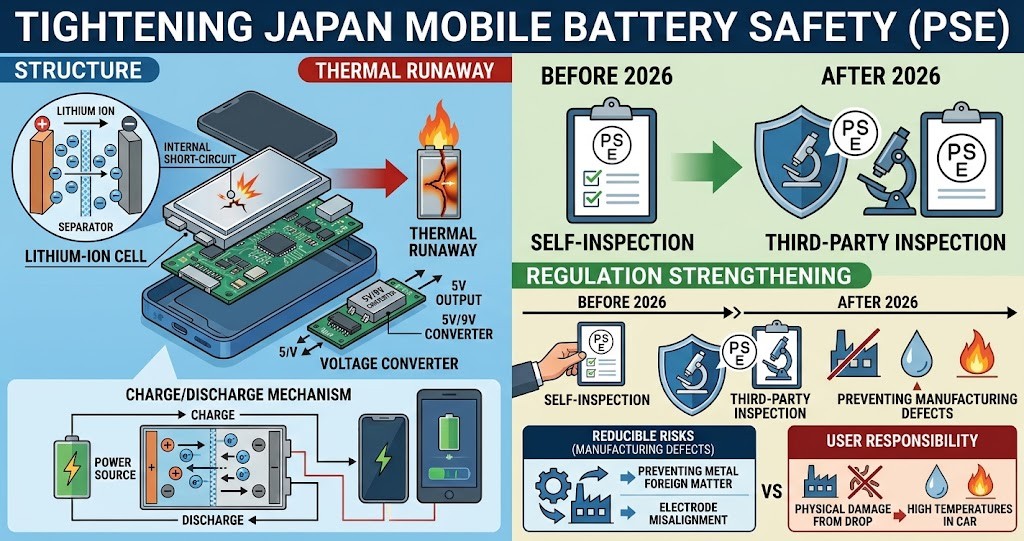
モバイルバッテリーの破裂や発火事故の急増を受け、経済産業省は2026年8月末、製品安全規格(PSE)の規制強化方針を示しました。本記事では、モバイルバッテリーが電気を蓄えて供給する技術的仕組み、内部短絡から発火へ至る連鎖的な反応、そして今回の第三者検査義務化によって防げるリスクと防げないリスクを解説します。
1. モバイルバッテリーの構造と「3つの役割」
モバイルバッテリーの内部は、単に電気を溜めるタンクではなく、主に3つの要素で構成されています。
- 電池セル: リチウムイオン移動による化学反応でエネルギーを保持・放出する。
- 電圧変換回路: スマートフォン等の機器に応じた適切な電圧(5Vや9Vなど)に変換する。
- 制御・保護回路: 過充電、過放電、過電流、過熱などを検知し、異常時に電流を遮断する。
充放電のメカニズム
充電時は外部からの電力によってリチウムイオンが負極へ移動し、化学エネルギーとして蓄えられます。放電時はイオンが電解液を通って正極へ移動すると同時に、電子がセパレーター(絶縁膜)を通過できず外部回路を通ることで、給電(電流)として機能します。
2. 発火に至る「熱暴走」の連鎖プロセス
保護回路は外部からの過電圧や過電流を遮断できますが、セル内部で起きる異常(内部短絡)を完全に止めることはできません。
発火への5段階プロセス
- 局所発熱: 製造時の微細な金属異物混入、電極の巻きずれ、落下等の外力によってセパーレーターが傷つき、内部短絡(ショート)が発生。傷ついた一点に電流が集中し局所的に発熱する。
- 短絡の拡大: 熱により樹脂製セパレーターが収縮・溶融し、正負極の接触面積が広がる。
- 発熱反応: 高温化に伴い、電極材料と可燃性の有機電解液が化学反応を起こし、さらに大量の熱を放出する。
- ガス発生と内圧上昇: 電解液等の分解により可燃性ガスが発生し、セル内部の圧力が急上昇(膨張現象)。
- 噴出と着火(熱暴走): 限界に達したケースから高温ガスと内容物が噴出し、空気に触れて激しく着火する。
3. 2026年最新動向:PSEマーク制度の強化と第三者検査の義務化
独立行政法人製品評価技術基盤機構(NITE)のデータによると、モバイルバッテリーの事故件数は2025年に192件に達し、2021年の約4倍に急増しました。これを受け、経済産業省は規制の大幅な強化へ舵を切りました。
- 「特定電気用品」への指定案(2026年8月31日表明)従来の「製造・輸入事業者による自己確認(自己検査)」主体の基準から、国の登録を受けた第三者機関による技術基準適合検査を義務付ける枠組みへの移行を目指します。
- 技術基準の見直し完成品の抜き取り検査だけでなく、製造工程における「異物混入防止」や「電極の巻きずれ防止」といった根本的な品質管理要求を追加する方針です。
- 今後のスケジュール2026年度内に電気用品安全法(PSE)の政省令を改正し、2027年3月頃の施行を目指しています。
4. 第三者検査で「減らせるリスク」と「手元に残るリスク」
制度の強化により出荷前の潜在的欠陥は大幅に低減されますが、すべての事故がゼロになるわけではありません。
| 区分 | 主な原因・事象 | 対策と防ぎ方 |
| 制度強化で減らせるリスク (製造・設計上の不備) | ・製造時の金属異物混入 ・電極やセパレーターの位置ずれ ・保護回路の設計不備 | 第三者機関の検査義務化および製造品質管理基準の厳格化(2027年施行予定) |
| 手元に残るリスク (購入後の使用環境・取り扱い) | ・落下や圧迫によるセルの物理的損傷 ・炎天下の車内など高温環境での放置 ・経年劣化によるセルの膨張 | ユーザー自身の安全管理(衝撃を避ける、熱を逃がす、異常兆候時の使用中止) |
まとめ:利用者が取るべき対策
PSEマークの強化は「製造時の初期不良」を排除するための措置であり、購入後の取り扱いは引き続き利用者の管理に委ねられます。
- 購入時: PSEマークの確認に加え、信頼できる販売事業者であるか、リコール対象になっていないかを確認する。
- 使用時: 車内放置や布団の上での充電など熱がこもる場所を避け、強い衝撃を与えない。
- 異常時の対応: 膨らみ、極端な発熱、変形、異臭などを確認した場合は直ちに使用を中止し、圧力をかけずに廃棄・回収手続きを行う。
出典:https://xenospectrum.com/mobile-battery-fire-mechanism/
What Changes with Stricter PSE Standards? “Post-Purchase Fire Risks” Unpreventable by Third-Party Inspections and Proper Handling
In response to a sharp increase in power bank rupture and fire accidents, Japan’s Ministry of Economy, Trade and Industry (METI) announced a policy to tighten regulations under the Electrical Appliances and Materials Safety Act (PSE) at the end of August 2026. This article explains the technical mechanisms by which power banks store and supply electricity, the chain reaction leading from internal short circuits to thermal runaway, and the risks that can—and cannot—be prevented by the newly mandated third-party testing.
1. Structure of a Power Bank and Its “Three Roles”
The interior of a power bank is not simply a container for storing electricity; it consists of three main components:
- Battery Cell: Holds and releases energy through chemical reactions driven by lithium-ion movement.
- Voltage Conversion Circuit: Converts voltage to the appropriate level (such as 5V or 9V) required by connected devices like smartphones.
- Control/Protection Circuit: Detects overcharging, overdischarging, overcurrent, and overheating, shutting off the electric current when anomalies occur.
Charge and Discharge Mechanism
During charging, external power forces lithium ions to move to the negative electrode (anode), where energy is stored chemically. During discharging, ions move back to the positive electrode (cathode) through the electrolyte. Because electrons cannot pass through the separator (insulating membrane), they travel through an external circuit, supplying power (electric current) to the connected device.
2. The Chain Reaction Leading to “Thermal Runaway” and Fire
While protection circuits can cut off external overvoltage or overcurrent, they cannot completely stop internal anomalies (internal short circuits) occurring within the cell.
5-Step Process to Fire
- Localized Heating: Microscopic metallic impurities introduced during manufacturing, electrode misalignment, or external forces like drops damage the separator, causing an internal short circuit. Current concentrates at the damaged point, generating localized heat.
- Expansion of the Short Circuit: Heat causes the polymer separator to shrink and melt, widening the contact area between the positive and negative electrodes.
- Exothermic Reaction: As temperatures rise, electrode materials react chemically with the flammable organic electrolyte, releasing massive amounts of additional heat.
- Gas Generation and Pressure Build-up: Decomposition of the electrolyte and electrode materials generates flammable gases, causing internal pressure to spike rapidly (swelling phenomenon).
- Venting and Ignition (Thermal Runaway): High-temperature gas and internal contents rupture the casing, violently igniting upon contact with air.
3. 2026 Latest Update: Strengthening PSE Certification and Mandating Third-Party Testing
According to data from the National Institute of Technology and Evaluation (NITE), power bank accidents reached 192 cases in 2025—roughly quadrupling compared to 2021. In response, METI decided to significantly tighten regulations.
- Proposal for “Specified Electrical Appliances” Designation (Announced August 31, 2026)Transitions from the traditional framework—which relied primarily on self-testing by manufacturers and importers—to a mandatory scheme requiring conformity testing by state-registered third-party testing bodies.
- Revision of Technical StandardsIn addition to sampling tests on finished products, fundamental quality control requirements—such as preventing foreign object contamination and electrode misalignment during manufacturing—will be added.
- Future ScheduleMETI aims to revise the ministerial orders under the Electrical Appliances and Materials Safety Act within fiscal year 2026, with enforcement targeted for around March 2027.
4. Risks Prevented by Third-Party Inspections vs. Risks Remaining with Users
While stricter regulations will substantially reduce latent defects prior to shipping, they cannot eliminate every type of accident.
| Category | Primary Causes / Phenomena | Countermeasures & Prevention |
| Risks Prevented by Regulatory Tightening (Manufacturing & Design Defects) | ・Metallic impurity contamination during manufacturing ・Misalignment of electrodes or separators ・Design flaws in protection circuits | Mandatory third-party testing and stricter manufacturing quality control standards (scheduled for enforcement in 2027) |
| Risks Remaining with Users (Post-Purchase Usage Environment & Handling) | ・Physical cell damage from drops or pressure ・Exposure to high temperatures (e.g., inside a hot vehicle) ・Cell swelling due to age-related degradation | User safety management (avoiding impacts, preventing heat buildup, and discontinuing use upon signs of abnormality) |
Summary: Actions Users Should Take
Strengthening PSE certification is aimed at eliminating initial defects from manufacturing; safe handling after purchase remains the user’s responsibility.
- At Purchase: Check for the PSE mark, ensure the vendor is reputable, and verify the product is not subject to recalls.
- During Use: Avoid places where heat can build up (such as hot cars or under bedding) and protect the unit from severe physical impacts.
- In Case of Abnormality: If swelling, extreme heating, deformation, or unusual odors are observed, immediately stop using the device. Do not apply pressure, and follow proper disposal/recycling procedures.

コメント