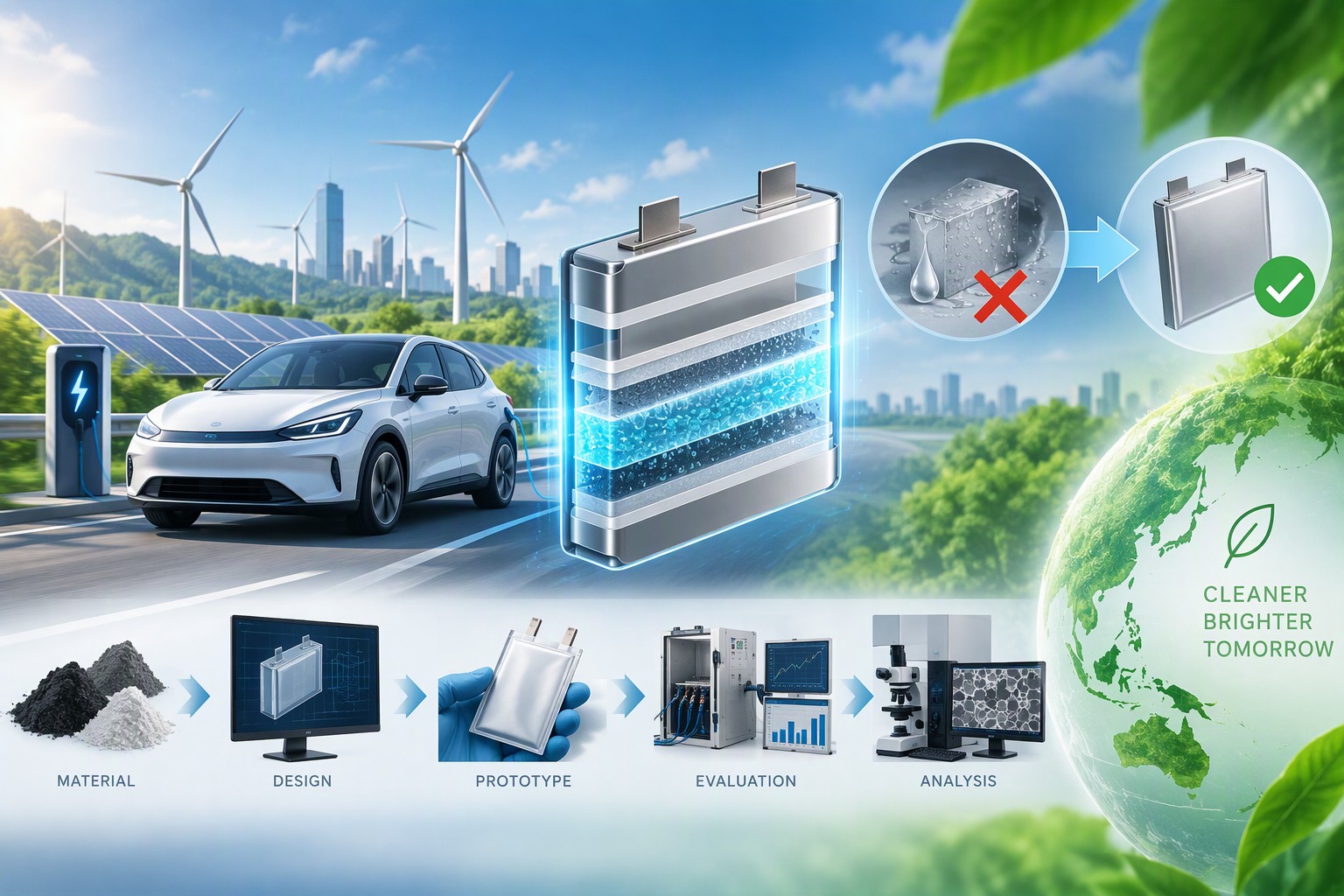
脱炭素社会の実現に向け、EV(電気自動車)や再生可能エネルギー分野での蓄電池需要が急速に高まっています。その中で、小型化と高出力を両立する次世代技術として「バイポーラ型リチウムイオン電池(BP-LIB)」が世界中から強い関心を集めています。しかし、液体電解質を用いるタイプでは漏液やセルの封止が極めて難しく、実用化に向けた大きな壁となっていました。
こうした課題に対し、JFEテクノリサーチは長年の技術蓄積をもとに独自の漏液抑制技術を確立。顧客が開発した最新材料を用いて、セルの試作から評価・分析までを一貫して請け負う新サービスを開始しました。本サービスは、材料メーカーや自動車メーカーの開発現場における試作コストや期間を大幅に削減し、次世代電池の早期社会実装を強力に後押しする取り組みとして期待されています。
1. プレスリリースのポイント
- 新サービスの開始: 液系バイポーラ型リチウムイオン電池(BP-LIB)のセル設計、試作、評価、分析までを一貫提供するサポートサービスをスタート。
- 独自の漏液抑制技術: 長年のラミネートセル試作・評価で培ったノウハウを活用し、これまで困難とされていた液系BP-LIBの漏液防止と安定試作技術を確立。
- 開発の加速とリソース最適化: 顧客の試作評価プロセスを代行することで、材料メーカーや自動車メーカーが中核の開発業務に集中できる環境を提供。
2. バイポーラ型電池(BP-LIB)の概要と課題
基本構造とメリット
- バイポーラ構造: 1枚の集電箔の表面に正極、裏面に負極を形成し、複数枚を1つのセル内で積層する構造。
- メリット: 従来型電池に必要な接続部品(リード)を削減できるため、内部抵抗が大幅に低減。大電流・高出力化に加え、小型・軽量化や高電圧化を同時に実現可能。
実用化に向けた課題
- 漏液と液絡: 液体電解質を用いる場合、隣接するセル間での電解液の漏れ(液絡)や外部漏れを防ぐ高度な封止技術が必要。
- 材料適合性: BP-LIBで性能を発揮するためには、電極や電解液だけでなく、新たなシール材や絶縁膜の選定・最適化が不可欠。
3. 提供サービスの仕様と評価項目
対象範囲および材料
- 対象電池: 単層セル、2直列セル、3直列セルなどの液系BP-LIB。
- 対象部材: 正極材(当面)、電解液、バインダー、セパレーター、タブシール、各種セル構成部材。
- 試作仕様例: 電極面積 50 mm x 50 mm(サイズ調整可能)、最大3層直列まで対応。電圧プローブを取り付けることで、各層ごとの電圧プロファイル計測が可能。
評価・分析項目
- 初期充放電試験(充電0.1 C、放電0.1 Cでの動作検証など)
- 直流抵抗測定および交流抵抗測定
- レート特性評価
- 試験後のセルおよび構成部材の劣化・構造分析
4. 今後の展望
- 対応部材の拡大: 集電箔やセル構成の改良を進め、負極材料についてもBP-LIB構造で評価可能な体制を準備。
- 他電池系への展開: リチウムイオン電池にとどまらず、ナトリウムイオン電池など他の電池系へのバイポーラ構造の応用も検討。
出典:https://www.rbbtoday.com/release/prtimes2-today/20261110/1399383.html
JFE Techno-Research Launches Prototype and Evaluation Service for Liquid-based Bipolar Lithium-ion Batteries
To achieve a decarbonized society, the demand for storage batteries in the EV (Electric Vehicle) and renewable energy sectors is rapidly growing. Under these circumstances, “Bipolar Lithium-ion Batteries (BP-LIB)” have attracted strong global interest as a next-generation technology that achieves both compactness and high power output. However, types using liquid electrolytes face significant obstacles to commercialization due to the extreme difficulty of preventing leakage and ensuring effective cell sealing.
To address these challenges, JFE Techno-Research established a proprietary leakage suppression technology based on years of technical expertise. The company launched a new service that provides end-to-end handling from cell prototyping to evaluation and analysis using advanced materials developed by customers. This initiative is expected to significantly reduce prototyping costs and cycle times at material suppliers and automaker R&D sites, strongly boosting the early real-world implementation of next-generation batteries.
1. Key Points of the Press Release
- Launch of New Service: Started a comprehensive support service covering cell design, prototyping, evaluation, and analysis of liquid-based bipolar lithium-ion batteries (BP-LIB).
- Proprietary Leakage Suppression Technology: Utilized know-how gained through years of pouch cell prototyping and evaluation to establish stable prototyping processes and leakage prevention techniques for liquid BP-LIBs, which were previously considered difficult.
- Accelerated Development and Resource Optimization: Provides an environment where material and automobile manufacturers can focus on core development tasks by outsourcing the prototype evaluation process.
2. Overview and Challenges of Bipolar Batteries (BP-LIB)
Basic Structure and Benefits
- Bipolar Structure: A design where a positive electrode is formed on the front surface and a negative electrode on the back surface of a single current collector foil, stacking multiple layers within a single cell package.
- Benefits: Eliminates connecting parts (tabs/leads) required in conventional batteries, significantly reducing internal resistance. Enables high-current, high-power output while simultaneously achieving miniaturization, weight reduction, and high voltage capability.
Challenges Toward Commercialization
- Leakage and Liquid Short Circuits: When liquid electrolyte is used, advanced sealing techniques are required to prevent electrolyte cross-leakage between adjacent cell layers (liquid shorting) and external leakage.
- Material Compatibility: Achieving high performance in BP-LIBs requires selecting and optimizing not only electrodes and electrolytes but also new sealing materials and insulating films.
3. Specifications and Evaluation Items of the Service
Scope and Materials Covered
- Target Batteries: Liquid BP-LIBs (single-layer cells, 2-series cells, 3-series cells, etc.).
- Target Materials: Cathode materials (for the time being), electrolytes, binders, separators, tab seals, and various cell components.
- Prototyping Specifications (Example): Electrode area of 50 mm x 50 mm (customizable), supporting up to 3-layer series stacking. Voltage profiles for each layer can be measured by attaching voltage probes.
Evaluation and Analysis Items
- Initial charge-discharge testing (e.g., performance verification at 0.1 C charge / 0.1 C discharge)
- Direct Current (DC) resistance measurement and Alternating Current (AC) resistance measurement
- Rate capability evaluation
- Post-test degradation and structural analysis of cells and components
4. Future Outlook
- Expanding Covered Materials: Advancing improvements in current collector foils and cell configurations to build an evaluation framework for anode materials in BP-LIB structures.
- Expansion to Other Battery Systems: Exploring the application of bipolar structures beyond lithium-ion batteries to other battery systems, such as sodium-ion batteries.
コメント