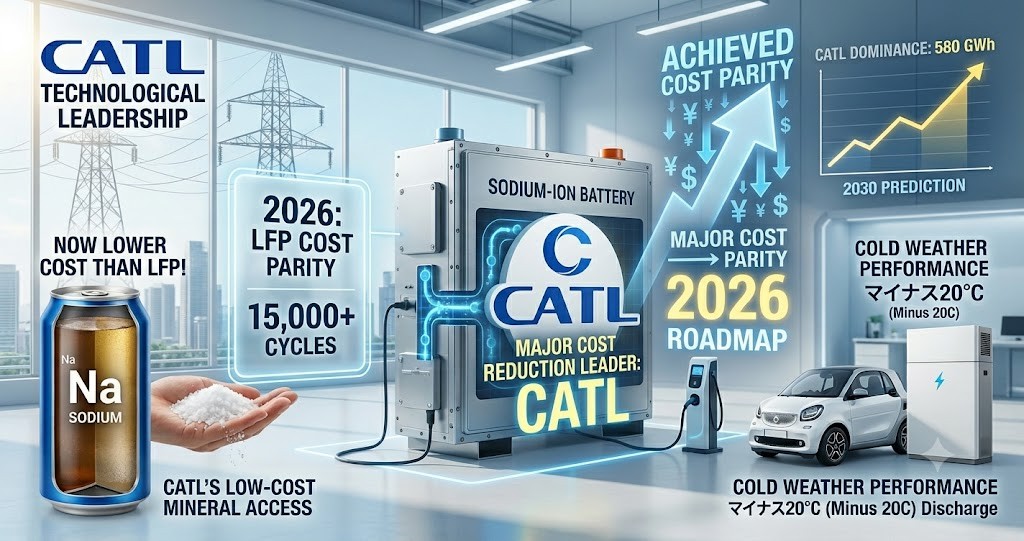
現在、電気自動車(EV)や蓄電システムの主力である「リチウムイオン電池(特にリン酸鉄リチウム:LFP電池)」の対抗馬として、ナトリウムイオン電池の実用化が急ピッチで進んでいます。
車載電池の世界最大手である中国のCATLは、2026年末までにナトリウムイオン電池の製造コストがLFP電池と同等になると予測しています。かつてはエネルギー密度の低さから実験段階にとどまると見られていた技術が、今や大規模な商業化の時代へと突入しようとしています。
1. CATLが主導する「完全商業化」へのロードマップ
CATLはナトリウムイオン電池を試験段階から「本格的な工業化製品時代」へと引き上げる計画を進めています。
- 初のシステム出荷: 2026年9月にもナトリウムイオン電池を搭載したエネルギー貯蔵システムの第一陣を出荷予定。
- 生産目標: 年間ギガワット時(GWh)規模の大量生産を目指す。
- 技術的課題の克服: 弱点であったエネルギー密度の低さを、電気化学パターンの再構成、硬質炭素電極内の湿度制御、動作中のガス発生抑制によって克服。
- 長寿命化の実現: 幅広い温度範囲での動作に加え、最大15,000回の充放電サイクルという優れた寿命を達成。
2. 劇的なコスト削減を支える素材価格の予測
価格競争力は、ナトリウムイオン電池が普及するための最大の鍵です。メーカー各社は「設計の最適化」「サプライチェーンの強化」「専用生産ラインの構築」を進めており、主要部材である硬質炭素(ハードカーボン)陽極材の価格は以下のように急落する見込みです。
| 年代 / 目標 | 硬質炭素陽極の推定価格(1トンあたり) |
| 2024年 | 6万から7万元 (約8,275から9,655米ドル) |
| 2026年(予測) | 3万5千から4万元 |
| 長期的な目標 | 2万5千元 (約3,448米ドル)以下 |
この素材価格の下落により、2026年末には電池単体で、2027年までには蓄電システム全体の統合コストも含めて、LFP電池と同等水準に達すると予測されています。
3. ナトリウムイオン電池の強みと適した用途
専門家は、ナトリウムイオン電池がリチウムイオン電池をすべて代替するのではなく、「ナトリウムとリチウムのデュアルエネルギーエコシステム(相互補完)」を形成すると見ています。
【関連補完情報:なぜナトリウムなのか?】
- 資源の豊富さ: リチウムが特定の地域に偏在し価格が乱高下しやすいのに対し、ナトリウムは海水などから無限に採取できるため、地政学的リスクが極めて低く、安定調達が可能です。
- 優れた低温特性: リチウムイオン電池は氷点下で著しく性能が低下しますが、ナトリウムイオン電池はマイナス20度C以下の極寒環境でも高い放電容量を維持できます。
- 高い安全性: 内部短絡が起きても発火・爆発のリスクがリチウムより低く、輸送時にも完全に放電した安全な状態で運ぶことができます。
主な活躍が期待される分野
- 寒冷地や高地などに設置されるエネルギー貯蔵システム(ESS)
- 電力系統の周波数調整装置
- 軽量電気自動車(LEV)や、航続距離の短い都市型コンパクトEV
4. 2030年に向けた市場予測
シンクタンクなどの予測(SPIR)によると、2030年までにエネルギー貯蔵用のナトリウムイオン電池の世界市場は580GWhに達する可能性があります。そのうち、電気自動車業界向けだけでも410GWhを超える見込みであり、持続可能な社会を支える不可欠なインフラとして、その地位を確固たるものにしようとしています。
出典:https://www.vietnam.vn/ja/catl-pin-natri-ion-se-co-gia-ngang-bang-pin-lithium-ion-vao-cuoi-nam-2026
Battery Market Shock at the End of 2026! CATL Sparks Price Disruption with Sodium-ion Batteries
Sodium-ion batteries are rapidly moving toward practical application as a strong challenger to lithium-ion batteries—specifically Lithium Iron Phosphate (LFP) batteries—which currently dominate the electric vehicle (EV) and energy storage system markets.
China’s CATL, the world’s largest manufacturer of automotive batteries, predicts that the manufacturing cost of sodium-ion batteries will become comparable to that of LFP batteries by the end of 2026. Once considered a technology confined to the experimental phase due to its low energy density, it is now on the verge of entering an era of large-scale commercialization.
1. Roadmap to “Full Commercialization” Led by CATL
CATL is moving forward with plans to elevate sodium-ion batteries from the testing phase into a “true era of industrialized products.”
- First System Shipments: The company plans to ship its first batch of energy storage systems equipped with sodium-ion batteries as early as September 2026.
- Production Target: Aiming to achieve an annual production scale in the gigawatt-hour (GWh) range.
- Overcoming Technical Challenges: The weakness of low energy density has been successfully resolved by reconfiguring electrochemical patterns, controlling humidity within the hard carbon electrodes, and suppressing gas generation during operation.
- Achieving Longer Lifespan: In addition to operating across a wide temperature range, the battery achieves an outstanding lifespan of up to 15,000 charge-discharge cycles.
2. Material Price Forecasts Supporting Dramatic Cost Reductions
Price competitiveness is the most critical factor for the widespread adoption of sodium-ion batteries. Manufacturers are focusing on three strategies: optimizing design, strengthening supply chain cooperation, and building dedicated production lines. As a result, the price of hard carbon anode material, a key component, is expected to drop sharply.
| Period / Target | Estimated Price of Hard Carbon Anode (per ton) |
|---|---|
| 2024 | 60,000 to 70,000 yuan (approx. 8,275 to 9,655 USD) |
| 2026 (Forecast) | 35,000 to 40,000 yuan |
| Long-term Target | 25,000 yuan (approx. 3,448 USD) or less |
Driven by this decline in material costs, the manufacturing cost of individual battery cells is projected to match LFP batteries by the end of 2026. Furthermore, by 2027, the total integration cost of sodium-based energy storage systems is also expected to reach parity with LFP systems.
3. Strengths and Suitable Applications of Sodium-ion Batteries
Experts emphasize that sodium-ion batteries will not completely replace lithium-ion batteries. Instead, they will play a strategic complementary role, creating a “sodium-lithium” dual-energy ecosystem.
[Why Sodium? Key Advantages]
- Abundant Resources: While lithium is concentrated in specific regions and prone to sharp price volatility, sodium can be sourced infinitely from places like seawater. This ensures exceptionally low geopolitical risk and stable procurement.
- Excellent Low-Temperature Performance: Lithium-ion batteries suffer a severe drop in performance at sub-zero temperatures. In contrast, sodium-ion batteries maintain high discharge capacity even in extreme cold environments of minus 20 degrees C or lower.
- High Safety: Even if an internal short circuit occurs, the risk of fire or explosion is lower than with lithium. They can also be transported in a completely discharged, safe state.
Key Target Sectors
- Energy storage systems (ESS) installed in cold regions or high altitudes.
- Frequency regulation devices for power grids.
- Light electric vehicles (LEVs) and short-range urban compact EVs.
4. Market Forecast for 2030
According to forecasts by think tanks like SPIR, the global market for sodium-ion batteries for energy storage could reach 580 GWh by 2030. The electric vehicle industry alone is expected to account for over 410 GWh, solidifying the technology’s position as an indispensable infrastructure supporting a sustainable society.


コメント