生成AIが画面の中から現実世界へと飛び出し、自律的に動くロボットや機械に知能を宿す「フィジカルAI(Physical AI)」の時代が本格化しています。中でも、人間の作業環境やインフラにそのまま適応できるヒューマノイド(人型ロボット)は、次世代の巨大産業として世界中で開発競争が過熱しています。そうした中、韓国政府は国家戦略である「超革新的経済イニシアチブ」の重点支援対象に、ヒューマノイドの頭脳と肉体を支える「センサー」「アクチュエーター」「専用バッテリー」の3分野を新たに追加しました。国家ぐるみでコア部品のサプライチェーンを掌握し、フィジカルAI時代の主導権を握る狙いです。
1. 韓国「超革新的経済イニシアチブ」にフィジカルAI関連3分野を追加
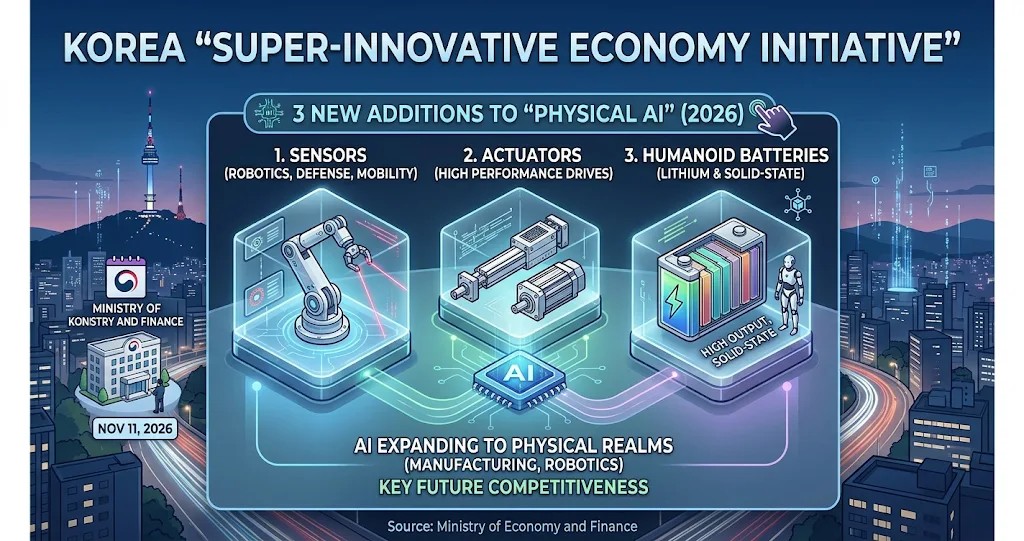
韓国の企画財政部(財務省)の李亨一(イ・ヒョンイル)長官は、2026年11月11日に開かれた経済関係閣僚会議において、国家戦略プロジェクト「超革新的経済イニシアチブ」の既存15分野(次世代半導体、太陽光発電、電力網、バイオ医薬品など)に、以下の3産業を追加すると発表しました。
- センサー(Sensor): ロボット工学、防衛、モビリティ分野における主要なセンサー搭載型AI技術の開発を促進します。
- アクチュエーター(Actuator): 独自技術に基づいた高性能かつ高耐久な駆動装置の国内開発と市場投入を目指します。
- ヒューマノイド用バッテリー(Humanoid Battery): 高出力・高エネルギー密度を備えた商用リチウムイオン電池の開発・実証に加え、次世代の全固体電池技術の開発を強力に推進します。
同省は追加の背景として、AIがデジタル空間から製造業やロボティクスといった物理領域へ拡大する中、「フィジカルAI」が将来の産業競争力を左右する最重要分野に浮上した点を挙げており、財政・税制支援および規制緩和を通じて商業化を後押しする方針です。
2. なぜヒューマノイドには「専用バッテリー」が不可欠なのか
今回の発表で特に注目されるのが、EV(電気自動車)や定置用蓄電池とは別枠で「ヒューマノイド用バッテリー」が重点育成対象に指定された点です。ヒューマノイドには、EVとは異なる極めて過酷な電池性能が求められます。
- 極限の省スペースと高エネルギー密度: 人間と同じサイズ・体重の筐体内部にすべての機構を収める必要があるため、限られた容積・重量で長時間稼働できる高いエネルギー密度(Wh/kgおよびWh/L)が不可欠です。
- 瞬発的な高出力(高レート放電): 二足歩行でのバランス制御や重い荷物の持ち上げ、転倒時のリカバリーなど、瞬間的に大電流を流す高出力性能が求められます。
- 安全性と全固体電池への期待: 人間のすぐそばで稼働し、万が一の転倒や衝撃のリスクも伴うため、発火リスクの低い高い安全性が要求されます。そのため、液漏れや熱暴走のリスクが極めて低く、高エネルギー密度化が可能な「全固体電池」の最初の本格適用先の一つとして、ヒューマノイド市場が有力視されています。
3. 韓国産業界のエコシステムとの相乗効果
韓国がこれら3分野を国家プロジェクトに据えた背景には、同国がすでに世界トップクラスの企業群を抱えているという強みがあります。
- 完成品メーカーの存在: 現代自動車(Hyundai Motor)グループは傘下にボストン・ダイナミクス(Boston Dynamics)を擁し、電動版ヒューマノイド「アトラス(Atlas)」の商用化や工場導入をリードしています。また、サムスン電子もレインボーロボティクス(Rainbow Robotics)への出資を通じてロボティクス事業を加速させています。
- 世界屈指のバッテリー基盤: LG Energy Solution、Samsung SDI、SK Onといった世界的な電池メーカーが集積しており、すでにヒューマノイドやドローン向けの高出力円筒形セルや全固体電池の研究開発を進めています。
完成品ロボットの需要と、世界最先端の電池・部品メーカーの技術力を政策面から結びつけることで、輸入依存度の高いロボット用コア部品の国産化(内製化)を進め、次世代産業のグローバル覇権を確立する構えです。
出典:https://www.koreaherald.com/article/10933026
Toward Supremacy in the Physical AI Era: South Korean Government Adds “Humanoid Batteries, Sensors, and Actuators” to National Strategy
The era of “Physical AI”—in which generative AI leaps off the screen into the real world, embedding intelligence into autonomously moving robots and machines—is shifting into high gear. Among these technologies, humanoids (human-shaped robots) capable of seamlessly adapting to human work environments and infrastructure are sparking intense global development competition as the next massive industry. Amid these trends, the South Korean government has newly added three sectors supporting the brains and bodies of humanoids—”sensors,” “actuators,” and “dedicated batteries”—to the priority support targets of its national strategy, the “Ultra-Innovative Economy Initiative.” The move aims to secure control over the core component supply chain at a national level and seize leadership in the Physical AI era.
1. South Korea Adds Three Physical AI-Related Sectors to the “Ultra-Innovative Economy Initiative” During a meeting of economy-related ministers held on November 11, 2026, Lee Hyoung-il, Minister of Economy and Finance (MOEF) of South Korea, announced the addition of the following three industries to the existing 15 key fields (including next-generation semiconductors, solar power generation, power grids, and biopharmaceuticals) under the national strategic project, the “Ultra-Innovative Economy Initiative”:
- Sensors: Promoting the development of key sensor-equipped AI technologies across robotics, defense, and mobility sectors.
- Actuators: Aiming for the domestic development and market launch of high-performance, high-durability drive devices based on proprietary technologies.
- Humanoid Batteries: Strongly promoting the development of next-generation all-solid-state battery technologies alongside the development and demonstration of commercial lithium-ion batteries featuring high output and high energy density.
As the background for these additions, the ministry noted that as AI expands from the digital realm into physical domains such as manufacturing and robotics, “Physical AI” has emerged as the most critical field determining future industrial competitiveness. The government plans to back commercialization through fiscal and tax support as well as deregulation.
2. Why “Dedicated Batteries” Are Indispensable for Humanoids A particularly noteworthy aspect of this announcement is that “humanoid batteries” were designated as a priority development target in a category separate from EV (electric vehicle) and stationary storage batteries. Humanoids demand extremely rigorous battery performance that differs significantly from that of EVs:
- Extreme Space Efficiency and High Energy Density: Because all mechanisms must fit inside a frame matching human size and weight, high energy density (Wh/kg and Wh/L) capable of powering extended operation within strict volume and weight limits is essential.
- Instantaneous High Output (High-Rate Discharge): High-power performance capable of delivering large instantaneous currents is required for balance control during bipedal walking, lifting heavy objects, and recovering from falls.
- Safety and Expectations for All-Solid-State Batteries: Operating right alongside humans and carrying the risk of accidental falls or impacts, these batteries require high safety with minimal fire risk. Consequently, the humanoid market is viewed as a prime candidate for one of the first full-scale applications of “all-solid-state batteries,” which offer extremely low risks of leakage or thermal runaway while enabling higher energy densities.
3. Synergies with South Korea’s Industrial Ecosystem Behind South Korea’s decision to place these three fields at the center of a national project lies the strength of already possessing world-class corporate players:
- Presence of Finished-Product Manufacturers: Hyundai Motor Group owns Boston Dynamics under its umbrella and is leading the commercialization and factory deployment of the electric humanoid “Atlas.” Meanwhile, Samsung Electronics is also accelerating its robotics business through its investment in Rainbow Robotics.
- World-Leading Battery Foundation: Global battery manufacturers such as LG Energy Solution, Samsung SDI, and SK On are concentrated in the country and are already advancing R&D on high-output cylindrical cells and all-solid-state batteries for humanoids and drones.
By linking the demand for finished robots with the technological capabilities of world-leading battery and component manufacturers through policy support, South Korea is poised to advance the domestic production of core robot components—which currently rely heavily on imports—and establish global supremacy in next-generation industries.
コメント