リチウム資源の偏在や価格変動リスクを背景に、次世代蓄電池の有力候補として開発が加速するナトリウムイオン電池。その実用化と普及の鍵を握るのが、コストと性能のバランスに優れた正極材の開発です。これまで「低コストで高安全」なリン酸系正極材(NFPPなど)は、初回効率の低さや構造劣化による寿命の課題を抱えていました。そうした中、中国科学院大連化学物理研究所(DICP)の研究チームが、独自の材料設計アプローチによって鉄マンガンリン酸塩正極の性能を大幅に引き上げることに成功し、すでに100トン規模のパイロットラインを稼働させるなど、実用化に向けた大きな一歩を踏み出しました。
1. 構造劣化の克服と飛躍的な電気化学性能の向上
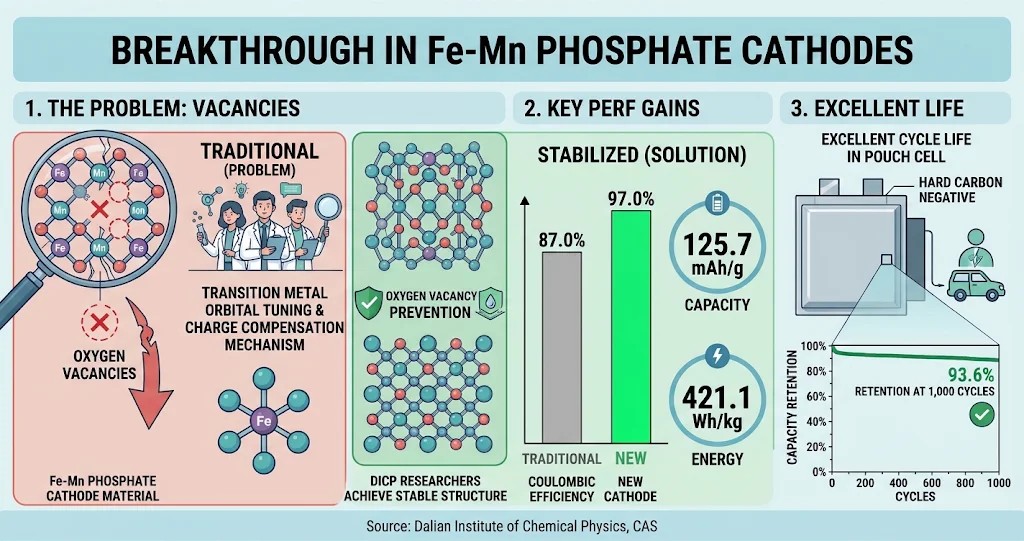
中国科学院大連化学物理研究所(DICP)の研究グループは、ナトリウムイオン電池用の鉄マンガンリン酸塩正極材において、充放電に伴う構造劣化の主な原因となっていた「酸素空孔(結晶格子から酸素原子が抜けた欠陥)」の問題を解決しました。
- 独自の材料制御アプローチ: 遷移金属の電子軌道調整と電荷補償メカニズムを組み合わせることで、酸素空孔に起因する結晶構造の不安定化を抑制しました。
- 初回クーロン効率の大幅改善: 実用化において重要な指標である初回サイクルのクーロン効率が、従来の87.0%から97.0%へと飛躍的に向上しました。
- 高い材料レベル特性: 正極材料単体で125.7 mAh/gの可逆比容量と、421.1 Wh/kgの比エネルギーを達成しています。
- 優れたサイクル寿命: ハードカーボン(硬質炭素)負極と組み合わせたパウチセルでの評価では、1Cレートでの充放電を1,000サイクル繰り返した後も初期容量の93.6%を維持しました。
(※なお、本報告では掲載学術誌名や詳細なセルサイズ、試験温度、具体的な製造コストの数値は公表されておらず、材料レベルのエネルギー密度はそのまま電池セル全体のエネルギー密度に換算されるものではありません。)
2. なぜ「鉄マンガンリン酸塩正極」が注目されるのか
現在、ナトリウムイオン電池の正極材には大きく分けて「層状酸化物系」「プルシアンブルー類似体(PBA)系」「ポリアニオン(リン酸)系」の3つの主流ルートが存在します。
DICPが取り組む鉄マンガンリン酸塩(NFPP:Na4Fe3(PO4)2P2O7の鉄の一部をマンガンで置換した系など)をはじめとするポリアニオン系は、強固なリン酸骨格を持つため熱安定性が極めて高く、長寿命である点が最大の強みです。また、高価なニッケルやコバルトを一切使わず、地球上に豊富に存在する鉄やマンガンを主原料とするため、原材料コストを極限まで抑えることができます。
一方で、従来のポリアニオン系は電子伝導性が低く、初回充電時にナトリウムイオンが不可逆的に消費されてクーロン効率が落ちやすいという弱点がありました。今回のDICPによる初回効率97.0%の達成は、限られたナトリウム源を無駄なく使えることを意味し、フルセル(実電池)化した際のエネルギー密度向上に直結する重要なブレイクスルーと言えます。
3. 100トン規模のパイロットライン稼働と産業化への展開
今回の成果は基礎研究の段階にとどまらず、すでに量産化と社会実装を見据えたフェーズへと移行しています。
- パイロットラインの構築: 同正極材を製造する年間100トン規模のパイロットラインがすでに建設され、稼働を開始しています。
- 産業パートナーとの連携: 研究チームは中国ナトリウム電池グループ(China Sodium Timesなど関連企業群)といった業界パートナーと産業化に向けた提携を締結しました。
- 系統連系プロジェクトの実績: DICPはこれに先立つ2025年12月にも、リン酸系正極を採用した100kWh級のナトリウムイオン蓄電システムを開発し、実際の電力網(グリッド)への接続に成功したことを報告しています。
定置用エネルギー貯蔵システム(ESS)や低速EV、バックアップ電源などの分野において、低コストかつ長寿命なポリアニオン系ナトリウムイオン電池の商業化が一段と現実味を帯びています。
Achieving 97.0% Initial Efficiency and 1,000-Cycle Lifespan: CAS DICP Significantly Improves Performance of Low-Cost Iron-Manganese Phosphate Cathodes for Sodium-Ion Batteries
Driven by the uneven geographic distribution of lithium resources and price volatility risks, the development of sodium-ion batteries is accelerating as a leading candidate for next-generation energy storage. The key to their commercialization and widespread adoption lies in developing cathode materials that offer an optimal balance of cost and performance. Until now, low-cost, high-safety phosphate-based cathode materials (such as NFPP) have faced challenges including low initial Coulombic efficiency and shortened lifespans caused by structural degradation. Against this backdrop, a research team at the Dalian Institute of Chemical Physics (DICP) of the Chinese Academy of Sciences (CAS) has succeeded in significantly boosting the performance of iron-manganese phosphate cathodes through a proprietary material design approach, taking a major step toward practical application by already putting a 100-ton-scale pilot line into operation.
1. Overcoming Structural Degradation and Achieving Leapfrog Gains in Electrochemical Performance The research group at CAS DICP resolved the issue of oxygen vacancies—defects where oxygen atoms are missing from the crystal lattice—which had been the primary cause of structural degradation during charge and discharge cycles in iron-manganese phosphate cathode materials for sodium-ion batteries.
- Proprietary Material Control Approach: By combining electron orbital modulation of transition metals with a charge compensation mechanism, the team suppressed crystal structure destabilization caused by oxygen vacancies.
- Dramatic Improvement in Initial Coulombic Efficiency: Initial cycle Coulombic efficiency, a critical metric for commercialization, jumped dramatically from the conventional 87.0% to 97.0%.
- High Material-Level Properties: The cathode material alone achieved a reversible specific capacity of 125.7 mAh/g and a specific energy of 421.1 Wh/kg.
- Superior Cycle Life: In evaluations using pouch cells paired with hard carbon anodes, the batteries retained 93.6% of their initial capacity after 1,000 charge-discharge cycles at a 1C rate.
(Note: The report did not disclose the name of the published academic journal, detailed cell dimensions, testing temperatures, or specific manufacturing cost figures, and material-level energy density does not directly translate to the overall energy density of a finished battery cell.)
2. Why Iron-Manganese Phosphate Cathodes Are Attracting Attention Currently, cathode materials for sodium-ion batteries are broadly divided into three mainstream routes: layered oxides, Prussian blue analogues (PBAs), and polyanion (phosphate) compounds.
Polyanion-based materials—including the iron-manganese phosphate targeted by DICP (such as systems based on Na4Fe3(PO4)2P2O7 where a portion of the iron is substituted with manganese)—possess a robust phosphate framework, giving them the major advantages of extremely high thermal stability and long cycle life. Furthermore, because they use zero expensive nickel or cobalt and rely instead on earth-abundant iron and manganese as primary raw materials, raw material costs can be kept to a minimum.
On the other hand, conventional polyanion materials suffered from low electronic conductivity and a tendency for sodium ions to be irreversibly consumed during the initial charge, leading to lower Coulombic efficiency. DICP’s achievement of 97.0% initial efficiency means that limited sodium sources can be utilized without waste, representing a critical breakthrough directly linked to improving energy density when assembled into full cells.
3. Operation of a 100-Ton Pilot Line and Expansion Toward Industrialization This achievement is not confined to basic research; it has already transitioned into a phase aimed at mass production and real-world deployment.
- Construction of a Pilot Line: A pilot production line with an annual capacity of 100 tons for manufacturing the cathode material has already been built and has begun operations.
- Collaboration with Industry Partners: The research team has signed industrialization partnerships with industry players such as China Sodium Battery Group (including affiliated companies like China Sodium Times).
- Track Record in Grid-Connected Projects: Prior to this, in December 2025, DICP reported that it had developed a 100kWh-class sodium-ion energy storage system utilizing a phosphate-based cathode and successfully connected it to an actual power grid.
In fields such as stationary energy storage systems (ESS), low-speed EVs, and backup power supplies, the commercialization of low-cost, long-life polyanion sodium-ion batteries is becoming increasingly realistic.

コメント