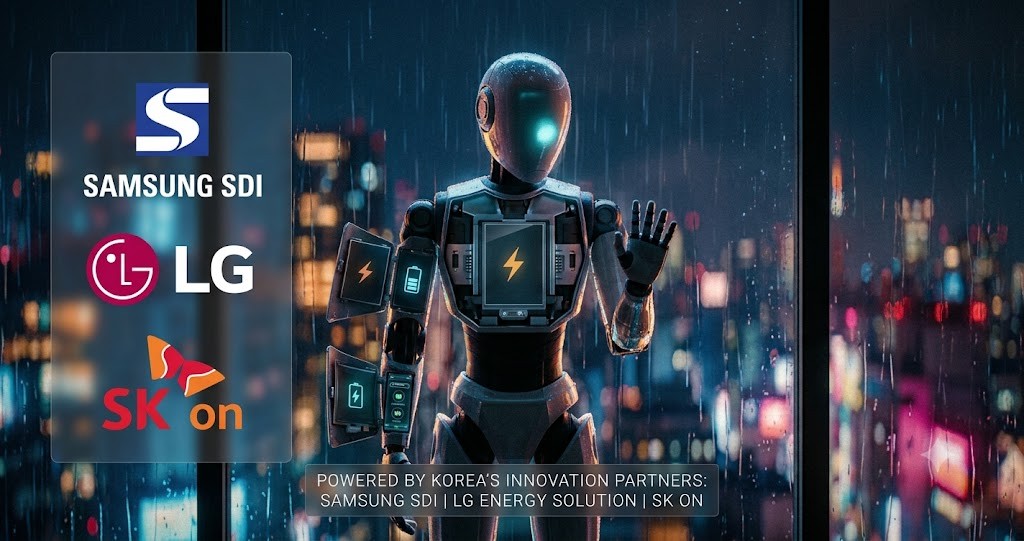
赤字脱却を目指す韓国のバッテリー大手3社(Samsung SDI、LG Energy Solution、SK On)は、電気自動車(EV)向け市場での価格競争や減速を乗り越える新たな成長領域として、ヒューマノイドロボットなどの「フィジカルAI」分野に着目しています。次世代電池として期待される全固体電池は非常に高価ですが、ロボット用途であればバッテリー容量が小さく価格抵抗が少ないため、商業化の初期市場として最適な足がかりになるとみられています。
関連情報:ロボット向け電池需要拡大の背景
ヒューマノイドロボット市場はAI技術の発展とともに世界的に急速な拡大が見込まれています。2026年には年間出荷台数が5万台を超えるとの予測もあり、駆動時に瞬間的な電力ピークが発生するロボットには、高出力・高安全性・密度の高いバッテリーが強く求められています。
自動車向けの全固体電池は本格普及までに相応の時間がかかると予想される中、まずは需要が増加するロボット向けで「規模の経済」を達成し、初期段階の市場を先取りしようとする動きが急速に強まっています。
韓国バッテリー3社の概要と戦略まとめ
1. ロボット市場を優先ターゲットとする理由
- コスト負担の低さ: EVの平均バッテリー容量が65kWhであるのに対し、ヒューマノイドロボット(例:Figure AI)は2.3kWh程度と約28分の1で済みます。
- 完成品への影響: テスラのヒューマノイド「Optimus」の原価に占めるバッテリーパックコストは推定2%にすぎず、初期の全固体電池(リチウムイオン電池の5から6倍)を採用しても製品全体の価格への跳ね返りが軽微です。
- 市場見通し: ヒューマノイド向け全固体電池の搭載量は、2030年の0.04GWhから2040年には76.1GWhまで急増し、ロボット用電池市場の半分以上を占めると試算されています。
2. 各社の個別戦略
- Samsung SDI: 最も積極的で、2027年下半期の量産化を目指します。ヒューマノイド向けパウチ型全固体電池サンプルの供給を開始し、市場の先取りを狙います。
- LG Energy Solution: 既存の円筒型2170バッテリーでまずロボット顧客層を確保し、段階的に全固体電池へ移動する堅実なアプローチを取っています。
- SK On: 2029年の量産を目標とし、既存のリチウムイオン電池プラットフォームと統合する製造工程を研究し、コスト競争力の確保を図ります。
3. 商用化に向けた2大課題
- 素材コストの圧倒的落差: 核心素材である硫化物系固体電解質は1kgあたり1500から1800ドル(約24万から28万円)と、液体電解質(1kgあたり30元/約700円)の約340から400倍に達しており、大幅なコストダウンが必要です。
- 大型セルの工程最適化: 固体電解質と正極の間に隙間が生じると「界面抵抗」が跳ね上がるため、大面積セルでも密着状態を均一に維持しながら量産できる技術革新が求められます。
今後は安価な代替素材の確保と精密な量産工程の確立が、ロボット向け全固体電池の普及スピードを左右することになります。
出典:https://finance.biggo.jp/news/40491517-c6de-4e3b-bd0a-4758c006415f
All-Solid-State Battery Strategies of Three Major South Korean Battery Makers Accelerating Humanoid Expansion
Aiming to emerge from the red, South Korea’s three major battery manufacturers (Samsung SDI, LG Energy Solution, and SK On) are focusing on the “Physical AI” sector, such as humanoid robotics, as a new growth domain to overcome price competition and the slowdown in the electric vehicle (EV) market. While next-generation all-solid-state batteries remain extremely expensive, their application in robotics requires smaller battery capacities, resulting in lower price resistance. Consequently, the robotics sector is seen as an ideal stepping stone for initial commercialization.
Related Context: Background on Growing Battery Demand for Robotics The humanoid robot market is expected to expand rapidly worldwide alongside advances in AI technology. With forecasts projecting annual shipments to exceed 50,000 units in 2026, robots—which experience instantaneous power peaks during operation—urgently require high-output, highly safe, and energy-dense batteries. While full-scale adoption of all-solid-state batteries for automotive applications is expected to take considerable time, momentum is gathering quickly to achieve economies of scale and capture the early-stage market first through the growing demand in robotics.
Overview and Strategy Summary of the Three South Korean Battery Makers
- Reasons for Prioritizing the Robotics Market
- Low Cost Burden: While the average EV battery capacity is 65 kWh, humanoid robots (e.g., Figure AI) require only about 2.3 kWh, roughly 1/28th as much.
- Impact on Finished Products: Battery pack costs are estimated to account for only 2% of the overall cost for Tesla’s humanoid “Optimus.” Thus, adopting early all-solid-state batteries (which cost 5 to 6 times more than lithium-ion batteries) has a minimal impact on the final product price.
- Market Outlook: All-solid-state battery installations for humanoids are projected to surge from 0.04 GWh in 2030 to 76.1 GWh by 2040, accounting for more than half of the total robot battery market.
- Individual Corporate Strategies
- Samsung SDI: Taking the most aggressive stance, aiming for mass production in the second half of 2027. The company is starting supply of pouch-type all-solid-state battery samples for humanoids to preemptively capture market share.
- LG Energy Solution: Taking a steady approach by first securing robot clients with existing cylindrical 2170 batteries and gradually transitioning them to all-solid-state batteries.
- SK On: Targeting mass production in 2029, researching manufacturing processes that integrate all-solid-state platforms with existing lithium-ion battery lines to secure cost competitiveness.
- Two Major Challenges for Commercialization
- Overwhelming Material Cost Gap: The sulfide-based solid electrolyte, a core material, costs 1,500 to 1,800 USD per kg (approx. 240,000 to 280,000 JPY)—roughly 340 to 400 times higher than liquid electrolytes (30 RMB per kg / approx. 700 JPY in China)—requiring substantial cost reductions.
- Process Optimization for Large-Scale Cells: Any gap between the solid electrolyte and the cathode sharply increases interfacial resistance. Technical innovations are required to maintain uniform adhesion during mass production, even in large-area cells.
Securing lower-cost alternative materials and establishing precise mass-production processes will dictate the adoption speed of all-solid-state batteries for robotics moving forward.

コメント