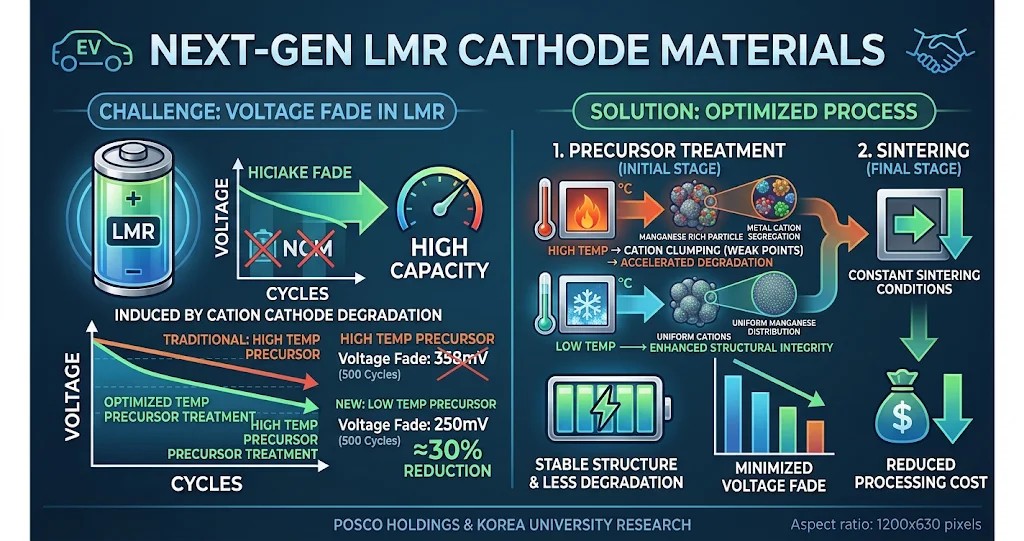
電気自動車(EV)の航続距離延伸とコスト削減を同時に実現する次世代正極材の最有力候補として、リチウム・マンガンリッチ(LMR)正極材が世界中で注目を集めています。しかし、従来の三元系(NCM)を上回る高容量を持つ一方で、充放電を繰り返すうちに電圧が徐々に低下してしまう「電圧減衰(ボルテージフェード)」が実用化への最大の壁となっていました。そうした中、韓国の鉄鋼・電池材料大手であるポスコホールディングスと高麗大学校の共同研究チームが、特殊な添加剤や複雑な化学組成の変更を一切行わず、「熱処理温度の最適化」という極めてシンプルなプロセス改善だけで、この電圧損失を約30%低減する画期的な手法を確立しました。
1. ポスコと高麗大学が開発した「熱処理温度制御」による電圧損失の低減
ポスコホールディングスのN.EX.T Hub研究所と高麗大学校材料科学工学科のパク・ヒョクジュン(朴孝俊)教授率いる研究チームは、次世代リチウムイオン電池向けLMR正極材の耐久性と寿命を大幅に向上させる新しい製造プロセスを開発しました。なお、この成果は2026年10月19日に学術誌「ACS Energy Letters」に掲載され、同誌の特別号の表紙を飾っています。
- 研究の核心(温度制御による均一化): 研究チームは、正極製造の初期段階(前駆体材料の処理工程)における温度条件に着目しました。その後の焼成条件などを一定に保ったまま初期温度を変えて比較した結果、低温で処理を行うことで正極粒子内部の金属元素が極めて均一に分布することを発見しました。
- 高温処理の弊害: 逆に初期段階で高温処理を行うと、金属元素が不均一な塊(偏析)へと分離し、これが構造的な弱点となって充放電時の劣化を加速させることが明らかになりました。
- 電圧低下を約30%削減: 500回の充放電サイクル試験において、従来の高温処理で作製した正極は358mVの電圧低下を示したのに対し、低温処理を採用した正極の電圧低下は250mVに抑えられ、電圧損失を約30%低減することに成功しました。
2. なぜLMR正極材は重要で、何が課題だったのか
LMR(Lithium- and Manganese-Rich)正極材は、高価で供給リスクの高いコバルトをほとんど、あるいは全く使用せず、豊富で安価なマンガンを主成分としながら、リチウムを過剰に含ませた次世代材料です。
- 高容量のメカニズム: 従来の正極材が遷移金属の酸化還元反応のみを利用するのに対し、LMR正極材は金属と「酸素」の双方の酸化還元反応(アニオンレドックス)を利用することで、極めて高いエネルギー密度を発揮します。
- 商業化を阻んできた「電圧減衰」: しかし、酸素の反応を伴うがゆえに結晶構造が不安定になりやすく、充放電を重ねると層状構造からスピネル相などへの相転移が起きて平均作動電圧が下がっていく(結果として電池のエネルギー出力が低下する)現象が長年解決できない課題でした。
3. 既存設備を活かせる「実用的な量産ルート」としての意義
今回の研究成果が業界から高く評価されている最大の理由は、その「実装のしやすさ」にあります。
これまでLMR正極材の電圧低下を防ぐ研究の多くは、高価な元素のドーピング(微量添加)や複雑な表面コーティングなど、原材料コストの増加や製造工程の複雑化を伴うものが中心でした。これに対し、今回のポスコと高麗大学の手法は、材料の化学組成を一切変えることなく、既存製造ラインの「温度プロファイル」を最適化するだけで達成できます。
EV市場の価格競争が激化し、ローコストなLFP(リン酸鉄リチウム)電池と高エネルギー密度な三元系電池の中間を埋める「高容量・低コスト正極」への需要が急増する中、今回の技術はLMR正極材の商業生産を一気に現実のものとする実用的なブレイクスルーと言えます。
出典:https://www.koreaherald.com/article/10927214
Achieved Solely by Optimizing Heat Treatment Temperature Without Changing Chemical Composition: POSCO and Korea University Reduce Voltage Loss in Next-Generation LMR Cathodes by Approx. 30%
Lithium- and manganese-rich (LMR) cathode materials are attracting global attention as the most promising next-generation cathode candidate capable of simultaneously extending electric vehicle (EV) driving ranges and reducing costs. However, while LMR cathodes offer higher capacity than conventional ternary materials (NCM), “voltage fade”—a gradual drop in voltage during repeated charge and discharge cycles—has remained the biggest barrier to their commercialization. Amid these challenges, a joint research team from South Korean steel and battery materials giant POSCO Holdings and Korea University has established a groundbreaking method to reduce this voltage loss by approximately 30% through a remarkably simple process improvement: optimizing heat treatment temperatures, without using any special additives or complex changes to chemical composition.
1. Voltage Loss Reduction via Heat Treatment Temperature Control Developed by POSCO and Korea University A research team led by POSCO Holdings’ N.EX.T Hub Research Institute and Professor Park Hyuk-jun of the Department of Materials Science and Engineering at Korea University has developed a new manufacturing process that significantly improves the durability and lifespan of LMR cathode materials for next-generation lithium-ion batteries. The findings were published on October 19, 2026, in the scientific journal ACS Energy Letters, where they were featured on the cover of a special issue.
- Core of the Research (Homogenization via Temperature Control): The team focused on temperature conditions during the initial stage of cathode manufacturing (the precursor material processing step). By varying the initial temperature while keeping subsequent calcination conditions constant, they discovered that processing at lower temperatures results in a far more uniform distribution of metal elements inside the cathode particles.
- Drawbacks of High-Temperature Processing: Conversely, when high-temperature processing was applied in the initial stage, metal elements separated into uneven clusters (segregation), creating structural weak points that accelerated degradation during charge and discharge cycles.
- Approx. 30% Reduction in Voltage Drop: In a 500-cycle charge-discharge test, the cathode produced using conventional high-temperature processing exhibited a voltage drop of 358mV, whereas the cathode utilizing low-temperature processing held the drop to 250mV, successfully reducing voltage loss by roughly 30%.
2. Why LMR Cathode Materials Are Important and What Their Challenges Were LMR (Lithium- and Manganese-Rich) cathode materials are next-generation materials that use little to no expensive, high-supply-risk cobalt, relying instead on abundant, low-cost manganese as a primary component while incorporating an excess of lithium.
- Mechanism Behind High Capacity: Whereas conventional cathode materials utilize only the redox reactions of transition metals, LMR cathode materials leverage redox reactions of both metals and oxygen (anionic redox), thereby delivering extremely high energy density.
- Voltage Fade Blocking Commercialization: However, because oxygen reactions are involved, the crystal structure tends to become unstable. Over repeated charge and discharge cycles, phase transitions from a layered structure to a spinel phase and other structures occur, causing the average operating voltage to decline (and consequently reducing the battery’s energy output)—a phenomenon that has long remained an unresolved challenge.
3. Significance as a Practical Mass-Production Route Leveraging Existing Equipment The primary reason this research achievement has been highly praised by the industry lies in its ease of implementation.
Until now, most research aimed at preventing voltage drop in LMR cathodes has centered on expensive elemental doping (trace additions) or complex surface coatings, which drive up raw material costs and complicate manufacturing processes. In contrast, the method developed by POSCO and Korea University can be achieved simply by optimizing the temperature profile of existing production lines without altering the material’s chemical composition at all.
As price competition in the EV market intensifies and demand surges for high-capacity, low-cost cathodes that bridge the gap between low-cost LFP (lithium iron phosphate) batteries and high-energy-density ternary batteries, this technology represents a practical breakthrough that brings the commercial production of LMR cathodes closer to immediate reality.

コメント