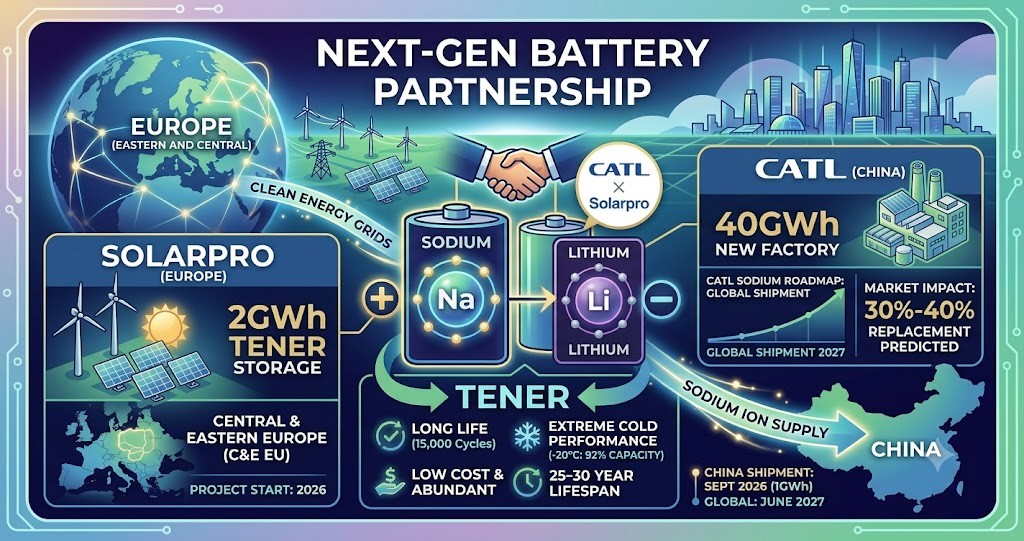
近年、再生可能エネルギーの導入拡大に伴い蓄電システムの需要が世界的に高まる中、主原料であるリチウムの価格変動リスクや資源の偏在を背景に、次世代電池として「ナトリウムイオン電池」が急速に注目を集めています。ナトリウムは塩などから無制限に入手可能で低コスト、さらに低温特性に優れるという強みを持ちます。こうした中で発表されたのが、世界最大手の電池メーカーであるCATLと、東欧の再生可能エネルギー企業Solarproによる大規模な提携です。
ニュースの要点
1. 協定の概要と規模
- 発表日: 2026年7月21日
- 提携企業: CATL(中国・寧徳時代)とSolarpro(東欧の大手再生可能エネルギー企業)
- 供給規模: 2GWh(ギガワット時)の「Tener(テナー)」ナトリウムイオン蓄電システム
- 事業の意義: 2026年内に中央・東ヨーロッパ初となる大規模ナトリウムイオン蓄電プロジェクトを展開予定
2. ヨーロッパ市場における展開加速
- 2件目の大型受注: 今月先週には欧州のAlfen NVと2027年からの西欧向け5GWhの導入合意(MOU)を締結したばかりであり、欧州での導入が急速に進展。
- 過酷な環境への適応力: Tenerナトリウムシステムは最大15,000サイクルの長寿命(25〜30年稼働)を誇り、摂氏マイナス20度の極寒環境でも容量の92%を維持。冬場に摂氏マイナス15度からマイナス20度まで下がるリトアニアなど東欧諸国の気候に最適。
3. CATLとSolarproの実績
- 2024年: ブルガリアで150MWhの「EnerC+」液冷蓄電システムを導入。
- 2026年5月: ブルガリアにて両社共同開発の602MWh「Tener」リチウムイオン蓄電システムが電力網に接続(同国の総蓄電容量が10%増加)。
4. CATLのナトリウムイオン電池戦略とロードマップ
- 製品特長: 2026年6月に発表された「Tenerナトリウム」は、定格容量30MWh超で1〜8時間の長時間蓄電に対応。リチウムイオン電池と寸法互換があり、シームレスな移行が可能。
- 出荷スケジュール:
- 2026年9月:中国国内で最初の出荷開始(2026年末までに累計1GWh見込み)
- 2027年6月:世界規模での商業出荷を開始
- 事業拡大の規模: 4月に中国HyperStrongと3年間で総計60GWhの供給契約を締結。これに応じるため、福建省に50億元(約7億3600万ドル)を投じて40GWhの工場建設を発表。
- 将来展望: ロビン・ゼン会長は、低コストなナトリウムイオン電池が最終的に既存電池市場の30%〜40%を置き換えると予測。
関連情報・背景解説
リチウムイオン電池とナトリウムイオン電池の違い
現在主流のリチウムイオン電池はエネルギー密度が高い反面、レアメタルであるリチウムの価格暴騰や供給網のボトルネックが課題視されています。一方、ナトリウムイオン電池は以下のメリットを持ちます。
- 資源の豊富さと低コスト: 地球上に無制限に存在するナトリウム(塩分など)を使用するため、材料コストを大幅に抑制可能。
- 優れた低温特性: リチウムイオン電池は氷点下で急激にパフォーマンスが低下しますが、ナトリウムイオン電池は摂氏マイナス20度などの極寒でも90%以上の性能を維持できるため、寒冷地でのグリッド安定化に適しています。
- 安全性: 熱暴走のリスクが比較的低く、輸送や保管時の安全性が高いとされています。
2GWhという規模のインパクト
1GWh(ギガワット時)は1,000MWh(メガワット時)に相当します。一般家庭の1日の電力消費量を約10kWh(キロワット時)と仮定すると、2GWhの蓄電容量は約20万世帯が1日に使う電力をそのまま賄える規模となります。中央・東欧地域における再生可能エネルギーの出力変動を抑え、地域電力網の信頼性を劇的に向上させることが期待されます。
出典:https://cnevpost.com/2026/07/21/catl-sodium-battery-storage-deal-solarpro/
CATL Accelerates Sodium-Ion Energy Storage Orders in Europe—Supplying 2 GWh “Tener” Systems to Eastern Europe’s Solarpro
In recent years, global demand for energy storage systems has surged alongside the expansion of renewable energy. Against this backdrop, “sodium-ion batteries” are rapidly drawing attention as a next-generation battery technology due to the price volatility risks and uneven geographical distribution of lithium, the primary raw material for conventional batteries. Sodium offers virtually unlimited availability from sources like salt, low cost, and superior low-temperature performance. It is in this environment that CATL, the world’s largest battery manufacturer, and Solarpro, a leading Eastern European renewable energy company, announced a major strategic partnership.
Key Highlights of the News
1. Agreement Overview and Scale
- Announcement Date: July 21, 2026
- Partner Companies: CATL (China) and Solarpro (a major Eastern European renewable energy company)
- Supply Scale: 2 GWh (gigawatt-hours) of “Tener” sodium-ion energy storage systems
- Significance: Deployment of the first large-scale sodium-ion energy storage project in Central and Eastern Europe within 2026
2. Accelerated Expansion in the European Market
- Second Major Order: Follows a Memorandum of Understanding (MOU) signed last week with European integrator Alfen NV to deploy 5 GWh of sodium-ion storage systems in Western Europe starting in 2027, signaling rapid expansion across Europe.
- Adaptability to Harsh Environments: The Tener sodium system boasts an ultra-long lifespan of up to 15,000 cycles (operating for 25 to 30 years) and retains 92% of its capacity even in freezing conditions as low as minus 20 degrees Celsius. This makes it ideal for the cold climates of Eastern European countries like Lithuania, where winter temperatures drop to between minus 15 degrees Celsius and minus 20 degrees Celsius.
3. Track Record of CATL and Solarpro
- 2024: Deployed a 150 MWh “EnerC+” liquid-cooled energy storage system in Bulgaria.
- May 2026: Connected a jointly developed 602 MWh “Tener” lithium-ion energy storage system to the grid in Bulgaria, boosting the country’s total storage capacity by 10%.
4. CATL’s Sodium-Ion Strategy and Roadmap
- Product Features: Unveiled in June 2026, “Tener Sodium” features a rated capacity exceeding 30 MWh and supports long-duration energy storage applications ranging from 1 to 8 hours. It is dimensionally compatible with lithium-ion systems, enabling seamless transitions between technologies.
- Shipment Schedule:
- September 2026: Initial shipments begin in domestic China (projected to reach a cumulative 1 GWh by the end of 2026).
- June 2027: Global commercial shipments scheduled to begin.
- Business Expansion Scale: Signed a 3-year supply agreement totaling 60 GWh with Chinese system provider HyperStrong in April. To support demand, CATL announced a 5 billion yuan (approx. 736 million USD) investment to build a new 40 GWh sodium-ion battery production facility in Fujian Province.
- Future Outlook: Chairman Robin Zeng previously predicted that low-cost sodium-ion batteries could eventually replace 30% to 40% of the existing battery market.
Related Information & Context
Differences Between Lithium-Ion and Sodium-Ion Batteries
While dominant lithium-ion batteries offer high energy density, they face challenges such as soaring prices of rare-metal lithium and supply chain bottlenecks. In contrast, sodium-ion batteries offer the following advantages:
- Abundant Resources and Low Cost: Utilizing sodium (found abundantly in materials like salt) significantly suppresses material costs.
- Superior Low-Temperature Performance: While lithium-ion batteries experience sharp performance drops below freezing, sodium-ion batteries retain over 90% of their performance even in extreme cold like minus 20 degrees Celsius, making them exceptionally suited for grid stabilization in cold regions.
- Safety: They feature a relatively low risk of thermal runaway, making transport and storage safer.
Impact of the 2 GWh Scale
1 GWh (gigawatt-hour) equals 1,000 MWh (megawatt-hours). Assuming an average household consumes about 10 kWh (kilowatt-hours) of electricity per day, a storage capacity of 2 GWh is equivalent to covering the daily power consumption of approximately 200,000 households. This is expected to curb renewable energy output fluctuations and dramatically improve grid reliability across Central and Eastern Europe.
コメント