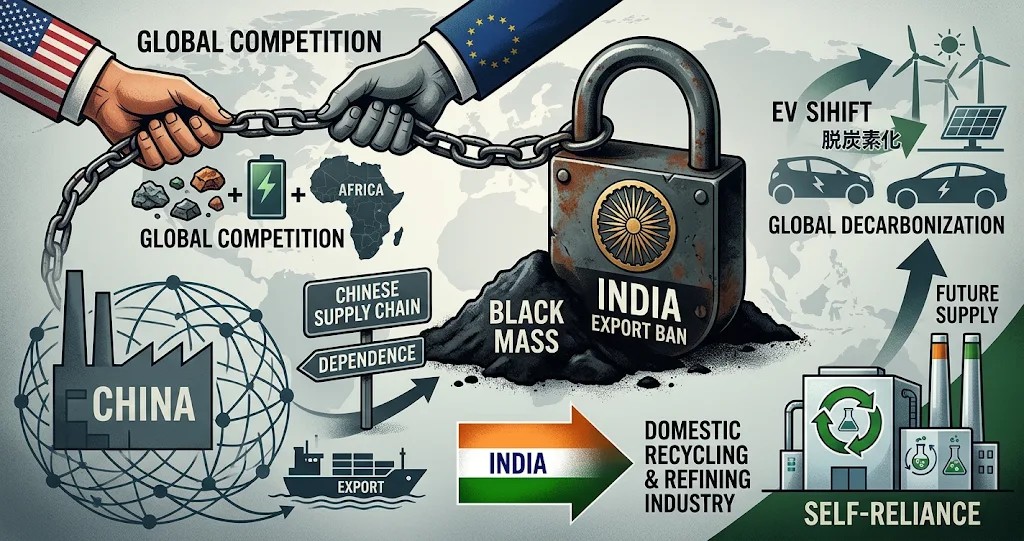
世界的な脱炭素化とEVシフトの加速に伴い、バッテリー資源の囲い込みに向けた動きが各国で急激に強まっています。インド政府が打ち出したリチウムイオン電池の「ブラックマス」輸出禁止措置は、単なる国内資源の保護にとどまらず、中国が主導するサプライチェーンへの依存脱却と、自国での高度なリサイクル・精製産業の育成を狙った極めて戦略的な一手です。
1. インド政府によるブラックマス輸出の即時禁止
- 記事の要点: インド政府は、リチウム、コバルト、ニッケル、マンガンなどを含むリユース・リサイクル原料である「ブラックマス(電池を破砕・選別した粉末状の混合物)」の輸出区分を「自由」から「禁止」へと即時変更しました。
- 【関連情報の補足】ブラックマスとは何か: 使用済み電池を物理的に破砕・処理して得られる黒色の粉末であり、リチウムやコバルト、ニッケルなどの貴重な有用金属が高濃度で濃縮されています。従来は、回収されたブラックマスが海外(特に中国など)の精錬プラントへ輸出され、そこで有価金属が回収されるケースが主流でした。今回の輸出禁止により、今後はこの重要な資源を国外へ流出させず、国内の精錬・再資源化プロセスへ強制的に振り向けることになります。
2. 国内処理の促進とEVサプライチェーンの強靭化
- 記事の要点: 商工省および商務局の通知によると、この措置はインドのリサイクル業者に対して国内での処理を義務付け・促進し、インドのEVサプライチェーン構築を支援するものです。さらに、インド内閣がリチウムとニッケルの国内加工を促進するために281億4000万ルピー(約3億20万ドル)相当の奨励策を承認した数日後に行われました。
- 【関連情報の補足】中国依存の低減と国家戦略: インドは世界でもトップクラスのスピードでEV市場(特に電動二輪・三輪車)が拡大しており、政府は2030年までに新車販売の30%、二輪・三輪車の80%をEVにする野心的な目標を掲げています。しかし、バッテリーの原料調達や川上・川中プロセスにおいて中国企業への依存度が高いため、巨額の財政支援策と今回の輸出禁止措置をセットで運用することで、国内に完結した「マイン・トゥ・リサイクル(鉱山からリサイクルまで)」の自給体制を一気に築く狙いがあります。
まとめ
インドによるリチウムイオン電池ブラックマスの輸出禁止は、インドネシアなどによる未加工鉱物の禁輸措置と同様に、資源国・巨大市場が自国での高付加価値化を急ぐ典型的な経済安全保障の動きといえます。中国依存のリスクを回避し、国内の環境配慮型リサイクル産業をいかにスケールアップできるかが、今後のインドEV産業の成否を分ける最大の鍵となります。
出典:https://batteryindustry.net/india-bans-export-of-lithium-ion-battery-recycled-material/
Indian Government Enforces Immediate Ban on Used Battery Black Mass Exports—A Hardline Measure Toward 2030 EV Adoption Goals
Amid accelerating global decarbonization and the shift to electric vehicles (EVs), efforts to secure battery resources are rapidly intensifying across nations. The export ban on lithium-ion battery “black mass” introduced by the Indian government goes beyond mere protection of domestic resources; it is an extremely strategic move aimed at breaking away from dependence on China-led supply chains and fostering an advanced domestic recycling and refining industry.
- Immediate Ban on Black Mass Exports by the Indian Government
- Key Points of the Article: The Indian government has immediately changed the export classification of “black mass” (a powdered mixture obtained by shredding and sorting batteries)—a reuse and recycling feedstock containing metals such as lithium, cobalt, nickel, and manganese—from “free” to “prohibited.”
- [Supplementary Information] What is Black Mass?: Black mass is a black powder obtained by physically shredding and processing spent batteries, in which valuable metals such as lithium, cobalt, and nickel are highly concentrated. Previously, it was common practice for recovered black mass to be exported to overseas refining plants (particularly in China) where valuable metals were extracted. With this export ban, these critical resources will no longer flow out of the country and will instead be forcibly directed into domestic refining and resource-recovery processes.
- Promotion of Domestic Processing and Strengthening of the EV Supply Chain
- Key Points of the Article: According to a notification from the Ministry of Commerce and Industry and the Directorate General of Foreign Trade, this measure mandates and promotes domestic processing by Indian recyclers and supports the development of India’s EV supply chain. Furthermore, it was enacted just days after the Indian Cabinet approved an incentive scheme worth 28.14 billion rupees (approximately 300.2 million dollars) to promote the domestic processing of lithium and nickel.
- [Supplementary Information] Reducing Dependence on China and National Strategy: India’s EV market (particularly electric two-wheelers and three-wheelers) is expanding at one of the fastest rates in the world, with the government setting ambitious targets for EVs to account for 30 percent of new car sales and 80 percent of two- and three-wheeler sales by 2030. However, because the country relies heavily on Chinese companies for battery raw material procurement as well as upstream and midstream processes, pairing massive financial support with this export ban aims to rapidly establish a self-sufficient, domestically closed “mine-to-recycle” system.
Conclusion India’s ban on exporting lithium-ion battery black mass, much like the export bans on unprocessed minerals implemented by countries such as Indonesia, represents a classic economic security move by a resource-rich nation and massive market rushing to capture higher added value domestically. Avoiding the risks of dependence on China and scaling up a domestic, environmentally friendly recycling industry will be the critical keys to determining the future success of India’s EV sector.
コメント