2030年以降の電気自動車(EV)向け量産化を見据え、全固体電池の開発競争が激化する中、電池性能を左右する「正極材前駆体」の微細化技術に熱い視線が注がれています。本記事では、製糖機械を祖業とする月島ホールディングス(HD)が、長年培った固液分離技術とM&Aで獲得したグループ力を結集し、全固体電池用正極材の製造プロセスにおいて不可欠なソリューションを提供する取り組みについて、技術的背景や業界動向の補足情報を交えてまとめました。
1. 全固体電池における「前駆体」微細化の重要性
- 記事の要点: 月島HDの事業子会社である月島機械は、2010年ごろから全固体電池の正極材向け微細前駆体の製造装置開発に取り組んでいる。千葉県八千代市のR&Dセンターでは、実験・パイロットレベルを含め数十案件を受託し、サンプル製造にも応じている。
- 【関連情報の補足】なぜ微細化が必要か: 従来の液系リチウムイオン電池では正極材の粒径は10~15um程度が一般的ですが、全固体電池では固体電解質と正極活物質を「点」ではなく「面」で密着させ、イオン伝導パスを確保する必要があります。そのため、一次粒子および二次粒子のさらなる微細化(数um以下への制御)や粒度分布のシャープ化が電池の出力特性や寿命に直結し、前駆体段階での精密な晶析制御が極めて重要となっています。
2. M&Aと自社技術の融合による「三位一体」のプロセス提案
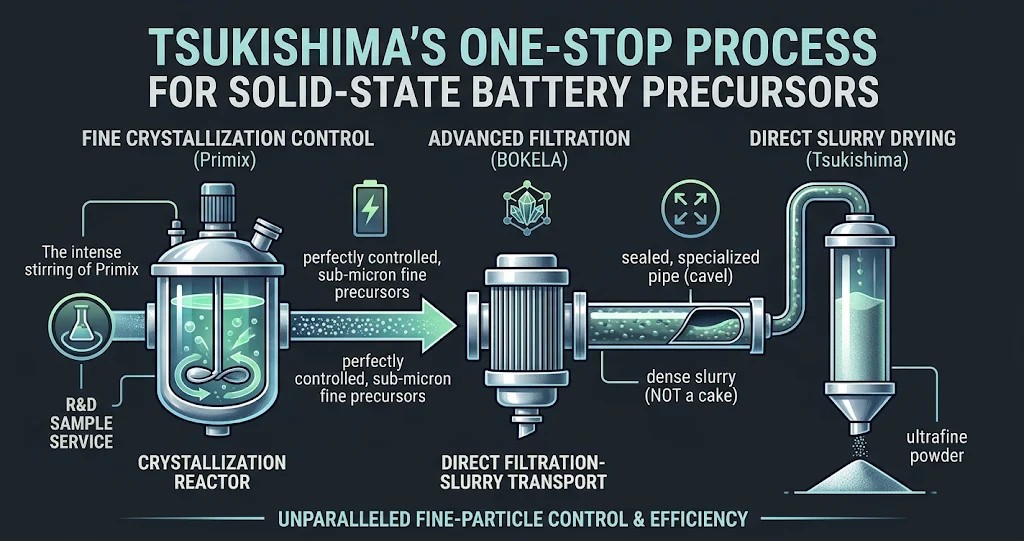
- 記事の要点: 正極前駆体(ニッケル、コバルト、マンガンの硫酸塩と水酸化ナトリウムを反応させて作るNCM系などの金属水酸化物)の製造には、「晶析」「濾過」「乾燥」の3工程が不可欠である。月島HDは以下のグループ技術・自社技術を組み合わせたワンストップ提供を強みとする。
- 晶析装置: 2020年に子会社化したプライミクス(兵庫県淡路市)の強い剪断力を持つ高速撹拌・分散技術を応用し、微細な結晶を生成。
- 濾過機: 2014年末に子会社化したドイツのボケラ(BOKELA)社の高度な固液分離・濾過技術を活用。
- 乾燥機: 下水汚泥処理などで培った自社技術を生かし、濾過後のケーキ状ではなく、濃度の高いスラリー状態のまま効率的に乾燥処理を行う。
- 【関連情報の補足】微粒子プロセスの技術的ハードル: 粒子が微細になるほど比表面積が増大し、濾過工程での目詰まりや洗浄効率の低下(不純物であるナトリウムや硫酸根の残留)、乾燥工程での粒子の再凝集といった課題が生じやすくなります。微粒子対応の晶析から高濃度スラリーの直接乾燥までを一貫して設計できる装置メーカーは世界でも限られており、日本の電池材料メーカーの競争力維持において大きな優位性となります。
3. 2030年の実用化に向けた開発伴走体制(本間友基執行役員インタビュー)
- 記事の要点: 正極材前駆体の品質は最終的な電池性能を大きく左右する。月島HDは開発の初期段階から顧客と課題を共有し、R&Dセンターでのテストを通じて実用化へ伴走する姿勢を重視している。1980年代から技術交流のある独ボケラ社の技術力と月島HDの顧客基盤を融合させ、日本の産業競争力強化とグローバル展開を目指す。
まとめ
製糖機械や環境・水処理プラントで培った「固液分離・乾燥」のコア技術に、M&Aで獲得した「微細化撹拌(プライミクス)」と「精密濾過(ボケラ)」を掛け合わせた月島HDの取り組みは、従来の化学プラントメーカーが次世代電池のサプライチェーン中核へと進化する好例です。2030年以降の全固体電池の本格普及に向け、材料メーカーと装置メーカーが開発初期から密に連携する「すり合わせ技術」の重要性が今後さらに高まっていきます。
出典:https://www.nikkan.co.jp/articles/view/796959
“Fine Precursors” Determining All-Solid-State Battery Performance: Tsukishima HD’s Three-in-One Process of Crystallization, Filtration, and Drying
As the race to develop all-solid-state batteries intensifies ahead of mass production for electric vehicles (EVs) after 2030, keen attention is being paid to fine particle technologies for “cathode active material precursors,” which dictate battery performance. This article summarizes the initiatives of Tsukishima Holdings (HD)—a company whose founding business was sugar refining machinery—as it combines its long-cultivated solid-liquid separation technologies with group capabilities acquired through M&A to provide essential solutions for all-solid-state battery cathode manufacturing processes, supplemented with technical background and industry trends.
- The Importance of Fine “Precursors” in All-Solid-State Batteries
- Key Points of the Article: Tsukishima Kikai, an operating subsidiary of Tsukishima HD, has been developing manufacturing equipment for fine precursors used in all-solid-state battery cathodes since around 2010. At its R&D Center in Yachiyo City, Chiba Prefecture, the company has been commissioned for dozens of projects, including experimental and pilot-scale trials, and also handles sample manufacturing.
- [Supplementary Information] Why Fine Particles Are Necessary: While conventional liquid-electrolyte lithium-ion batteries typically use cathode materials with particle sizes of around 10 to 15 um, all-solid-state batteries require solid electrolytes and cathode active materials to make surface-to-surface contact rather than point-to-point contact to secure ion conduction pathways. Consequently, further refinement of both primary and secondary particles (controlling them to a few um or less) and achieving a sharper particle size distribution directly impact battery power output and lifespan, making precise crystallization control at the precursor stage critically important.
- A “Three-in-One” Process Proposal Blending M&A and Proprietary Technologies
- Key Points of the Article: Three processes—”crystallization,” “filtration,” and “drying”—are indispensable for manufacturing cathode precursors (such as NCM-based metal hydroxides produced by reacting sulfates of nickel, cobalt, and manganese with sodium hydroxide). Tsukishima HD’s strength lies in offering a one-stop solution combining the following group and proprietary technologies:
- Crystallizer: Generates fine crystals by applying high-speed mixing and dispersion technologies with strong shear force from PRIMIX (Awaji City, Hyogo Prefecture), which became a subsidiary in 2020.
- Filter: Utilizes advanced solid-liquid separation and filtration technologies from Germany’s BOKELA, acquired as a subsidiary at the end of 2014.
- Dryer: Leverages proprietary technology cultivated in sewage sludge treatment to efficiently dry the material while it is still in a highly concentrated slurry state, rather than as a post-filtration filter cake.
- [Supplementary Information] Technical Hurdles in Fine Particle Processing: As particles become finer, their specific surface area increases, easily leading to issues such as clogging during filtration, reduced washing efficiency (resulting in residual impurities like sodium and sulfate radicals), and particle re-agglomeration during drying. Equipment manufacturers capable of consistently designing everything from fine-particle crystallization to direct drying of high-concentration slurries are limited worldwide, giving Japanese battery material manufacturers a major advantage in maintaining competitiveness.
- Collaborative Development Structure Toward Practical Application in 2030 (Interview with Executive Officer Tomoki Homma)
- Key Points of the Article: The quality of cathode material precursors heavily influences final battery performance. Tsukishima HD emphasizes working closely with customers from the early stages of development, sharing challenges and supporting them toward commercialization through testing at its R&D Center. By merging the technological prowess of Germany’s BOKELA—with whom it has maintained technical exchanges since the 1980s—with Tsukishima HD’s customer base, the company aims to strengthen Japan’s industrial competitiveness and expand globally.
Conclusion Tsukishima HD’s initiative—combining its core “solid-liquid separation and drying” technologies cultivated in sugar refining machinery and environmental/water treatment plants with “fine particle mixing (PRIMIX)” and “precision filtration (BOKELA)” acquired through M&A—serves as a prime example of a traditional chemical plant manufacturer evolving into a core player in the next-generation battery supply chain. Moving toward the full-scale adoption of all-solid-state batteries after 2030, the importance of “integral manufacturing” (suriawase technology), where material manufacturers and equipment makers collaborate closely from the earliest stages of development, will only continue to grow.

コメント