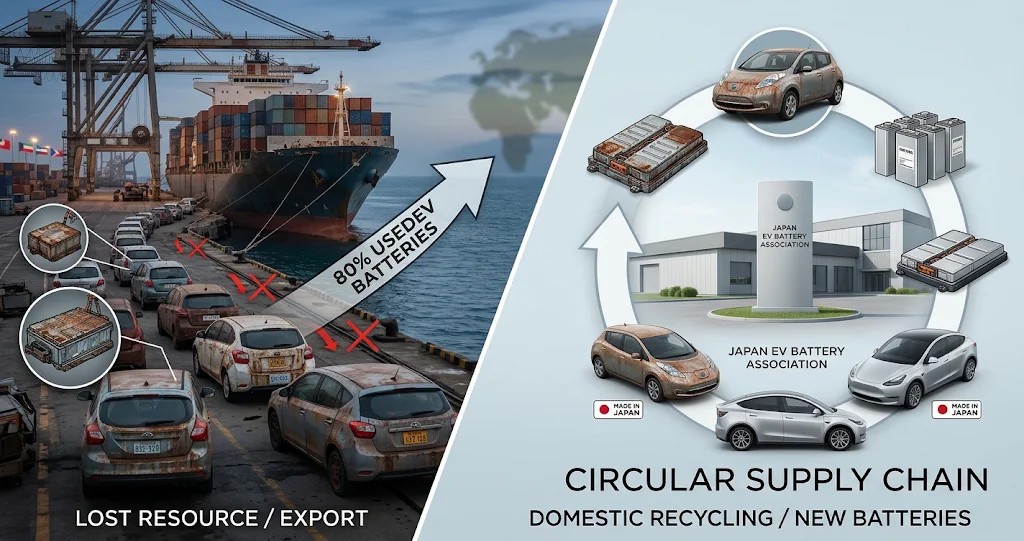
自動車の電動化が急ピッチで進む現代、見落とされがちな「隠れた資源の争奪戦」が水面下で激化しています。主役は、文字通りクルマの心臓部であるリチウムイオン電池です。普及の陰で、貴重な資源を宿した中古EVの約8割が海外へと流出し、国内のサプライチェーン構築は待ったなしの状況にあります。こうした中、日本総合研究所が主導するEV電池協議会が一般社団法人化され、サーキュラーエコノミー実現に向けた本格的な号砲が鳴らされました。業界の垣根を越えた中立的な組織による、新たな挑戦の全貌を紐解きます。
1. 日本総研「EV電池スマートユーザー推進協議会(EvBSU)」の始動
株式会社日本総合研究所は、2026年11月11日に「EV電池スマートユース協議会」を一般社団法人化し、一般社団法人EV電池スマートユーザー推進協議会(略称:EvBSU、呼称:イービス)として新たに発足させました。
- 代表理事: 中村崇氏(東北大学名誉教授)
- 参画主体: EV・EV電池の利用者、電池診断、金融・保険、運搬・物流、リユース・リサイクル事業者、地方自治体など
- 日本総研の役割: 運営の中核を担う幹事会員として参画し、これまでの知見やネットワークをいかした調整を推進
これまでの自主運営組織から、より客観性と信頼性の高い中立組織へと脱皮を図り、産官学の連携を一段と加速させる体制が整えられました。
2. 背景にある深刻な課題:海外流出と不透明な電池評価
EVの普及台数が右肩上がりに増える一方、現場のビジネスシーンや資源循環の仕組みには、クリアすべき大きな壁が立ちはだかっています。
- 中古EVの約8割が海外流出: 有用なレアメタル(リチウム、コバルト、ニッケルなど)をふんだんに内包した使用済みEVや電池が、国内で再利用されることなく国外へ流出しています。
- 電池の残価評価の難しさ: バッテリーの劣化度合いを正確かつ簡易に測る客観的な物差しがないため、中古EVとしての適正な価格(残価)を見込むことが困難になっています。
- 高止まりする物流コスト: 広範囲に点在する使用済み蓄電池を効率的に回収・集約するための物流ネットワークやインフラが未成熟です。
日本総研の試算によると、EV電池の循環利用やリユース・リサイクル関連の国内市場規模は、2030年に約6000億円、2050年には約8兆円に達すると予測されています。この巨大市場をいかに国内で囲い込み、持続可能なサーキュラーエコノミーに繋げるかが急務となっています。
3. 一般社団法人化の3大狙いと今後のロードマップ
組織を法人化した背景には、明確な戦略と狙いがあります。
- 中立的な立場の確立: 特定企業の利害に縛られず、競合関係にある事業者同士でも協調領域での連携や共創をしやすくする。
- 社会的信用の獲得と政策提言: 法人格を持つことで、関係省庁との対話や制度設計、CO2削減効果の算定・クレジット化に向けた働きかけを強化する。
- オープンな会員基盤の構築: 幅広い業界や自治体からの参画を広く促し、中長期的に持続可能な活動基盤を確立する。
今後は、電池状態の診断・評価方法の規格化・標準化、貢献度を示す指標づくりを進めるとともに、地域特性を活かした回収からリユース・リサイクルまでのモデルプロジェクトの全国展開を本格化させる方針です。
出典:https://cehub.jp/news/jri-ev-battery-smart-user-council-incorporated/
The Reality of 80% of Used EVs Flowing Overseas: The Japan Research Institute Establishes General Incorporated Association “EvBSU” to Tackle Domestic EV Battery Circulation
As automotive electrification accelerates rapidly today, an often-overlooked “hidden battle for resources” is intensifying beneath the surface. The main protagonist is literally the heart of the vehicle: the lithium-ion battery. Behind the scenes of widespread EV adoption, roughly 80% of used EVs—housing valuable resources—are flowing overseas, making the construction of a domestic supply chain an urgent necessity. Against this backdrop, an EV battery council led by The Japan Research Institute, Limited (JRI) has been incorporated as a general incorporated association, sounding the starting gun in earnest toward realizing a circular economy. We unravel the full picture of this new challenge undertaken by a neutral organization that transcends industry boundaries.
1. Launch of JRI’s “EV Battery Smart User Promotion Council (EvBSU)” On November 11, 2026, The Japan Research Institute, Limited incorporated the “EV Battery Smart Use Council” and newly launched it as the General Incorporated Association EV Battery Smart User Promotion Council (abbreviated as EvBSU).
- Representative Director: Takashi Nakamura (Professor Emeritus, Tohoku University)
- Participating Entities: EV and EV battery users, battery diagnostics, finance and insurance, transportation and logistics, reuse and recycling businesses, local governments, etc.
- Role of JRI: Participates as a managing member responsible for core operations, promoting coordination by leveraging its accumulated expertise and networks.
By evolving from a voluntarily operated organization into a more objective and reliable neutral body, a framework has been established to further accelerate industry-academia-government collaboration.
2. Serious Underlying Challenges: Overseas Outflow and Opaque Battery Valuation While the number of EVs on the road continues to climb, major hurdles stand in the way of actual business operations and resource circulation systems.
- Roughly 80% of Used EVs Flow Overseas: Used EVs and batteries packed with valuable rare metals (such as lithium, cobalt, and nickel) are flowing out of the country without being reused domestically.
- Difficulty in Assessing Battery Residual Value: Due to the lack of an objective yardstick to accurately and easily measure the degree of battery degradation, it is difficult to project a fair price (residual value) for used EVs.
- Persistently High Logistics Costs: Logistics networks and infrastructure for efficiently collecting and consolidating used storage batteries scattered across wide areas remain underdeveloped.
According to JRI’s estimates, the domestic market size related to EV battery circular utilization, reuse, and recycling is projected to reach approximately 600 billion yen in 2030 and around 8 trillion yen in 2050. Securing this massive market domestically and connecting it to a sustainable circular economy has become an urgent priority.
3. Three Major Objectives of Incorporation and the Future Roadmap Behind the incorporation of the organization lies a clear strategy and set of objectives:
- Establishing a Neutral Stance: Free from the interests of any specific company, making it easier for even competing businesses to collaborate and co-create in cooperative domains.
- Gaining Social Credibility and Policy Advocacy: Acquiring legal personality strengthens dialogue with relevant ministries and agencies, institutional design, and efforts toward calculating and crediting CO2 reduction effects.
- Building an Open Membership Base: Widely encouraging participation from a broad range of industries and local governments to establish a sustainable operational foundation over the medium to long term.
Moving forward, the association plans to advance the standardization of battery condition diagnosis and evaluation methods, create indicators showing levels of contribution, and begin the full-scale nationwide rollout of model projects spanning from collection to reuse and recycling tailored to regional characteristics.


コメント