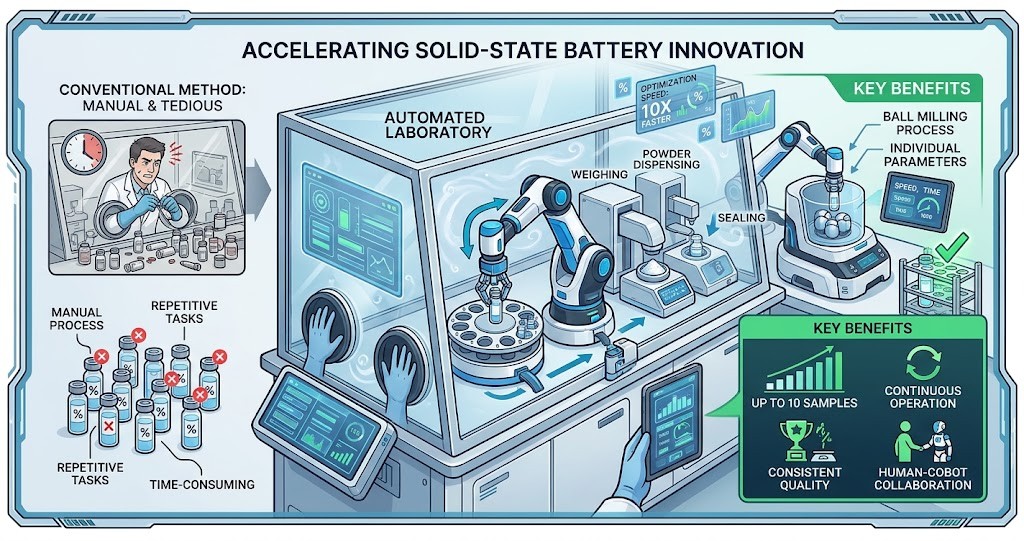
次世代の蓄電池として期待される「全固体電池」は、安全性やエネルギー密度に優れる反面、最適な材料組成や合成条件を導き出すために膨大な試行錯誤が必要とされます。特に、大気と反応しやすい材料を扱うグローブボックス内での手作業は研究者にとって大きな負担となっていました。こうした課題を解決するため、産業技術総合研究所(産総研)などの共同チームは、一度の指令で最大10試料の連続自動処理を可能にする人協働型の実験システムを開発しました。
開発された自動実験システムの概要と主な特徴
- 一貫したプロセスの自動化: 粉体やビーズの秤量、容器の蓋の開閉、遊星ボールミルによる処理、そして試料の保管に至るまでの一連のメカノケミカル合成プロセスを、人の手を介さず連続して実行できます。
- グローブボックス内での運用: 小型の人協働ロボットと専用モジュールを組み合わせることで、限られた作業空間や、水分・酸素を遮断する必要があるグローブボックス内での安定した運用を実現しています。
- 最大10試料の連続処理: 遊星ボールミル1回につき2試料を取り扱い、これを5回連続で実行することで、一度の指令で最大10試料の自動処理が可能です。試薬量や回転数、処理時間などのパラメータを個別に変更できます。
技術的な工夫と周辺モジュールの役割
- 専用エンドツールの活用: デンソーウェーブが開発した専用のエンドツールにより、微量な粉体の扱い、薬さじの操作、ビーズの投入、形状の異なる容器の搬送など、協働ロボットの標準ハンドでは難しい細かな粉体操作を安定化させています。
- 負荷を支えるオリジナルモジュール: 愛知工業大学が開発した補助モジュールが、固く閉まった容器の蓋の開閉や重量物の取り扱いを担い、システムの柔軟性と耐久性を高めています。
研究DXへの貢献と今後の展望
- デジタルデータの一元管理: 試薬量やミル回転数、処理時間などの実験パラメータがデジタルデータとして一元管理されるため、マテリアルズ・インフォマティクス(MI)やプロセス・インフォマティクス(PI)の入力データとして活用できます。
- 自律型材料開発への発展: 今後は合成した試料の導電率や構造評価をAI解析と連携させ、次の実験条件を自動提案する自律型プラットフォームへの展開が計画されています。また、セラミックス材料開発全般への応用や、2029年以降の地域企業等への共同利用導入も見据えられています。
出典:https://www.aist.go.jp/aist_j/press_release/pr2026/pr20261105/pr20261105.html
[AIST and Partners] Development of an Automated Experimental System for Mechanochemical Synthesis Supporting All-Solid-State Battery Material Exploration
All-solid-state batteries are highly anticipated as next-generation rechargeable batteries due to their superior safety and energy density. However, identifying optimal material compositions and synthesis conditions requires an immense amount of trial and error. In particular, manual operations inside gloveboxes to handle air-sensitive materials have imposed a heavy burden on researchers. To address these challenges, a joint research team led by the National Institute of Advanced Industrial Science and Technology (AIST) has developed a human-collaborative experimental system capable of continuously and automatically processing up to 10 samples with a single command.
Overview and Key Features of the Automated Experimental System
- End-to-End Process Automation: The system seamlessly automates the entire mechanochemical synthesis process without human intervention, from weighing powders and beads to opening/closing container lids, planetary ball milling, and sample storage.
- Operation Inside Gloveboxes: Combining compact human-collaborative robots with dedicated modules enables stable operation within the confined space of a glovebox, where moisture and oxygen must be excluded.
- Continuous Processing of Up to 10 Samples: By handling 2 samples per planetary ball milling run and executing 5 consecutive runs, the system automatically processes up to 10 samples under a single command. Parameters such as reagent quantity, rotation speed, and processing time can be customized for each run.
Technical Innovations and Peripheral Modules
- Dedicated End-Effectors: Specialized end-effectors developed by Denso Wave stabilize intricate powder-handling operations that standard robot grippers struggle with, including measuring trace amounts of powder, manipulating spatulas, introducing beads, and transporting containers of various shapes.
- Custom Auxiliary Modules: Auxiliary modules developed by Aichi Institute of Technology handle heavy loads and tasks such as opening and closing tightly sealed container lids, enhancing system flexibility and durability.
Contributions to Research DX and Future Outlook
- Centralized Digital Data Management: Experimental parameters, including reagent quantities, mill rotation speeds, and processing times, are centrally managed as digital data, allowing seamless integration as input data for Materials Informatics (MI) and Process Informatics (PI).
- Evolution Toward Autonomous Material Development: Future plans include connecting conductivity and structural evaluation data of synthesized samples with AI analysis to build an autonomous platform that automatically suggests subsequent experimental conditions. The team also aims to expand application to general ceramic materials development and introduce the system for shared use by local enterprise partners starting in 2029 or later.
コメント