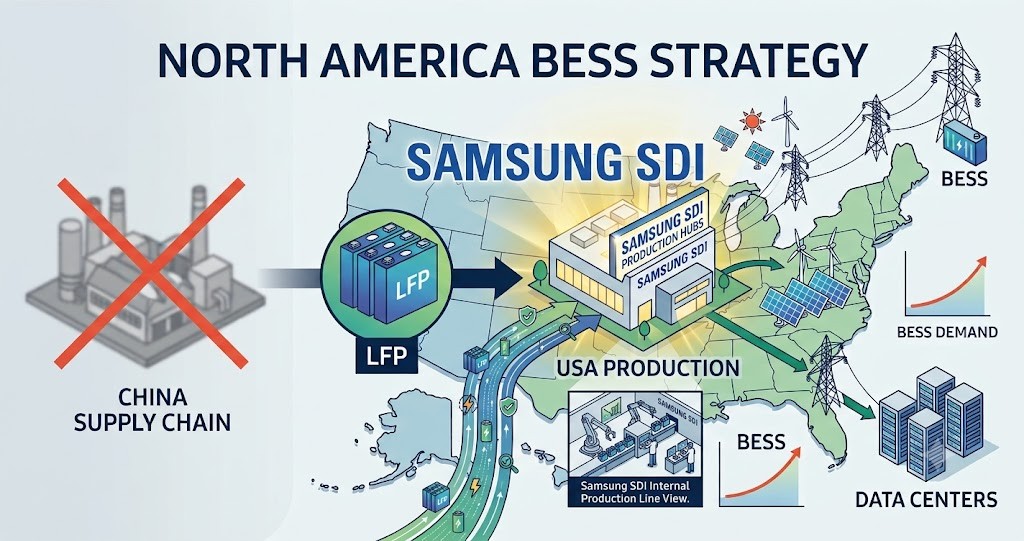
再生可能エネルギーの導入拡大やデータセンターの急増に伴い、世界的に定置型蓄電池システム(BESS)の需要が急拡大しています。こうした中、韓国の電池大手サムスンSDIが、米国市場におけるBESS向けリン酸鉄リチウム(LFP)電池セルの現地生産計画を具体化させました。
従来、LFP電池市場は価格競争力に勝る中国企業が圧倒的なシェアを握ってきました。しかし、米国の通商規制や税制優遇措置(IRAなど)の変化に伴い、サプライチェーンの脱中国化(FEOC非該当化)が急務となっています。サムスンSDIの今回の動きは、北米の定置型蓄電池市場におけるシェア争いと、米国の規制に対応した次世代サプライチェーン構築の本格化を象徴するものとして注目されています。
ニュースの要点まとめ
- 生産開始時期と製品計画サムスンSDIは、2026年10月に米国でBESS向け角型LFP電池セルの生産を開始します。現在生産ラインは量産品質検証の段階にあり、新世代の蓄電池システム「サムスンバッテリーボックス(SBB)2.0」の初回出荷を年内に予定しています。
- 生産能力の拡張と堅調な需要2026年末までに米国で年産30 GWhのBESSセル生産能力を確立する目標を掲げており、さらに生産能力を拡大する選択肢も検討中です。同社は2028年以降、需要が供給能力を上回ると予測しています。
- 脱中国(FEOC非該当)サプライチェーンの構築韓国および米国のサプライヤーとの提携により、LFP正極材などの主要部品を確保。米国の懸念外国企業(FEOC)規制に準拠したサプライチェーンを確立し、米国の税制優遇(インセンティブ)要件を満たしています。
- 受注状況と新規技術開発すでに2029年までの計画生産能力の多くを占める受注を獲得しており、直近(第2四半期)にも米BESS事業者と長期供給契約を締結しました。また、LFPに加え、データセンターや大規模エネルギー貯蔵向けのナトリウムイオン電池の開発も並行して進めています。
関連情報・背景知識の補足
BESS市場における「LFP電池」の台頭理由
かつてリチウムイオン電池といえば高エネルギー密度の三元系(NMCなど)が主流でしたが、定置型蓄電池(BESS)においては価格の安さ、高い安全性、長寿命(充放電サイクルの多さ)が最重視されます。そのため、エネルギー密度では劣るものの安定性とコストに優れるLFP(リン酸鉄リチウム)電池が現在のBESS市場のグローバルスタンダード(シェアの8割以上)となっています。
FEOC(懸念外国企業)規制と米国の税制優遇
米国ではインフレ削減法(IRA)などに基づき、税制優遇措置を受けるための条件を厳格化しています。特に中国関連企業が一定以上関与する部品や原材料(FEOC:Foreign Entity of Concern)を排除する規定が強化されており、米国市場で事業を展開するエネルギー企業は、中国依存から脱却したLFPサプライチェーンを強く求めています。サムスンSDIが韓国や米国のサプライヤーと組む最大の狙いはこの点にあります。
ナトリウムイオン電池(SIB)開発の意味
サムスンSDIがLFPと並行して開発を進める「ナトリウムイオン電池」は、希少金属(リチウムやコバルト)を一切使わず、豊富な塩(ナトリウム)を原料とするため、さらなるコストダウンと資源リスク回避が期待できる次世代電池です。特にエネルギー密度よりも徹底した低コスト化が求められる大規模データセンターや電力網向けBESSとして、LFPの次の手札として世界的に開発競争が加速しています。
Samsung SDI to Begin U.S. Production of LFP Batteries for BESS in October 2026
With the expansion of renewable energy adoption and the rapid surge in data centers, global demand for Battery Energy Storage Systems (BESS) is growing rapidly. Amid this trend, South Korean battery giant Samsung SDI has finalized its plans for local production of lithium iron phosphate (LFP) battery cells for BESS in the U.S. market.
Historically, Chinese companies have held a dominant market share in the LFP battery space due to their price competitiveness. However, driven by changes in U.S. trade regulations and tax incentive programs such as the Inflation Reduction Act (IRA), establishing a non-Chinese supply chain (non-FEOC compliant) has become an urgent priority. Samsung SDI’s latest move is drawing significant attention as a signal of intensifying competition for market share in the North American BESS industry, as well as the full-scale construction of next-generation supply chains designed to meet U.S. regulatory standards.
Key Takeaways
- Production Timeline and Product Roadmap: Samsung SDI will start producing prismatic LFP battery cells for BESS in the U.S. in October 2026. The production line is currently undergoing mass-production quality verification, with initial shipments of its next-generation storage system, the Samsung Battery Box (SBB) 2.0, scheduled within the year.
- Capacity Expansion and Strong Demand: The company aims to establish an annual BESS cell production capacity of 30 GWh in the U.S. by the end of 2026 and is already evaluating options to expand capacity further. Samsung SDI projects that demand will exceed its supply capacity from 2028 onward.
- Building a Non-Chinese (FEOC-Compliant) Supply Chain: Through partnerships with South Korean and U.S. suppliers, the company has secured key components, including LFP cathode materials. By establishing a supply chain compliant with U.S. Foreign Entity of Concern (FEOC) rules, Samsung SDI meets the requirements for U.S. tax incentives.
- Order Backlog and New Technology Development: Backlog orders already account for a significant portion of the planned production capacity through 2029, including a long-term supply agreement signed with a U.S. BESS client in the second quarter. Alongside LFP technology, Samsung SDI is concurrently developing sodium-ion batteries for data centers and large-scale energy storage systems.
Supplementary Context and Background Knowledge
Why LFP Batteries Dominate the BESS Market
While high-energy-density nickel-manganese-cobalt (NMC) chemistry was previously the mainstream standard for lithium-ion batteries, stationary storage systems (BESS) prioritize low cost, high safety, and long cycle life. Consequently, LFP (lithium iron phosphate) batteries—which offer superior stability and cost-efficiency despite lower energy density—have become the global standard in the BESS market, accounting for over 80% of market share.
FEOC Regulations and U.S. Tax Incentives
Under legislation like the Inflation Reduction Act (IRA), the U.S. has tightened eligibility requirements for tax credits. Rules excluding components and raw materials tied to Foreign Entities of Concern (FEOC)—specifically targeting Chinese entities—have been strengthened. Energy companies operating in the U.S. are urgently seeking LFP supply chains that reduce reliance on China. Partnering with South Korean and U.S. suppliers is Samsung SDI’s strategic move to address this requirement.
Strategic Significance of Sodium-Ion Battery (SIB) Development
The sodium-ion battery technology Samsung SDI is developing alongside LFP utilizes abundant sodium (salt) as a raw material instead of rare metals like lithium or cobalt. This promises further cost reductions and mitigation of resource supply risks. Sodium-ion batteries are increasingly viewed as the next logical step following LFP in the global development race, particularly for grid-scale BESS and large data centers where extreme cost reduction takes precedence over energy density.
コメント