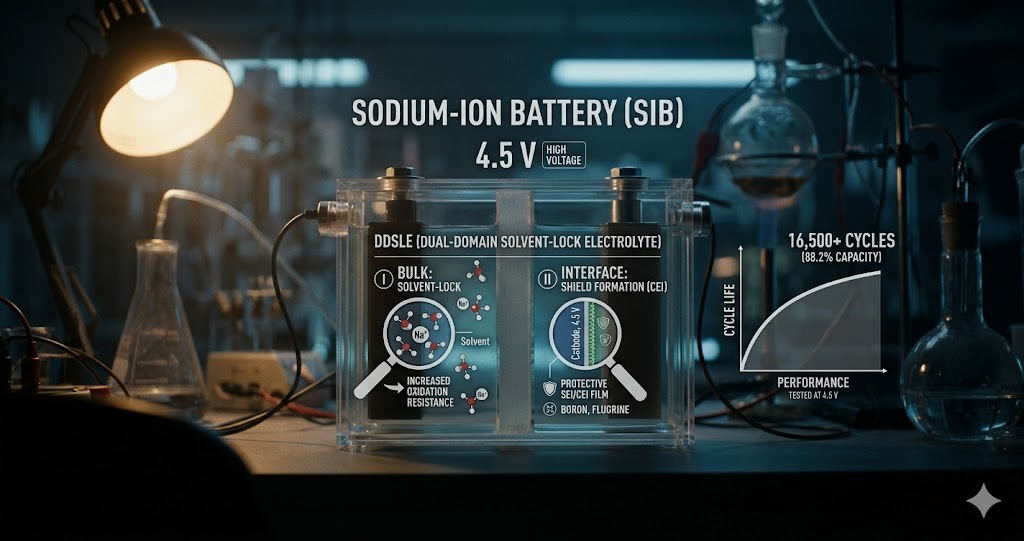
持続可能なエネルギー貯蔵システムとして、資源が豊富なナトリウムイオン電池(SIB)が注目されています。SIBのエネルギー密度をリチウムイオン電池に近づけるには、作動電圧を「4.5 V級」まで高めることが不可欠です。
しかし、従来の電解液は高電圧下で正極表面の強い攻撃を受け、激しく分解してしまいます。これにより、電池の寿命が急激に縮まることが大きな課題でした。本研究では、特定の添加剤(NaDFOB)を用いて、電解液の分子構造を「ロック(固定)」し、界面に強固な保護膜を形成するDDSLE(デュアルドメイン溶媒ロック電解質)を開発しました。
- 1. 従来の課題:高電圧における「求電子攻撃」
- 2. 新開発:DDSLE(デュアルドメイン溶媒ロック電解質)
- 3. 実証結果:驚異的なサイクル寿命
- 4. 結論と意義
- Design of Electrolyte for 4.5 V-class High-Voltage Sodium Batteries Based on the Dual-Domain Solvent-Locked Concept
1. 従来の課題:高電圧における「求電子攻撃」
高電圧(4.5 V以上)で充電を行うと、正極表面から電子が奪われ、非常に不安定な状態(強い求電子性)になります。
- 現象: 電解液中の自由な溶媒分子が正極表面で攻撃を受け、分解されます。
- 結果: 分解によってできた「ゴミ(オリゴマー)」が堆積し、それがさらなる分解を招く悪循環に陥り、容量がすぐに低下してしまいます。
2. 新開発:DDSLE(デュアルドメイン溶媒ロック電解質)
研究チームは、標準的な電解液(1M NaPF6 EC/EMC)にNaDFOB(ジフルオロオキサレートホウ酸ナトリウム)を最適濃度(0.4M)で添加しました。この電解液は、2つの領域(ドメイン)で効果を発揮します。
ドメイン I:バルク相(液体全体)での補強
Na+(ナトリウムイオン)の周囲にある溶媒分子の結びつきを強めます。
- 溶媒ロック: DFOBアニオンの電子吸引効果により、Na+と溶媒(EC/EMC)の距離が縮まり、構造が「タイト」になります。
- 効果: 溶媒分子が自由に動き回って分解されるのを防ぎ、酸化に対する耐性が向上します。
ドメイン II:電極界面での保護(インターフェース)
DFOBアニオンは正極表面に吸着しやすく、優先的に分解される性質を持っています。
- アニオンリッチ・シールド: 電極表面に「ホウ化物」や「フッ化物」を主成分とする薄くて均一な膜(CEI)を形成します。
- 絶縁性の向上: この膜はワイドバンドギャップ(>6.2 eV)を持ち、電子の漏れ(トンネル効果)を強力に遮断します。
3. 実証結果:驚異的なサイクル寿命
このDDSLEを用いたナトリウム金属電池(Na||Na2.26Fe1.87(SO4)3)は、4.5 Vという過酷な条件で圧倒的な安定性を示しました。
| セルタイプ | 条件 | 性能 |
| コインセル | 1000 mA g–1 / 16,500サイクル | 88.2% の容量を維持 |
| パウチセル | 100 mA g–1 / 500サイクル | 93.9% の容量を維持 |
- 高温耐性: 60 ℃の高温動作下でも、180サイクル後に95.2%の容量を維持し、実用的な安定性を証明しました。
- 負極の安定化: 正極だけでなく、ナトリウム金属負極側でもデンドライト(樹枝状結晶)の発生を抑え、滑らかな表面を保つことが確認されました。
4. 結論と意義
本研究で提案された「溶媒ロック」コンセプトは、高電圧電池における界面の不安定性を克服するための新しい指針となります。
- 汎用性: 開発された電解液は、一般的な酸化物系正極やポリアニオン系正極など、幅広い材料と高い互換性を持っています。
- 未来への影響: この技術は、ナトリウムイオン電池だけでなく、次世代の高エネルギー密度電池(リチウム金属電池など)の寿命延長にも応用できる可能性があります。
出典:https://www.nature.com/articles/s41467-026-72849-z
Design of Electrolyte for 4.5 V-class High-Voltage Sodium Batteries Based on the Dual-Domain Solvent-Locked Concept
Sodium-ion batteries (SIBs) are attracting significant attention as sustainable energy storage systems due to the abundance of sodium resources. To bring the energy density of SIBs closer to that of lithium-ion batteries, it is essential to increase the operating voltage to the 4.5 V-class.
However, conventional electrolytes suffer from severe decomposition under high voltage due to intense attacks on the positive electrode surface. This leads to a rapid decline in battery life, posing a major challenge. In this study, a Dual-Domain Solvent-Locked Electrolyte (DDSLE) was developed. By using a specific additive (NaDFOB), the molecular structure of the electrolyte is “locked,” forming a robust protective film at the interface.
1. Conventional Challenge: “Electrophilic Attack” at High Voltage
Charging at high voltages (4.5 V or higher) strips electrons from the positive electrode surface, leaving it in a highly unstable and strongly electrophilic state.
- Phenomenon: Free solvent molecules in the electrolyte are attacked and decomposed at the positive electrode surface.
- Result: Decomposition products (oligomers) accumulate, creating a vicious cycle that triggers further decomposition and leads to a rapid loss of capacity.
2. New Development: DDSLE (Dual-Domain Solvent-Locked Electrolyte)
The research team added NaDFOB (sodium difluoro(oxalato)borate) at an optimal concentration (0.4 M) to a standard electrolyte (1 M NaPF6 in EC/EMC). This electrolyte functions effectively across two domains.
Domain I: Reinforcement in the Bulk Phase (Entire Liquid)
DDSLE strengthens the bonding of solvent molecules surrounding the sodium ions ($Na^+$).
- Solvent Locking: Due to the electron-withdrawing effect of the DFOB anion, the distance between $Na^+$ and the solvents (EC/EMC) is shortened, creating a “tight” structure.
- Effect: This prevents solvent molecules from moving freely and decomposing, thereby improving overall oxidation resistance.
Domain II: Protection at the Electrode Interface
The DFOB anion adsorbs easily onto the positive electrode surface and possesses the property of preferential decomposition.
- Anion-Rich Shield: It forms a thin, uniform film (Cathode Electrolyte Interphase, or CEI) primarily composed of borides and fluorides on the electrode surface.
- Improved Insulation: This film features a wide bandgap (>6.2 eV), which strongly blocks electron leakage (tunneling effect).
3. Experimental Results: Extraordinary Cycle Life
The sodium-metal battery using this DDSLE ($Na$||$Na_{2.26}Fe_{1.87}(SO_4)_3$) demonstrated overwhelming stability under the harsh condition of 4.5 V.
| Cell Type | Conditions | Performance |
| Coin Cell | 1000 mA g–1 / 16,500 cycles | Retained 88.2% capacity |
| Pouch Cell | 100 mA g–1 / 500 cycles | Retained 93.9% capacity |
- High-Temperature Durability: Even under high-temperature operation at 60 °C, the battery retained 95.2% of its capacity after 180 cycles, proving practical stability.
- Anode Stabilization: In addition to the positive electrode, it was confirmed that dendrite growth was suppressed on the sodium-metal negative electrode, maintaining a smooth surface.
4. Conclusion and Significance
The “solvent-locked” concept proposed in this study serves as a new guideline for overcoming interfacial instability in high-voltage batteries.
- Versatility: The developed electrolyte is highly compatible with a wide range of materials, including common oxide-based and polyanionic positive electrodes.
- Future Impact: This technology has the potential to extend the lifespan not only of sodium-ion batteries but also of next-generation high-energy-density batteries, such as lithium-metal batteries.

コメント