株式会社3DCは、横浜国立大学の宇賀田洋介助教、藪内直明教授らとの共同研究において、同社が開発する炭素材料「Graphene MesoSponge(GMS)」をリチウムイオン電池の正極に1重量%添加することで、急速放電性能が大幅に向上することを実証しました。この研究成果は、国際学術誌「Advanced Energy Materials」にオンライン掲載されています。
主な成果とポイント
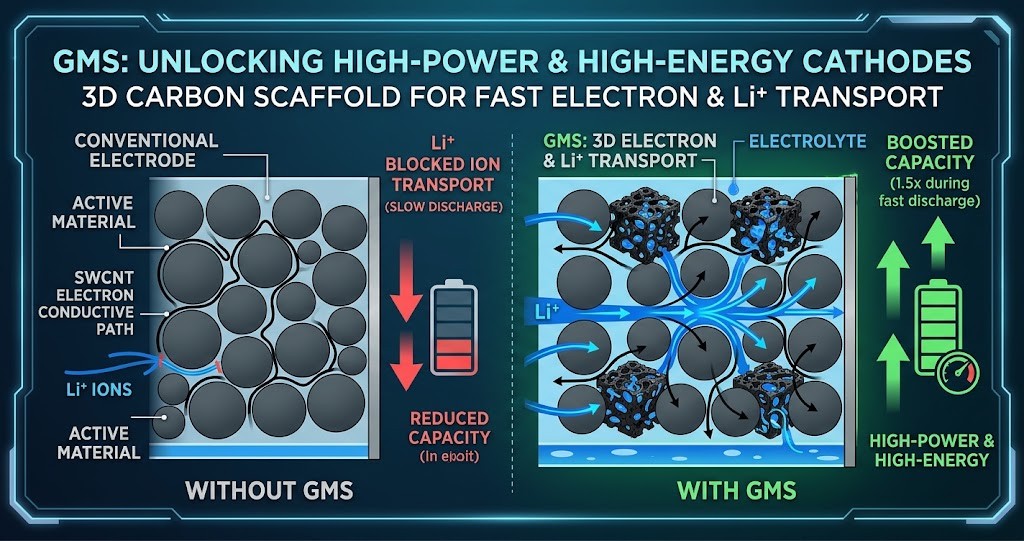
- 急速放電時の容量が約1.5倍に向上:高密度かつ厚膜の正極において、大電流放電時に取り出せる容量が、従来の単層カーボンナノチューブ(SWCNT)を用いた電極の約1.5倍を達成しました。試験条件は800 mA g-1(15.5 mA cm-2)です。
- 電子とリチウムイオンの3次元輸送:GMSの炭素骨格が電子の通り道(電線)として機能し、内部のナノサイズ細孔に保持された電解液がリチウムイオンの輸送経路(水路)として寄与します。
- 高エネルギー密度と高出力の両立:従来はトレードオフの関係にあった「電極の高密度化による高容量化」と「イオン拡散性低下による入出力低下」の課題を同時に解決します。
GMSが電極内で果たす役割と背景
リチウムイオン電池の高エネルギー密度化には、正極を厚くし、活物質を高密度に充填することが不可欠です。しかし、充填密度を高めると電解液の保持スペースが減少し、リチウムイオンの移動が妨げられるため、急速放電時に容量が低下するというジレンマがありました。
従来の導電助剤である単層カーボンナノチューブ(SWCNT)は優れた電子伝導パスを形成するものの、内部に電解液を保持することはできません。これに対し、GMSはスポンジ状の三次元炭素構造を持ち、電子とイオンの双方を同時にスムーズに輸送できるため、厚膜・高密度化された電極内部でも優れた性能を発揮します。
今後の展開と活用分野
本成果は、学術的な裏付けを得た大きな前進であり、今後は以下の分野への展開や事業化が進められます。
- 主な用途:データセンターのバックアップ電源、産業用ドローン、EV(電気自動車)、半導体分野など、高出力・高エネルギー密度が求められる領域。
- 事業化への取り組み:国内外の電池メーカーや材料メーカーとの共同開発を加速し、研究成果の早期実用化を目指しています。
論文情報
- 論文題目:Unlocking Three-Dimensional Electron and Ion Transport in High-Loading and Dense Lithium-Ion Battery Electrodes Assisted via Porous Graphene Networks
- 掲載誌:Advanced Energy Materials
- 掲載日:2026年10月8日(オンライン)
- 著者:Yosuke Ugata, Rei Matsumoto, Sera Sato, Jaejin Lim, Yong Min Lee, Hiroshi Ueda, Atsuo Omaru, Kosuke Ishii, Naoaki Yabuuchi
1.5 Times SWCNT! Sponge-Like Carbon “GMS” Overcomes the Limitations of Lithium-Ion Batteries
In joint research with Assistant Professor Yosuke Ugata and Professor Naoaki Yabuuchi of Yokohama National University, 3DC Co., Ltd. demonstrated that adding 1 wt% of its proprietary carbon material, “Graphene MesoSponge (GMS),” to a lithium-ion battery cathode significantly improves rapid discharge performance. The results of this research have been published online in the international academic journal “Advanced Energy Materials.”
Key Findings and Points
- Rapid Discharge Capacity Increased by Approx. 1.5 Times: In high-density, high-loading cathodes, the dischargeable capacity under high-current conditions reached approximately 1.5 times that of electrodes using conventional single-walled carbon nanotubes (SWCNTs). The test condition was 800 mA g-1 (15.5 mA cm-2).
- Three-Dimensional Electron and Lithium-Ion Transport: The carbon framework of GMS acts as an electron path (wiring), while the electrolyte retained within its internal nano-sized pores provides a lithium-ion transport route (waterway).
- Simultaneous High Energy Density and High Power Output: This approach resolves the trade-off between increasing capacity by densifying electrodes and the resulting drop in power output due to suppressed ion diffusion.
Background and Role of GMS inside the Electrode Increasing the energy density of lithium-ion batteries requires making the cathode thicker and packing the active material at high density. However, higher packing density reduces the space available to hold electrolyte, creating a dilemma where restricted lithium-ion movement lowers capacity during rapid discharge.
While single-walled carbon nanotubes (SWCNTs) serve as excellent conductive additives for electron transport, they cannot retain electrolyte within their structure. In contrast, GMS features a sponge-like 3D carbon network capable of smoothly transporting both electrons and ions simultaneously, delivering superior performance even inside thick, highly densified electrodes.
Future Outlook and Applications This achievement represents major progress with solid academic validation, paving the way for commercialization across various applications:
- Main Applications: Data center backup power supplies, industrial drones, EVs (electric vehicles), and semiconductor equipment sectors requiring high output and high energy density.
- Business Development: 3DC is accelerating joint development with domestic and overseas battery and material manufacturers to achieve early commercial implementation.
Publication Information
- Title: Unlocking Three-Dimensional Electron and Ion Transport in High-Loading and Dense Lithium-Ion Battery Electrodes Assisted via Porous Graphene Networks
- Journal: Advanced Energy Materials
- Publication Date: October 8, 2026 (Online)
- Authors: Yosuke Ugata, Rei Matsumoto, Sera Sato, Jaejin Lim, Yong Min Lee, Hiroshi Ueda, Atsuo Omaru, Kosuke Ishii, Naoaki Yabuuchi
コメント