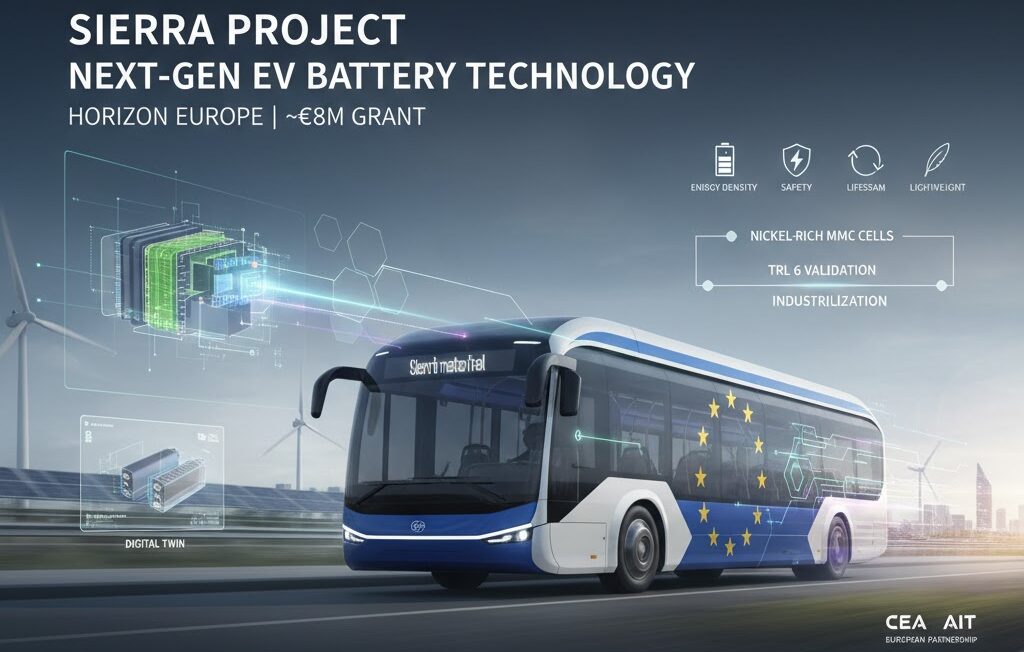
欧州連合(EU)の「Horizon Europe」プログラムから約800万ユーロの助成を受ける「SIERRAプロジェクト」は、電気バスの性能を左右する次世代バッテリーパックの産業化を目指しています。フランスのCEAが主導し、欧州7カ国から11のパートナーが参加するこのプロジェクトは、既存のバッテリー技術が限界を迎えつつある大型車両市場に革新をもたらそうとしています。
1. プロジェクトの背景と目的
現在、電気バスにはLFP(リン酸鉄リチウム)やNMC(ニッケル・マンガン・コバルト)など様々なセルが使われていますが、大型用途では「エネルギー密度」「安全性」「寿命」「急速充電」「軽量化」という相反する要件の両立が最大の課題です。 SIERRAプロジェクトは、比エネルギー向上のポテンシャルが高いニッケルリッチNMCセルに焦点を当て、技術成熟度レベル6(TRL6)までの検証を行うことで、研究開発から産業化への橋渡しを担います。
2. 主な技術革新のポイント
従来のバッテリーパック構造の限界を突破するため、以下の高度な設計手法と製造技術を導入しています。
- 先進的なハウジング製造: 軽量なマルチマテリアルハウジングを資源効率よく製造する「ワンショット製造プロセス」の採用。
- 次世代熱管理・電気設計: 完全に統合された冷却システムとプリントされたバスバー(導電板)を導入し、広範な動作ウィンドウでの高出力充電をサポート。
- インテリジェント監視: バッテリー管理システムの複雑さを抑えつつ、構造監視、熱マッピング、充電状態・健全性診断を多段階で行うコンセプト。
- デジタルツインの活用: 設計の初期段階からシミュレーションベースで開発を行い、デジタルツインを用いることで、車両全体への統合と最適化を早期に検証。
3. プロジェクトにおけるAIT(オーストリア工科大学)の役割
AITは、モデルベースのバッテリーシステム開発の専門知識を提供しています。「設計段階からの安全性と持続可能性(Safe and Sustainable by Design)」を徹底し、将来の電気商用車において、エネルギー効率と安全性を高次元で両立させるコンセプトを確立しています。
出典:https://batteryindustry.net/improved-nmc-battery-pack-developed-for-electric-buses/
A Solution for Heavy-Duty Transport: The European Consortium’s Challenge to Optimize Nickel-Rich NMC Cells
The SIERRA project, which receives approximately 8 million EUR in funding from the European Union’s Horizon Europe program, aims to industrialize next-generation battery packs that will define the performance of electric buses. Led by the French Atomic Energy and Alternative Energies Commission (CEA) and involving 11 partners from 7 European countries, this project is set to bring innovation to the heavy-duty vehicle market, where existing battery technologies are reaching their limits.
1. Project Background and Objectives
Currently, various cells such as LFP (Lithium Iron Phosphate) and NMC (Nickel Manganese Cobalt) are used in electric buses. However, the greatest challenge for heavy-duty applications is balancing conflicting requirements, including energy density, safety, lifespan, fast-charging capabilities, and weight. The SIERRA project focuses on nickel-rich NMC cells, which offer significant potential for improved specific energy, and aims to bridge the gap between research and industrialization by validating technology up to Technology Readiness Level 6 (TRL6).
2. Key Technological Innovations
To break through the limitations of conventional battery pack architectures, the project is introducing advanced design methodologies and manufacturing techniques:
- Advanced Housing Manufacturing: Adoption of a “one-shot” manufacturing process to produce lightweight multi-material housings in a resource-efficient manner.
- Next-Generation Thermal and Electrical Design: Introduction of fully integrated cooling systems and printed busbars to support high-power charging across a wide operating window.
- Intelligent Monitoring: A multi-stage monitoring concept (structural monitoring, thermal mapping, state-of-charge, and state-of-health diagnostics) that reduces the complexity of battery management systems.
- Utilization of Digital Twins: Implementing simulation-based development from the early design stages, utilizing digital twins to verify vehicle-level integration and optimization at an early phase.
3. The Role of AIT (Austrian Institute of Technology) in the Project
AIT provides expertise in model-based battery system development. By thoroughly applying a “Safe and Sustainable by Design” approach, AIT is establishing concepts that achieve a high-level balance of energy efficiency and safety in future electric commercial vehicles.

コメント