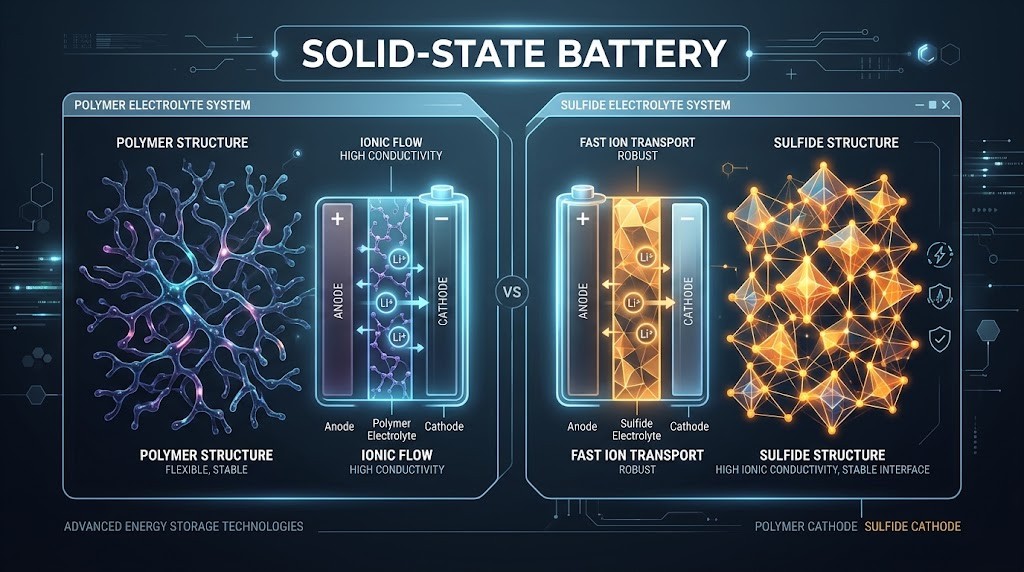
電気自動車(EV)や次世代モビリティの市場において、安全性の向上と航続距離の飛躍的な延伸を同時に実現する「全固体電池(Solid-State Battery)」は、業界のゲームチェンジャーとして世界中から大きな注目を集めています。従来の液状電解質を使用するリチウムイオン電池に比べ、エネルギー密度の向上や発火リスクの低減が期待される一方で、材料コストや製造プロセスの確立、量産歩留まりの確保など解決すべき技術的ハードルも依然として多く存在します。
本記事では、中国を代表するバッテリーメーカーであるサンウォダ(Sunwoda / SEVB)とCATL(寧徳時代)の最新動向を軸に、両社が採用する技術アプローチの違い、性能仕様、コスト面での課題、およびEV・航空分野(eVTOLなど)への応用展開について関連情報を補足しながらわかりやすくまとめています。
全固体電池開発競争:サンウォダとCATLのアプローチ比較
中国の主要バッテリーサプライヤー2社は、それぞれ異なる電解質技術と量産スケジュールを掲げて開発を進めています。
- サンウォダ(Sunwoda / SEVB)
- 採用技術: ポリマー複合電解質
- 進捗状況: 設計およびプロセスの検証を完了し、現在自動車メーカー(OEM)による評価段階(顧客テスト)。2026年5月から実施しているテストプログラムの継続・進展状況を公開。
- ロードマップ: 2027年に第2世代硫化物電池の開発を目標とし、2030年にはエネルギー密度500Wh/kgを超える次世代電池の開発を目指す。
- CATL(寧徳時代)
- 採用技術: 硫化物系電解質
- 進捗状況: 2024年に20Ahの全固体電池プロトタイプを発表済み。
- ロードマップ: 2027年に少量生産(パイロット生産)の開始を目標として掲げる。
サンウォダの「Xin Bixiao」ポリマー複合電池の仕様と特長
サンウォダの20Ah「Xin Bixiao」セルは、ポリマー複合材料のアプローチを採用することで、製造および構造上の利点を目指しています。
- エネルギー密度: 400Wh/kg
- サイクル寿命: 1MPa以下の外部圧力環境下で1,200サイクル以上
- 構成要素: 12ミクロンのポリマー複合膜、ナノスケール高エントロピーシリコン負極
- 耐熱性・安全性: 200度Cの高温試験に合格
- 低圧動作のメリット: 充電・放電時の電極の膨張・収縮に対して電極と固体電解質の接触を維持。1MPa以下の低圧で動作可能なため、バッテリーパック側の補強・構造要件(持続的な加圧機構など)を軽減できる可能性がある。
【補足:硫化物系電解質との違いと技術的背景】
- 硫化物系の課題: 界面の劣化を防ぐために高い外部圧力を維持し続ける設計が必要となることが多い。また、空気中の水分(水)と反応すると有毒な硫化水素(H2S)ガスが発生する恐れがあるため、製造ラインにおける厳格な湿度管理・ドライルーム環境が不可欠。
- 検証上の留意点: セル単体での低圧動作や耐熱性が確認されても、車両全体のバッテリーパックとして組み立てた際に同等のパフォーマンスを発揮できるか、追加支持部材を完全に排除できるかについては継続的な検証が必要。
パイロット生産ラインと航空(eVTOL)分野への応用
- パイロットライン稼働: サンウォダの自動車用電池子会社SEVBは、年間設計容量0.2GWhの全固体電池パイロットラインを稼働開始。
- 材料コストの壁(硫化物系):
- 硫化物系電解質(Li6PS5Clなど)の市場価格:1kgあたり約3,500元〜4,500元
- 従来の液体電解質の市場価格:1kgあたり約30元〜50元
- ※約100倍の価格差が存在しており、本格的な普及には低コスト化技術の確立が必須。
- 航空分野(eVTOL・空飛ぶクルマ)への展開:
- サンウォダは「広東省航空用バッテリー工学研究センター」に参画。
- セルエネルギー密度目標:最低450Wh/kg
- eVTOL向け目標性能:連続放電電力密度1,000W/kg以上
車両性能および出資企業(Li Auto・Xiaomi)との関係
車両性能への影響(シミュレーション例)
仮にバッテリー容量を55kWhから80kWhに拡大し、車両効率が一定であると仮定した場合の航続距離試算:
- CLTC規格: 550km → 800kmに延伸
- WLTP規格: 約450km → 約660kmに延伸 ※上記は高エネルギー密度化がもたらす効果の例示であり、特定車種の公表値ではありません。
出資メーカー(Li Auto・Xiaomi)の独自電池計画
- 株主構成: Li Auto(理想汽車)およびXiaomi(シャオミ)はSEVBの大株主。
- Li Auto:当初26億5,000万元(約3億9,500万米ドル)を投資(出資比率8.79%)。取引完了後は約8.32%で第2株主。
- Xiaomi:17億元(約2億5,300万米ドル)の出資を提案(出資比率5.34%で第3株主)。
- 独自開発との関係: Li AutoおよびXiaomiは一部車種向けに社内でバッテリーパックの独自開発を進めているが、サンウォダ側は顧客の意向を尊重しつつ製品・サービス向上を図る姿勢を示している。現時点で両社がサンウォダの全固体電池サンプルの直接的な評価者であるとは特定されていない。
まとめと今後の見通し
全固体電池の商用化に向けた次の大きなステップは、「車両レベルでの実証検証」と「高歩留まりで再現性のある量産体制の構築」です。
サンウォダが追求するポリマー複合材アプローチは、難易度とコストが高い硫化物化学に対する有望な代替手段となり得ます。しかし最終的な商業的成功は、今後の製造歩留まり、生産コスト、長期耐久性、およびEV車体パッケージへの適合性・統合性に依存することになります。CATLの2027年目標を含め、各社の技術実用化に向けた動きは今後さらに加速していく見込みです。
- 全固体電池開発競争:サンウォダとCATLのアプローチ比較
- サンウォダの「Xin Bixiao」ポリマー複合電池の仕様と特長
- パイロット生産ラインと航空(eVTOL)分野への応用
- 車両性能および出資企業(Li Auto・Xiaomi)との関係
- まとめと今後の見通し
- [Solid-State Batteries] Sunwoda Enters OEM Evaluation Phase with Polymer Tech; CATL Targets 2027 — The Forefront of Chinese Battery Development
[Solid-State Batteries] Sunwoda Enters OEM Evaluation Phase with Polymer Tech; CATL Targets 2027 — The Forefront of Chinese Battery Development
In the electric vehicle (EV) and next-generation mobility markets, Solid-State Batteries (SSBs) are attracting global attention as industry game-changers capable of simultaneously improving safety and significantly extending driving range. Compared to traditional lithium-ion batteries using liquid electrolytes, solid-state batteries offer higher energy density and reduced fire risks. However, numerous technical hurdles remain, including material costs, establishing manufacturing processes, and securing mass-production yields.
This article summarizes the latest developments of leading Chinese battery manufacturers Sunwoda (SEVB) and CATL. It breaks down the differences in their technological approaches, performance specifications, cost challenges, and potential applications in EVs and aviation (such as eVTOLs), supplemented with context for clarity.
Solid-State Battery Race: Sunwoda vs. CATL Approach Comparison
Two major Chinese battery suppliers are advancing development with distinct electrolyte technologies and mass-production timelines:
- Sunwoda (SEVB)
- Technology: Polymer composite electrolyte
- Current Status: Completed design and process verification; currently in the customer evaluation phase with automakers (OEMs). Sunwoda released progress updates on its ongoing testing program, which has been in place since May 2026.
- Roadmap: Targets development of 2nd-generation sulfide batteries by 2027 and next-generation cells exceeding 500 Wh/kg by 2030.
- CATL
- Technology: Sulfide-based electrolyte
- Current Status: Unveiled a 20Ah solid-state battery prototype in 2024.
- Roadmap: Targets starting small-scale (pilot) production by 2027.
Specifications and Features of Sunwoda’s “Xin Bixiao” Polymer Composite Cell
Sunwoda’s 20Ah “Xin Bixiao” cell utilizes a polymer composite approach to aim for manufacturing and structural advantages:
- Energy Density: 400 Wh/kg
- Cycle Life: Over 1,200 cycles under operating pressure below 1 MPa
- Components: 12-micron polymer composite membrane, nanoscale high-entropy silicon anode
- Heat Resistance & Safety: Passed high-temperature testing at 200 degrees C
- Low-Pressure Advantage: Maintains contact between electrodes and solid electrolyte during expansion and contraction during charging/discharging. Operating below 1 MPa may reduce structural reinforcement requirements (such as sustained external pressure mechanisms) on the battery pack level.
[Supplementary Context: Key Differences from Sulfide-Based Electrolytes]
- Sulfide Challenges: Often require sustained high external pressure to prevent interface degradation. Additionally, exposure to moisture in the air can release toxic hydrogen sulfide (H2S) gas, requiring strict humidity control and dry room environments during manufacturing.
- Verification Notes: Even if low-pressure operation and thermal stability are proven at the cell level, ongoing validation is necessary to confirm equivalent performance once assembled into a full vehicle battery pack and to determine whether additional structural support can be completely eliminated.
Pilot Production Line and Applications in Aviation (eVTOL)
- Pilot Line Operational: Sunwoda’s automotive battery subsidiary, SEVB, has brought a solid-state battery pilot line into operation with an annual design capacity of 0.2 GWh.
- Material Cost Barrier (Sulfide):
- Sulfide electrolyte (e.g., Li6PS5Cl) market price: approx. 3,500 to 4,500 RMB per kg
- Conventional liquid electrolyte market price: approx. 30 to 50 RMB per kg
- Note: The roughly 100-fold price gap highlights the need for cost-reduction technologies before widespread adoption can occur.
- Aviation Expansion (eVTOL / Flying Cars):
- Sunwoda is participating in the Guangdong Aviation Battery Engineering Research Center.
- Target cell energy density: Minimum 450 Wh/kg
- Target eVTOL performance: Continuous discharge power density of 1,000 W/kg or higher
Vehicle Performance and Investor Relations (Li Auto & Xiaomi)
Impact on Vehicle Performance (Simulation Example)
Assuming battery pack capacity increases from 55 kWh to 80 kWh with constant vehicle efficiency, projected range increases as follows:
- CLTC Standard: Extends from 550 km to 800 km
- WLTP Standard: Extends from approx. 450 km to approx. 660 km (Note: These figures serve as illustrative examples of energy density improvements and do not represent official vehicle specifications.)
In-House Battery Plans of Investor OEMs (Li Auto & Xiaomi)
- Shareholder Structure: Li Auto and Xiaomi are major shareholders in SEVB.
- Li Auto initially agreed to invest 2.65 billion RMB (approx. 395 million USD) for an 8.79% stake. Upon completion of pending transactions, its stake will shift to approx. 8.32%, making it the second-largest shareholder.
- Xiaomi proposed an investment of 1.7 billion RMB (approx. 253 million USD) for a 5.34% stake, becoming the third-largest shareholder.
- Relation to In-House Plans: Both Li Auto and Xiaomi are developing in-house battery packs for select models. Sunwoda stated that it respects customer choices while continuing to expand its business through product quality and service. Neither automaker has been identified as a direct tester of Sunwoda’s solid-state battery samples.
Summary and Future Outlook
The next major steps toward commercializing solid-state batteries are vehicle-level validation and building a high-yield, reproducible mass-production system.
Sunwoda’s polymer composite approach offers a promising alternative to high-cost, high-complexity sulfide chemistry. However, ultimate commercial success will depend on future manufacturing yields, production costs, long-term durability, and integration into EV platform packaging. With CATL targeting 2027, the race toward practical solid-state battery deployment is set to accelerate.
コメント