本レポートは、マクセル株式会社の代表取締役社長である中村啓氏による説明内容に基づき、同社が推進する小型全固体電池の技術的特徴、具体的な用途、製造技術、および今後の事業展望についてまとめたものです。
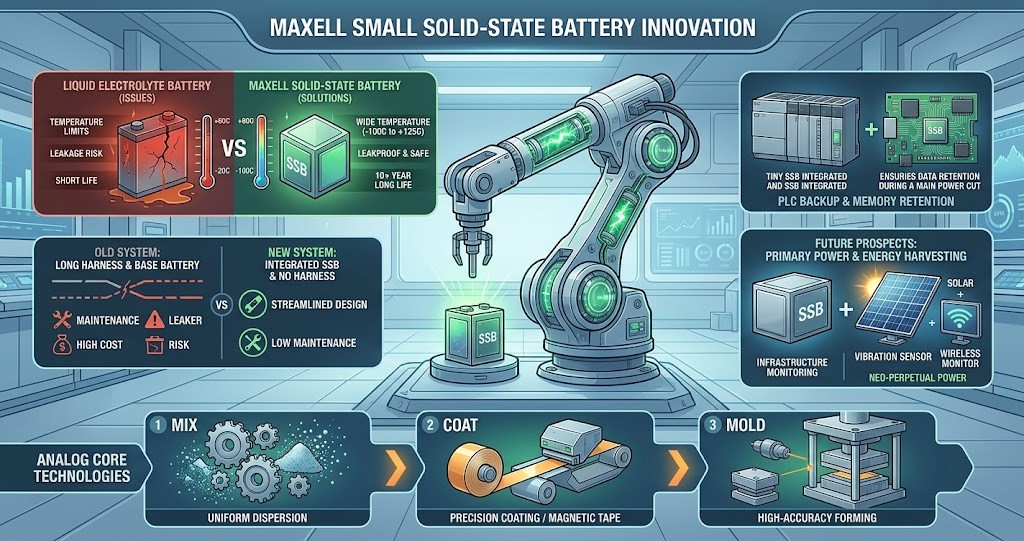
1. 現行電池(液体電解質)の課題とマクセルの全固体電池の特徴
一般的な二次電池(リチウムイオン電池等)では、電解質として液体(電解液)が使用されています。しかし、液体を使用することは以下の課題を引き起こします。
- 動作温度の制約: 低温では凍結、高温では沸騰するため、動作可能な温度範囲が制限されます。
- 液漏れおよび安全上のリスク: 経年劣化等による液漏れが発生し、機器の故障や安全上の問題につながります。
- 寿命の限界: 充放電の繰り返しに伴い電解液が劣化し、バッテリー容量が低下します。
マクセルが開発・量産している小型全固体電池は、電解質を含むすべての構成材料を固体化することでこれらのデメリットを克服しています。優れた耐熱性と耐久性を備え、10年以上の長寿命を実現しています。
2. 小型全固体電池の主な用途とソリューション価値
現在、マクセルでは9mm角程度の小型全固体電池を京都の量産ラインで生産し、実際の市場へ供給しています。主に以下の産業用分野で課題解決に貢献しています。
- 産業用ロボットの駆動情報(メモリ)バックアップ
- 従来の課題: 従来の電池は熱に弱いためロボットの土台部に配置され、各関節のモーターへ長いハーネス(配線)で接続されていました。これにより断線リスクや定期的な電池交換作業が発生し、多大なメンテナンスコストがかかっていました。
- マクセルの解決策: 高温に耐える小型全固体電池をロボットの関節部に直接設置することでハーネスを排除し、軽量化(省配線化)を実現。10年以上の寿命により電池交換が不要となり、大幅なメンテナンスコスト削減に寄与します。
- PLC(シーケンス制御機器)のバックアップ電源
- 既存の生産ラインや機械において、一次電池から形状互換性のあるマクセルの小型全固体電池への置き換えが進められています。通常稼働時にフル充電状態を維持することで、長期休暇などで主電源が落ちた際にも確実にメモリを保持します。
- 将来展望:主電源化と環境発電(エナジーハーベスティング)との融合
- 現在はバックアップ用途が中心ですが、今後は電池サイズの大型化を進める方針です。これにより主電源としての利用が可能となり、微小なエネルギーから発電する環境発電技術と組み合わせることで、インフラの遠隔モニタリング等に向けた「ほぼ永久的に稼働する電源」の実現をめざしています。
3. マクセルを支える3つの「アナログコア技術」
全固体電池をはじめとする高信頼性電池の製造において、マクセルは長年蓄積してきた以下の3つの「アナログコア技術」を強みとしています。
- まぜる(混合分散技術)
- 原料粉体の粒度分布やロットごとの品質ばらつきを考慮し、電池性能を損なわないよう均一に混ぜ合わせ、粘度を精密にコントロールするプロセス技術。
- ぬる(精密塗布技術)
- 磁性テープ(カセットテープ等)の開発・製造で培われたコーティング技術を応用し、薄く均一にペーストを塗布する技術。
- かためる(高精度成形技術)
- 粉体を押し固める技術や、樹脂・筐体を高い寸法精度と耐久性で成形する技術。
4. 一次電池との棲み分けと今後の事業戦略
全固体電池の拡大推進にあたり、従来の「一次電池(使い捨て電池)」との役割分担(棲み分け)について、同社は以下のように説明しています。
| 電池種別 | 主なメリット・特徴 | マクセルにおける主な適用分野 |
| 小型全固体電池 | 高温耐久性、10年以上の長寿命、充放電可能、メンテナンスフリー | 産業用ロボット関節部、PLCバックアップ、次世代IoT機器 |
| 一次電池(高付加価値品) | 充電不可だが10年間交換不要、高い保存性と信頼性 | インフラ用スマートメーター(電気・ガス・水道)、タイヤパンクセンサー、医療用CGM(血糖値測定器) |
※医療機器用途などでは、衛生・感染症対策の観点から部品の再利用や充電が認められないため、一次電池の需要が強固に維持されます。
マクセルは、中期経営計画(MEX26)において小型電池領域を成長のメインドライバーと位置づけ、「Micro batteries. Maximum impact.」というメッセージのもと、BtoB市場(自動車、医療、産業インフラ等)における高信頼性小型電池のフロントランナーをめざして積極的な成長投資を行っています。
出典:https://minkabu.jp/news/4610972
Small All-Solid-State Battery Business at Maxell: Initiatives and Outlook
This report summarizes the technical features, specific applications, manufacturing technologies, and future business outlook of small all-solid-state batteries promoted by Maxell, Ltd., based on explanations provided by Keisuke Nakamura, President and Representative Director of Maxell, Ltd.
1. Challenges of Existing Liquid-Electrolyte Batteries and Features of Maxell’s All-Solid-State Batteries
Conventional secondary batteries, such as lithium-ion batteries, utilize liquid electrolytes. However, the use of liquid components introduces several key operational challenges:
- Operating Temperature Constraints: The operating temperature range is significantly restricted because the electrolyte freezes at low temperatures and boils at high temperatures.
- Leakage and Safety Risks: Electrolyte leakage caused by degradation over time leads to equipment failure and potential safety hazards.
- Lifespan Limitations: Repeated charge and discharge cycles cause electrolyte degradation, leading to a gradual loss in battery capacity.
Maxell’s small all-solid-state batteries, developed and mass-produced in-house, overcome these drawbacks by solidifying all constituent materials, including the electrolyte. They deliver superior heat resistance and durability, achieving an extended operational lifespan of over 10 years.
2. Primary Applications and Solution Value of Small All-Solid-State Batteries
Maxell currently produces small all-solid-state batteries (approximately 9 mm square) on a mass-production line in Kyoto and supplies them to the market. They contribute to solving operational challenges primarily across the following industrial fields:
- Backup Power for Industrial Robot Motion/Drive Information (Memory)
- Conventional Challenge: Conventional batteries are sensitive to heat and were traditionally placed at the base of the robot, connected to motors at each joint via long wiring harnesses. This created wire breakage risks and required periodic battery replacements, resulting in substantial maintenance costs.
- Maxell’s Solution: By installing heat-resistant, small all-solid-state batteries directly at the robot joint, harnesses are eliminated, achieving lightweighting and wiring simplification. Furthermore, the battery lifespan of over 10 years eliminates the need for battery replacement, contributing to significant maintenance cost reductions.
- Backup Power for PLCs (Programmable Logic Controllers)
- In existing production lines and machinery, primary batteries are being replaced with Maxell’s small all-solid-state batteries offering shape compatibility. By maintaining a fully charged state during normal operation, these batteries reliably back up and preserve memory even when main power is shut off during extended factory shutdowns.
- Future Outlook: Main Power Adoption and Integration with Energy Harvesting
- While current applications focus primarily on memory backup, Maxell plans to scale up battery sizes in the future. This will enable their deployment as primary power sources. When combined with energy harvesting technologies that generate power from ambient micro-energy sources, Maxell aims to realize “nearly permanent power supplies” for remote infrastructure monitoring and related applications.
3. Maxell’s Three “Analog Core Technologies”
In manufacturing highly reliable batteries, including all-solid-state batteries, Maxell leverages three core analog process technologies accumulated over many years:
- Mixing (Mixing and Dispersion Technology): A process technology that accounts for particle size distribution and lot-to-lot quality variations in raw material powders to mix them uniformly and precisely control viscosity without compromising battery performance.
- Coating (Precision Coating Technology): A technology applying advanced coating methods cultivated through the development and manufacturing of magnetic media (such as cassette tapes) to apply paste thinly and uniformly onto substrates.
- Molding (High-Precision Molding Technology): A technology for compacting powders and molding resins/enclosures with high dimensional accuracy and long-term durability.
4. Market Segmentation relative to Primary Batteries and Future Strategy
Regarding market segmentation and role division between all-solid-state batteries and conventional primary (disposable) batteries, Maxell outlines the following framework:
| Battery Type | Key Advantages & Features | Primary Application Fields at Maxell |
| Small All-Solid-State Batteries | High-temperature durability, 10+ year lifespan, rechargeable, maintenance-free | Industrial robot joint parts, PLC backup, next-generation IoT devices |
| Primary Batteries (High-Value-Add) | Non-rechargeable but replacement-free for 10 years, high storage stability & reliability | Smart meters (electricity, gas, water), tire pressure monitoring systems (TPMS), medical CGMs (continuous glucose monitors) |
* In medical device applications, component reuse or recharging is prohibited due to hygiene and infection control standards, ensuring strong sustained demand for primary batteries.
Under its Mid-Term Management Plan (MEX26), Maxell positions the micro battery sector as its primary growth driver under the slogan “Micro batteries. Maximum impact.” The company is making aggressive growth investments to become the front-runner in high-reliability small batteries across BtoB markets including automotive, medical, and industrial infrastructure.
コメント