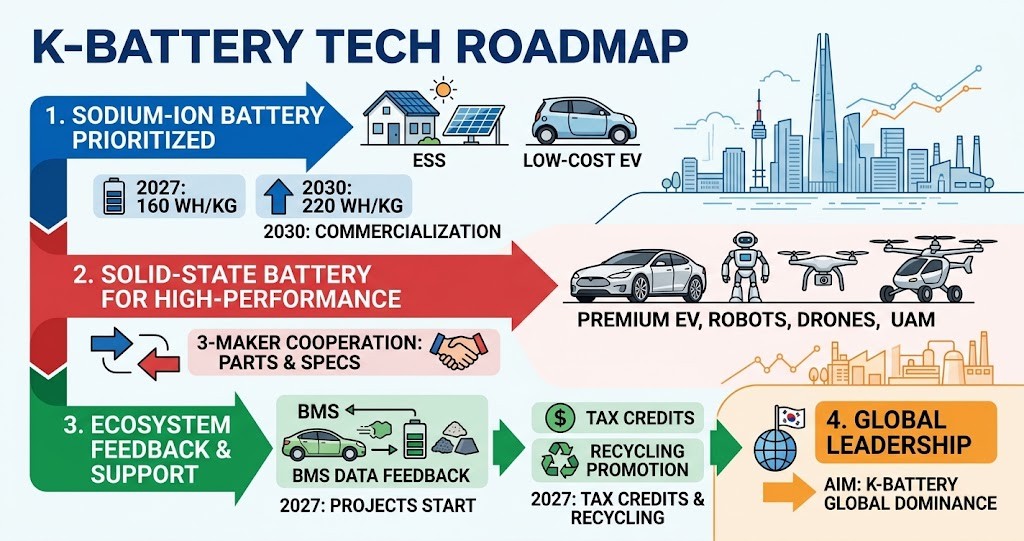
韓国の国家目標は突如としてナトリウムイオン電池へとシフトし、新たな「電池産業技術ロードマップ」が発表された。これは、国内の電池メーカーに対し、エネルギー貯蔵システム(ESS)や低コストの電気自動車(EV)向けにはナトリウムイオン電池を優先的に開発し、高性能EV、ロボット、ドローン、都市型航空モビリティ(UAM)向けには全固体電池を開発するよう求めるものだ。
9月22日に発表された電池業界のロードマップでは、2027年までにエネルギー密度 160 Wh/kg、2030年までに 220 Wh/kg のナトリウムイオン電池の実現を目指している。政府は2030年の本格的な商業化を目標としており、LGエナジーソリューション、サムスンSDI、SKオンなどの企業や、韓国の大手材料サプライヤーが協力している。
同省の主要発表はさらに踏み込み、「K電池」が「選定と集中」によって世界市場の主導権を取り戻すと宣言した。(CATLは2021年にエネルギー密度 160 Wh/kg の初のナトリウムイオン電池を発売し、その後も改良を重ねてきた。)
政府は、電池の寸法や集電体などの部品仕様といった、競争関係にないと考えられる分野で、3つの電池メーカーに協力を求めている。また、材料メーカーが目標とする価格と性能レベルまで開発を行い、電池メーカーがその結果をテストして購入するというプロジェクトも提案している。
別の取り組みとして、電気自動車用バッテリー管理システム(BMS)のデータを電池および材料開発企業にフィードバックする計画もある。これらのプロジェクトは2027年に開始される予定だ。さらに、政府は2027年からの生産税額控除と、バッテリーのリサイクルを促進するための措置を提案している。
ナトリウム ロードマップ
ナトリウムイオン電池の選択は、韓国のサプライヤーがどの分野でシェアを失っているかを反映している。国際エネルギー機関(IEA)によると、現在、世界のバッテリー蓄電システム(BESS)の約 90% はリン酸鉄リチウム(LFP)電池で占められている。LFP電池セルと材料の生産は中国メーカーが支配的であり、韓国の生産は一般的に電気自動車向けのニッケル含有量の多いリチウムイオン電池(NCM等)に集中している。
ナトリウムイオンは、韓国企業にとって、エネルギー密度よりも低コストが重視される市場への参入経路となる可能性があるが、現状では依然として高価である。
このロードマップでは、2027年から2031年にかけて総額約 4000 億ウォン(約 3 億ドル弱)の研究プログラムが提案されている。同省によると、企業は2026年から2030年にかけて研究開発・生産設備に約 8 兆ウォン(約 80 億ドル)を投資する意向だという。ただし、このうちナトリウムイオン関連にどれだけの金額が割り当てられているかは明らかにされていない。
政府はまた、電池メーカーに対し材料供給業者との連携強化を求めており、2027年から生産税額控除を導入する計画だ。
固体素子 に注目
全固体電池は、このロードマップにおけるもう一つの主要な技術投資であり、2027年のプロトタイプ開発目標と2030年の商用化目標が別途設定されている。
韓国はロードマップにおいて、エネルギー密度 400 Wh/kg の全固体電池を2028年までに実現するという目標を設定しており、高性能電気自動車、ロボット、ドローン、都市型航空モビリティなどが潜在的な市場として挙げられている。
同省は、計画中の2027年のプロトタイプを「世界初」と称しているが、既に他国で生産されている固体型プロトタイプとの違いについては説明しておらず、注目すべきは 400 Wh/kg という目標値である。
【追加補足】ナトリウムイオン電池および全固体電池に関する関連情報
本ロードマップの背景および提示されている技術仕様を理解するうえで、重要となる関連情報は以下の通りです。
- ナトリウムイオン電池の構造とメリット
- 資源の豊富さと低コスト性:ナトリウムは海水や岩塩などから無制限に近い形で入手可能なため、原材料リスクが高いリチウムやコバルトへの依存度を低減できます。将来的な量産段階において大幅なコストカットが期待されています。
- 安全性の向上:リチウムイオン電池に比べて熱暴走のリスクが低く、完全放電状態(0 V)での輸送や保管が可能なため、運搬時の安全性が極めて高い特徴を持ちます。
- 集電体(コレクター)のコスト削減:リチウムイオン電池では負極に銅箔を使用しますが、ナトリウムはアルミニウムと反応しないため、正極・負極ともに安価なアルミニウム箔を使用できます。
- 技術目標(エネルギー密度)の位置づけ
- 2027年目標(160 Wh/kg):中国CATLが発表した第1世代モデルと同等の水準であり、標準的なLFP(リン酸鉄リチウム)電池の初期モデルに匹敵します。
- 2030年目標(220 Wh/kg):現行の主要なLFP電池の性能上限を超え、三元系リチウムイオン電池(NCMなど)のローエンド領域に接近する水準です。BESS(蓄電システム)やエントリークラスのEVに十分な航続距離を提供できるようになります。
- 全固体電池の2028年目標(400 Wh/kg):現在普及している高性能EV用リチウムイオン電池(約 250 – 300 Wh/kg)の約 1.3 – 1.5 倍に相当します。車体重量の軽量化や、ドローン・都市型航空モビリティ(UAM)といった重量制約の厳しい用途において不可欠な技術とされています。
- 市場での競合状況
- 韓国企業は、高エネルギー密度のNCM系(ニッケル・コバルト・マンガン)を中心にグローバルシェアを獲得してきましたが、低コスト領域では中国企業が支配するLFP電池に大きく押される形となりました。今回の「ナトリウムイオン電池へのシフト」および「高価格帯向けの全固体電池への集約」という戦略は、中国主導のLFP市場と直接戦うことを避けつつ、次世代の低コスト市場と超高エネルギー密度市場の双方でイニシアチブを奪還するための構造的転換を意味しています。
Targeting 220 Wh/kg: South Korea’s Technology Roadmap Through 2030 for Sodium-Ion Batteries
South Korea’s national objectives have suddenly shifted toward sodium-ion batteries with the announcement of a new “Battery Industry Technology Roadmap.” This asks domestic battery manufacturers to prioritize the development of sodium-ion batteries for energy storage systems (ESS) and low-cost electric vehicles (EVs), while developing all-solid-state batteries for high-performance EVs, robots, drones, and urban air mobility (UAM).
The battery industry roadmap announced on September 22 aims to achieve sodium-ion batteries with an energy density of 160 Wh/kg by 2027 and 220 Wh/kg by 2030. The government targets full commercialization by 2030, with cooperation from companies such as LG Energy Solution, Samsung SDI, and SK On, as well as major South Korean material suppliers.
The ministry’s main announcement went further, declaring that “K-Battery” will regain leadership in the global market through “selection and concentration.” (CATL launched its first sodium-ion battery with an energy density of 160 Wh/kg in 2021 and has continued to refine it since.)
The government is asking three battery manufacturers to cooperate in areas considered non-competitive, such as battery dimensions and component specifications like current collectors. It also proposes projects where material manufacturers conduct development up to targeted price and performance levels, after which battery manufacturers test and purchase the results.
In another initiative, there are plans to feed back data from electric vehicle battery management systems (BMS) to battery and material development companies. These projects are scheduled to begin in 2027. Furthermore, the government proposes production tax credits starting in 2027 and measures to promote battery recycling.
Sodium Roadmap The choice of sodium-ion batteries reflects where South Korean suppliers are losing market share. According to the International Energy Agency (IEA), approximately 90% of global battery energy storage systems (BESS) are currently occupied by lithium iron phosphate (LFP) batteries. The production of LFP battery cells and materials is dominated by Chinese manufacturers, whereas South Korean production is generally concentrated in nickel-rich lithium-ion batteries (such as NCM) for electric vehicles.
Sodium-ion could offer a pathway for South Korean companies to enter markets where low cost is prioritized over energy density, although it currently remains expensive.
This roadmap proposes research programs totaling approximately 400 billion won (just under 300 million USD) from 2027 to 2031. According to the ministry, companies intend to invest approximately 8 trillion won (about 8 billion USD) in R&D and production facilities from 2026 to 2030. However, it has not been disclosed how much of this amount is allocated to sodium-ion related projects.
The government is also calling on battery manufacturers to strengthen ties with material suppliers and plans to introduce production tax credits starting in 2027.
Focus on Solid-State Devices All-solid-state batteries represent another major technology investment in this roadmap, with separate targets set for prototype development in 2027 and commercialization in 2030.
In the roadmap, South Korea has set a goal to achieve all-solid-state batteries with an energy density of 400 Wh/kg by 2028, citing high-performance electric vehicles, robots, drones, and urban air mobility as potential markets.
The ministry describes the planned 2027 prototype as a “world first,” though it has not explained how it differs from solid-state prototypes already produced in other countries; the noteworthy aspect remains the 400 Wh/kg target value.
[Supplementary Information] Related Information on Sodium-Ion and All-Solid-State Batteries
To understand the background and technical specifications presented in this roadmap, the following related information is key:
Structure and Advantages of Sodium-Ion Batteries
- Resource Abundance and Low Cost: Sodium can be obtained in nearly unlimited quantities from sources like seawater and rock salt, reducing dependence on lithium and cobalt, which carry high raw material risks. Significant cost cuts are expected during future mass production stages.
- Enhanced Safety: Compared to lithium-ion batteries, the risk of thermal runaway is lower, and because transportation and storage are possible in a fully discharged state (0 V), safety during transport is exceptionally high.
- Current Collector Cost Reduction: While lithium-ion batteries use copper foil for the negative electrode, sodium does not react with aluminum, allowing inexpensive aluminum foil to be used for both the positive and negative electrodes.
Positioning of Technical Goals (Energy Density)
- 2027 Target (160 Wh/kg): Equivalent to the level of the first-generation model announced by China’s CATL, comparable to early models of standard LFP (lithium iron phosphate) batteries.
- 2030 Target (220 Wh/kg): Exceeds the upper performance limit of current mainstream LFP batteries and approaches the low-end range of ternary lithium-ion batteries (such as NCM). This will provide sufficient driving range for BESS (battery energy storage systems) and entry-level EVs.
- All-Solid-State Battery 2028 Target (400 Wh/kg): Equivalent to about 1.3 to 1.5 times the capacity of high-performance EV lithium-ion batteries currently in wide use (approx. 250 – 300 Wh/kg). This technology is essential for vehicle weight reduction and weight-sensitive applications such as drones and urban air mobility (UAM).
Competitive Landscape in the Market South Korean companies have secured global market share primarily with high-energy-density NCM (nickel-cobalt-manganese) chemistries, but have been heavily pressured in the low-cost sector by Chinese companies dominating LFP batteries. This dual strategy of “shifting to sodium-ion batteries” and “concentrating on all-solid-state batteries for high-end applications” represents a structural transformation aimed at regaining initiative in both next-generation low-cost markets and ultra-high-density markets, while avoiding direct competition in the Chinese-dominated LFP market.
コメント