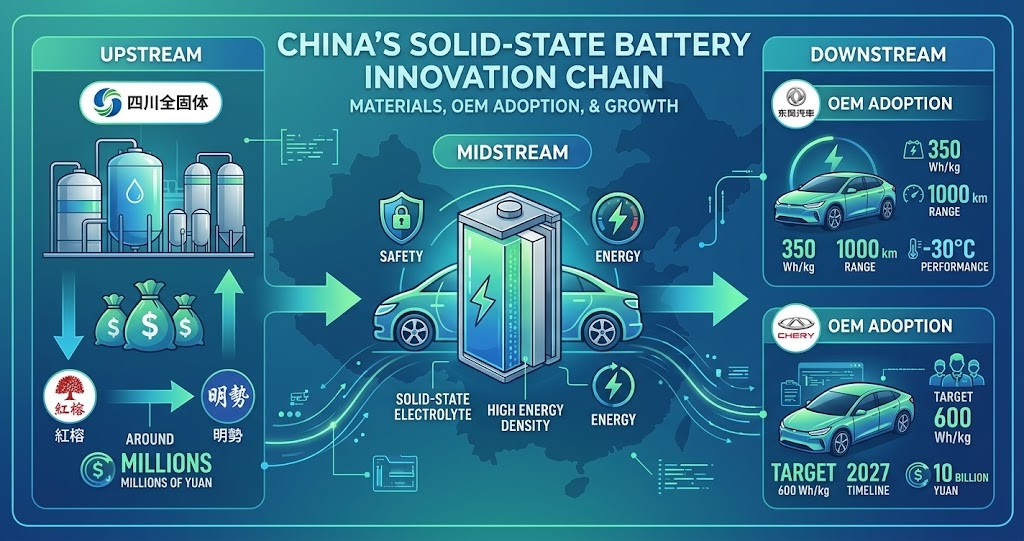
次世代の車載電池として期待される「全固体電池」を巡り、従来の液状リチウムイオン電池から安全性とエネルギー密度に優れる新技術への転換が急速に進んでいます。特に中国市場では、キーテクノロジーである原材料のスケールアップ生産から、東風汽車やChery(奇瑞汽車)といった完成車メーカーによる実車搭載検証に至るまで、サプライチェーン全体を巻き込んだ実用化への取り組みが一段と熱を帯びています。
本稿では、上流の原材料メーカーにおける大規模な資金調達の動き、大手完成車メーカーの量産・搭載スケジュール、ならびに製造設備・先端材料分野への波及効果についてまとめ、関連する技術背景とともにお伝えします。
中国における全固体電池分野の最新動向まとめ
1. 原材料メーカーの資金調達と生産体制強化
全固体電池の中核材料である硫化リチウムを手掛ける四川全固体新材料有限公司(四川全固体)が、数千万元(約数億円)のAラウンド資金調達を完了しました。
- 主な投資家: 紅榕資本、明勢創投がリード投資を実施。
- 資金の使途: 100トン級生産ラインの機能拡充・増産、長沙研究開発センターの開設、および開発体制の強化。
- 意義: 硫化リチウムの安定供給体制の構築は、下流の電池セルメーカーにおけるパイロットプラント(中試)運用や大規模量産のスピードに直結します。
2. 主要完成車メーカー(OEM)の量産・搭載計画
| 車両メーカー | 主なプロジェクト・進展 | 主要スペック・目標値 |
| 東風汽車 | 新世代固体電池の量産搭載が間近 | エネルギー密度: 350ワット時毎キログラム 航続距離: 1000キロメートル超 耐寒性能: マイナス30度でも正常動作 |
| Chery(奇瑞汽車) | 犀牛S全固体電池の開発を推進(2027年搭載検証予定) | セルエネルギー密度: 目標600ワット時毎キログラム 開発規模: 1000人規模の研究チーム、100億元(約2380億円)級の投資 |
3. 関連銘柄とサプライチェーンへの波及効果
Huayuan Securitiesの分析によると、2026年10月以降、全固体電池に関する実証・検証プロセスが加速しており、製造設備や電池材料企業への恩恵が期待されています。
- 金龍羽: 固体セル、固体電解質、リン酸マンガン鉄リチウム正極、シリコンカーボン負極など、材料からシステムまでの垂直統合を展開。
- 上海洗覇: 先端材料の技術開発から生産ライン建設、実証試験、スケールアップ生産に至る総合的なプロセス能力を構築。
関連情報・背景解説
- なぜ「硫化リチウム」が重視されるのか? 全固体電池には「硫化物系」「酸化物系」「ポリマー系」などの電解質タイプが存在します。その中でも硫化物系固体電解質は、高いイオン電導度を持ち、急速充電や高出力に適しているため、車載用の本命技術の一つとされています。その主原料となるのが硫化リチウムであり、製造コストの削減と高純度な大量生産技術の確立が、全固体電池全体の普及に向けた最大の課題となっています。
- 従来型リチウムイオン電池(液系)からの製造プロセスの変化 液状の電解液を使用する従来の電池から全固体電池へ移行する場合、電極の作製、電解質層の成形、超高圧での圧着(セル成形)、封入(パッケージング)など、製造工程の大半で新しい専用設備が必要となります。このため、電池本体だけでなく、専用の精密製造設備メーカーにとっても大きな市場機会が生まれています。
- 市場投入に向けた今後の見通しとリスク 全固体電池は現在、「技術検証・パイロット生産」から「量産搭載」へと移行する過渡期にあります。エネルギー密度350ワット時毎キログラムクラスの「半固体・一部固体系」から段階的に導入が進み、目標値600ワット時毎キログラムを掲げるような完全な全固体電池の量産化は2027〜2030年頃にかけて本格化すると見られています。短期〜中期的な業界の動向を測る上では、設備入札の推移や材料の調達規模が重要な指標となります。
出典:https://finance.biggo.jp/news/2d1ee2af-9b1e-4601-8a2f-a92de219e5ef
China’s All-Solid-State Battery Industry Rapidly Accelerates: Moving Toward Commercialization Across the Supply Chain from Material Mass Production to EV Integration
Surrounding “all-solid-state batteries,” which are expected to be the next-generation automotive power source, the shift from conventional liquid lithium-ion batteries to new technologies offering superior safety and energy density is progressing rapidly. In the Chinese market in particular, efforts toward commercialization involving the entire supply chain are gaining significant momentum, spanning from scaling up production of key raw materials to vehicle-level integration and validation by major automakers such as Dongfeng Motor and Chery.
This article summarizes the large-scale fundraising activities of upstream raw material suppliers, the mass production and installation schedules of major finished car manufacturers, and the ripple effects on manufacturing equipment and advanced material sectors, together with the relevant technical background.
Summary of Recent Trends in China’s All-Solid-State Battery Sector
1. Fundraising and Production Expansion by Raw Material Suppliers
Sichuan All-Solid-State New Material Co., Ltd., a producer of lithium sulfide—a core raw material for all-solid-state batteries—has completed a Series A funding round of tens of millions of yuan (approx. several hundred million yen).
- Major Investors: Led by Red Banyan Capital and Ming势 Capital (Ming势 Venture Capital).
- Use of Funds: Upgrading equipment and expanding capacity for a 100-ton scale production line, establishing a Changsha R&D center, and strengthening the R&D team.
- Significance: Building a stable supply system for lithium sulfide directly impacts the pace of pilot plant operations and large-scale mass production for downstream battery cell manufacturers.
2. Mass Production and Installation Plans of Major Automakers (OEMs)
| Automaker | Key Projects and Progress | Major Specifications and Target Values |
| Dongfeng Motor | Mass production installation of new-generation solid-state batteries is imminent | Energy density: 350 watt-hours per kilogram Cruising range: Expected over 1,000 kilometers Low-temperature performance: Operates normally even at minus 30 degrees Celsius |
| Chery | Advancing development of Rhino S all-solid-state batteries (vehicle installation validation planned for 2027) | Cell energy density: Target of 600 watt-hours per kilogram R&D scale: 1,000-person research team, investment reaching 10 billion yuan (approx. 238 billion yen) |
3. Related Stocks and Ripple Effects on the Supply Chain
According to an analysis by Huayuan Securities, verification and validation processes for all-solid-state batteries have accelerated since October 2026, and manufacturing equipment and battery material companies are expected to benefit.
- Jinlongyu: Developing vertical integration from materials to systems, including solid-state cells, solid-state electrolytes, lithium manganese iron phosphate cathodes, and silicon-carbon anodes.
- Shanghai Washba: Building comprehensive capabilities across various stages, including advanced material R&D, process scaling up, production line construction, performance testing, product verification, and commercial production.
Related Information and Background Explanation
- Why is “Lithium Sulfide” Emphasized? All-solid-state batteries exist in various electrolyte types, such as “sulfide-based,” “oxide-based,” and “polymer-based.” Among them, sulfide-based solid-state electrolytes possess high ionic conductivity and are suitable for rapid charging and high power output, making them one of the leading candidate technologies for automotive applications. Lithium sulfide serves as the primary raw material, and reducing manufacturing costs while establishing high-purity mass production technology represents the single largest hurdle toward the widespread adoption of all-solid-state batteries.
- Changes in Manufacturing Processes from Conventional (Liquid) Lithium-Ion Batteries Transitioning from traditional batteries using liquid electrolyte to all-solid-state batteries requires new specialized equipment for most of the manufacturing steps, including electrode fabrication, solid electrolyte layer molding, ultra-high-pressure compaction (cell formation), and encapsulation (packaging). As a result, substantial market opportunities are emerging not only for battery makers themselves but also for precision manufacturing equipment suppliers.
- Future Outlook and Risks Toward Market Deployment All-solid-state batteries are currently in a transition phase from “technical verification and pilot production” to “mass production and vehicle installation.” Step-by-step introduction is progressing starting with “semi-solid or partially solid-state” batteries in the 350 watt-hour per kilogram energy density class, while full commercial mass production of complete all-solid-state batteries aiming for 600 watt-hours per kilogram is expected to gain full momentum between 2027 and 2030. In gauging short- to medium-term industry trends, equipment bidding trends and material procurement scale serve as key indicators to monitor.
コメント