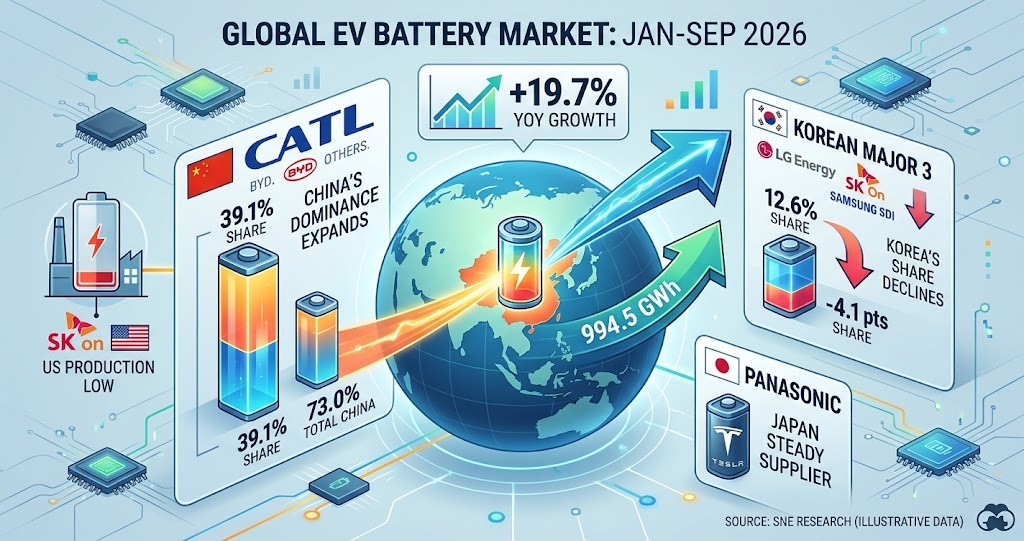
韓国の市場調査会社SNEリサーチの発表によると、2026年1〜9月期の世界の電動車向け車載電池搭載量は、前年同期比19.7パーセント増の994.5ギガワット時を記録しました。
企業・国別の動向とシェア
- 中国勢の躍進
- CATL(寧徳時代): 389.2ギガワット時(24.9パーセント増)で首位を獲得。シェアは39.1パーセント(1.6ポイント上昇)に拡大。
- BYD(比亜迪): 150.9ギガワット時(7.4パーセント増)で2位を維持。
- 中国企業全体: 上位10社中7社を占め、合計シェアは73.0パーセント(3.5ポイント上昇)に達し、市場での支配力をさらに強めています。
- 韓国勢の苦戦
- LGエナジーソリューション: 81.9ギガワット時(0.7パーセント増)で3位を維持。主要自動車メーカー向け供給でプラスを維持したものの、シェアは8.2パーセント(1.6ポイント下落)へ縮小。
- SKオン: 28.3ギガワット時(18.1パーセント減)で8位(シェア2.8パーセント)に後退。特に北米市場での搭載量が46.7パーセント減と大きく低迷。
- 韓国主要3社合計: LGエナジーソリューション、SKオン、サムスンSDIを合わせたシェアは12.6パーセントとなり、前年同期から4.1ポイント低下しました。
- 日本勢の動向
- パナソニック: 35.6ギガワット時(0.8パーセント減)。テスラ向けの割合が高い構成となっています。
関連情報・背景解説
- 安価なリン酸鉄リチウム(LFP)電池の普及拡大中国企業が強みを持つLFP電池は、韓国勢が得意とするニッケル・コバルト・マンガン(NCM)などの三元系電池に比べ、製造コストが安く熱安定性に優れています。低価格帯の電気自動車(EV)需要が高まる中、グローバルな自動車メーカーがLFP電池の採用を増やしていることが中国シェア拡大(73.0パーセント)の主な要因となっています。
- 北米市場における政策変動と供給環境の影響 韓国3社(特にSKオンなど)のシェア低下の背景には、北米市場での電動車販売の伸び悩みや、各国の補助金政策見直しが影響しています。米国の通商政策や税制優遇(IRA法など)の動向は、今後の各社の北米投資や車載電池の供給網戦略に大きな課題を与えています。
- 自動車メーカー自社製電池(内製化)とサプライチェーン再編 テスラやBYDをはじめとする完成車メーカーの内製化や調達先の複数化が進んでおり、特定企業に依存するサプライヤーへのプレッシャーが高まっています。今後の市場では、価格競争力に加えて技術革新(全固体電池や次世代LFP電池の開発など)が各国のシェア回復の鍵を握ると見られています。
出典:https://news.yahoo.co.jp/articles/b3a6c316ddc006b5f411d9a94cf7142f8837415e
Global EV Battery Usage Reaches 73 Percent Market Share for Chinese Companies in Jan-Sep 2026, Strengthening Their Dominance
According to an announcement by South Korean market research firm SNE Research, global usage of automotive batteries for electric vehicles in the January-September 2026 period reached 994.5 gigawatt-hours, an increase of 19.7 percent compared to the same period of the previous year.
Trends and Market Share by Company and Country
- Advancement of Chinese Companies
- CATL (Contemporary Amperex Technology): Secured the top position with 389.2 gigawatt-hours (a 24.9 percent increase). Its market share expanded to 39.1 percent (up 1.6 percentage points).
- BYD: Maintained second place with 150.9 gigawatt-hours (a 7.4 percent increase).
- Chinese Companies Overall: Accounting for 7 of the top 10 companies, their combined market share reached 73.0 percent (up 3.5 percentage points), further strengthening their market dominance.
- Struggle of South Korean Companies
- LG Energy Solution: Maintained third place with 81.9 gigawatt-hours (a 0.7 percent increase). Although it maintained growth through supplies to major automakers, its market share shrank to 8.2 percent (down 1.6 percentage points).
- SK On: Fell to eighth place (2.8 percent market share) with 28.3 gigawatt-hours (an 18.1 percent decrease). Usage in the North American market in particular experienced a sharp decline of 46.7 percent.
- Combined Total of Top 3 South Korean Companies: The combined market share of LG Energy Solution, SK On, and Samsung SDI stood at 12.6 percent, down 4.1 percentage points from the same period of the previous year.
- Trends of Japanese Companies
- Panasonic: 35.6 gigawatt-hours (a 0.8 percent decrease). Its supply structure remains heavily weighted toward Tesla.
Related Information and Background Explanation
- Widespread Adoption of Low-Cost Lithium Iron Phosphate (LFP) Batteries LFP batteries, in which Chinese companies excel, offer lower manufacturing costs and superior thermal stability compared to ternary batteries such as nickel-manganese-cobalt (NCM) batteries favored by South Korean manufacturers. As demand for affordable electric vehicles (EVs) increases, global automakers are increasingly adopting LFP batteries, serving as the primary factor driving the expansion of China’s market share to 73.0 percent.
- Impact of Policy Changes and Supply Environment in the North American Market Behind the declining market share of the three major South Korean companies (especially SK On), factors include sluggish EV sales growth in the North American market and revisions to subsidy policies in various countries. Trends in US trade policies and tax incentives (such as the IRA) pose significant challenges to the future North American investment and battery supply chain strategies of these companies.
- In-House Battery Production by Automakers and Supply Chain Restructuring Finished car manufacturers, including Tesla and BYD, are advancing in-house battery production and diversifying their procurement sources, increasing pressure on suppliers that rely heavily on specific companies. In the future market, technological innovation (such as the development of all-solid-state batteries and next-generation LFP batteries), alongside price competitiveness, is expected to hold the key to recovering market share for each country.
コメント