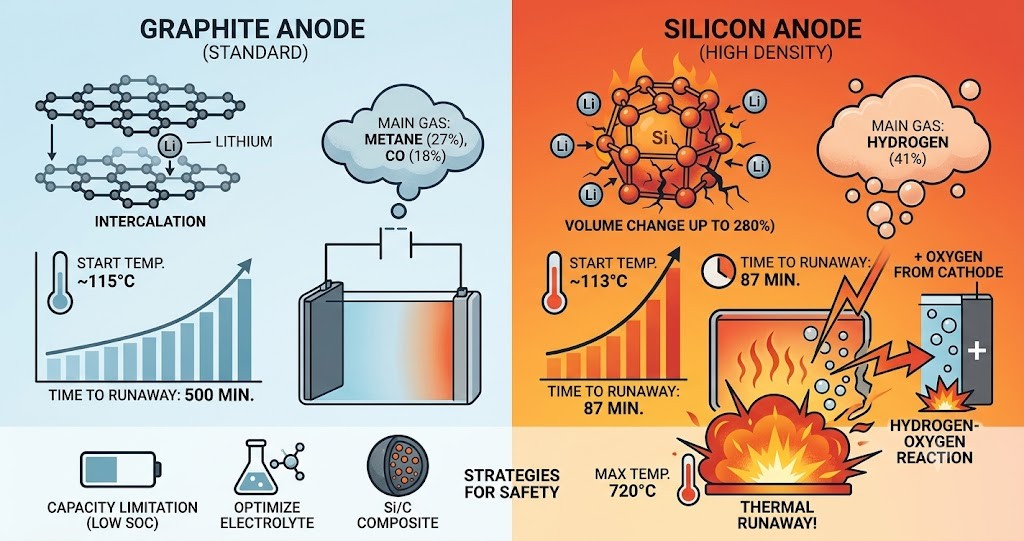
本研究は、同等の絶対容量(Li含有量)を持つグラファイト系負極とシリコン(Si)系負極の熱挙動を、材料組み合わせレベル(DSC、ARC)およびフルセルレベル(HWS-ARC)で包括的に比較したものです。
1. 主な研究結果の比較一覧
実験データを基にした、両材料の熱特性および安全性の主要パラメータの比較です。
| 評価項目 | グラファイト系負極 | シリコン(Si)系負極 | 補足・影響 |
| 理論比容量 | 372 mAh g⁻¹ | 3579 mAh g⁻¹ | シリコンが約10倍高い |
| 充放電時の体積変化 | 軽微 | 最大280%の巨大な変化 | Siは機械的応力やSEI崩壊が課題 |
| 発熱反応の開始温度 | 約115 ℃(セルレベル) | 約113 ℃(セルレベル) | 開始温度自体はほぼ同等 |
| 試験中の最高到達温度 | 450 ± 10 ℃ | 720 ± 30 ℃ | 材料組み合わせ試験(ARC)での結果 |
| 開始から熱暴走までの時間 | 500 ± 100 分 | 87 ± 9 分 | Si系はグラファイトの約6分の1の速さ |
| 熱暴走の発生温度 | 201 ± 6 ℃ | 184 ± 4 ℃ | Si系は正極の酸素放出温度(200 ℃)より前 |
| 主な発生ガス(体積比) | メタン27%、CO 18%など | 水素(H₂)41% | Si系は極めて可燃性の高い水素が主成分 |
【関連情報・解説】なぜシリコン負極は危険性が高いのか?
論文内で示されたデータと、電池内部で起こっている現象の解説です。
1. 分解メカニズムの根本的な違い
グラファイトとシリコンでは、熱が加わった際の構造破壊の進み方が異なります。
- グラファイトの場合: 熱によって固体電解質界面(SEI)が分解されると、内部に挿入(インターカレーション)されていたリチウムイオンのみが脱挿入して電解液と反応します。グラファイトの炭素骨格自体は維持されるため、反応は比較的緩やかに進みます。
- シリコンの場合: リチウム化されたシリコン(LixSiy)は、粒子構造の全体が表面から内部まで電解液との激しい発熱分解反応に巻き込まれます。 さらに、シリコンの持つ高い体積容量密度(リチウム濃度が表面で高くなる)特性が、初期の自己発熱速度を急激に高める原因となっています。
2. 「大量の水素発生」という二次的リスク
ガス分析により、シリコン系負極では分解時に水素(H₂)が41%という非常に高い割合で発生することが判明しました。
これは、シリコン表面のシラノール基や酸化膜が電解液の分解生成物(HFなど)と反応し、構造崩壊を伴いながら連続的に水素を生み出すためです。
正極との複合リスク(水素酸素反応)
高温(200 ℃付近)になると、正極材(NMC622など)から相転移に伴って酸素(O₂)が放出されます。シリコン負極から発生した大量の水素と、正極から放出された酸素が混ざり合うことで、セル内部で激しい「水素酸素反応(燃焼・爆発)」が引き起こされ、熱暴走のダイナミクスを決定的に悪化させます。
シリコン負極の安全性を高めるための今後の戦略
シリコンの持つ高いエネルギー密度というメリット活かしつつ、今回露呈した熱安定性の低さを克服するために、論文では以下の3つのアプローチが提案されています。
- 容量制限運用(低SOC駆動)シリコンの持つ理論容量をあえてフルに使わず、部分的な利用に留めることで、リチウム化状態(SOC)を低く抑え、熱安定性をグラファイトと同等レベルまで向上させます。
- 電解液組成の最適化添加剤などを工夫し、熱的に頑丈なSEI(固体電解質界面)をシリコン表面に形成することで、発熱分解の開始を遅らせ、発生する総ガス量や水素の危険性を低減します。
- 反応性/低反応性複合マトリックス(Si/Cコンポジット)活性の高いシリコン粒子を、反応性の低い炭素(カーボン)材料の内部に埋め込むことで、シリコンと電解液が直接接触する面積を物理的に減らし、激しい熱分解反応を抑制します。
出典:https://pubs.rsc.org/en/content/articlelanding/2026/eb/d6eb00051g
Graphite vs. Silicon Anode: A Comparative Analysis of Thermal Stability and Gas Evolution Behavior in Lithium-Ion Batteries
This study comprehensively compares the thermal behavior of graphite-based anodes and silicon (Si)-based anodes with equivalent absolute capacities (Li content) at both the material combination level (DSC, ARC) and the full-cell level (HWS-ARC).
1. Summary Comparison of Key Research Results
The following table compares the key parameters of thermal properties and safety for both materials based on the experimental data.
| Evaluation Item | Graphite-Based Anode | Silicon (Si)-Based Anode | Supplementary Information / Impact |
| Theoretical Specific Capacity | 372 mAh g-1 | 3579 mAh g-1 | Silicon is approximately 10 times higher. |
| Volume Change During Cycling | Slight | Massive expansion up to 280% | Si faces challenges regarding mechanical stress and SEI collapse. |
| Onset Temperature of Exothermic Reaction | Approx. 115 degrees C (Cell level) | Approx. 113 degrees C (Cell level) | The onset temperatures themselves are almost identical. |
| Maximum Reached Temperature During Test | 450 +/- 10 degrees C | 720 +/- 30 degrees C | Results from the material combination test (ARC). |
| Time from Onset to Thermal Runaway | 500 +/- 100 minutes | 87 +/- 9 minutes | The Si-based system is about 6 times faster than graphite. |
| Thermal Runaway Onset Temperature | 201 +/- 6 degrees C | 184 +/- 4 degrees C | For the Si system, it occurs prior to the oxygen release temperature of the cathode (200 degrees C). |
| Main Evolved Gases (Volume Ratio) | Methane 27%, CO 18%, etc. | Hydrogen (H2) 41% | The primary component in the Si system is highly flammable hydrogen. |
[Related Information & Commentary] Why is the Silicon Anode Highly Hazardous?
This section explains the data presented in the paper and the phenomena occurring inside the battery.
1. Fundamental Differences in Decomposition Mechanisms
Graphite and silicon progress through structural destruction differently when subjected to heat.
- In the Case of Graphite: When the solid electrolyte interphase (SEI) decomposes due to heat, only the lithium ions that were intercalated inside de-intercalate and react with the electrolyte. Because the carbon framework of the graphite itself is maintained, the reaction proceeds relatively moderately.
- In the Case of Silicon: For lithiated silicon (LixSiy), the entire particle structure from the surface to the core becomes involved in a violent exothermic decomposition reaction with the electrolyte. Furthermore, silicon’s high volumetric capacity density (which leads to higher lithium concentration at the surface) acts as a trigger that rapidly accelerates the initial self-heating rate.
2. The Secondary Risk of “Massive Hydrogen Evolution”
Gas analysis revealed that the silicon-based anode generates an exceptionally high proportion of hydrogen (H2) at 41% during decomposition. This occurs because silanol surface groups and oxide layers on the silicon react with electrolyte decomposition products (such as HF), continuously generating hydrogen alongside structural collapse.
Combined Risk with the Cathode (Hydrogen-Oxygen Reaction)
When high temperatures (around 200 degrees C) are reached, oxygen (O2) is released from the cathode material (such as NMC622) due to phase transition. The blending of the massive amount of hydrogen generated by the silicon anode with the oxygen released from the cathode triggers a violent “hydrogen-oxygen reaction (combustion/explosion)” inside the cell, decisively worsening the dynamics of thermal runaway.
Future Strategies to Enhance Silicon Anode Safety
To leverage the benefit of silicon’s high energy density while overcoming the low thermal stability exposed in this study, the paper proposes the following three approaches:
- Capacity-Limited Operation (Low-SOC Driving): By intentionally not utilizing the full theoretical capacity of silicon and limiting it to partial utilization, the state of charge (SOC) of the lithiated state is kept low, thereby improving thermal stability to a level comparable to graphite.
- Optimization of Electrolyte Composition: By engineering additives and other components, a thermally robust SEI (solid electrolyte interphase) can be formed on the silicon surface. This delays the onset of exothermic decomposition and reduces both the total volume and the hazard level of the generated gases.
- Reactive / Low-Reactive Composite Matrix (Si/C Composite): By embedding highly reactive silicon particles inside a low-reactive carbon material, the direct contact area between the silicon and the electrolyte is physically reduced, thereby suppressing violent thermal decomposition reactions.
コメント